
Gyeongju · Where to stay
Where to stay in Gyeongju
경주 숙소 지역
Gyeongju, the old Silla capital that VisitKorea calls a museum without walls, gives you three bases: the old town around Daereungwon and Hwangnidan-gil, the lake resort at Bomun, and the temple end of the city at Bulguksa. Choose by how you arrive and where you want to be at nine in the evening. Here is the quick answer, then everything behind it.
Quick pick
| Your trip | Stay in | Why |
|---|---|---|
| First visit | Hwangnidan-gil & Daereungwon | Daereungwon, Cheomseongdae, Gyerim and Wolji Pond link up as one walking course from your door. |
| Night views | Hwangnidan-gil & Daereungwon | Wolji Pond, Woljeonggyo and Daereungwon stay open until 22:00, and you walk home afterwards. |
| Arriving by express or airport bus | Hwangnidan-gil & Daereungwon | Buses from Seoul, Busan and Gimhae Airport end at the downtown terminals, where buses 10 and 11 start. |
| Arriving by KTX | Bomun Lake Resort | Routes 700 and 710 run straight from the KTX station to the lake, about every 30 minutes together. |
| Families | Bomun Lake Resort | Gyeongju World, its summer water park and winter snow park, and a lake path suited to pushchairs. |
| Cherry blossoms | Bomun Lake Resort | Bomun Lake is one of Korea's best blossom spots, at its peak in April. |
| Wheelchair users | Bomun Lake Resort | The lakeside path is on the city's barrier-free course. |
| Temples at opening time | Bulguksa | Seokguram and Bulguksa both open at 09:00, and the 3 km trail links them. |
| Hiking | Bulguksa | Walk the trail up to Seokguram and ride bus 12 back down. |
Stay the night, not just the day
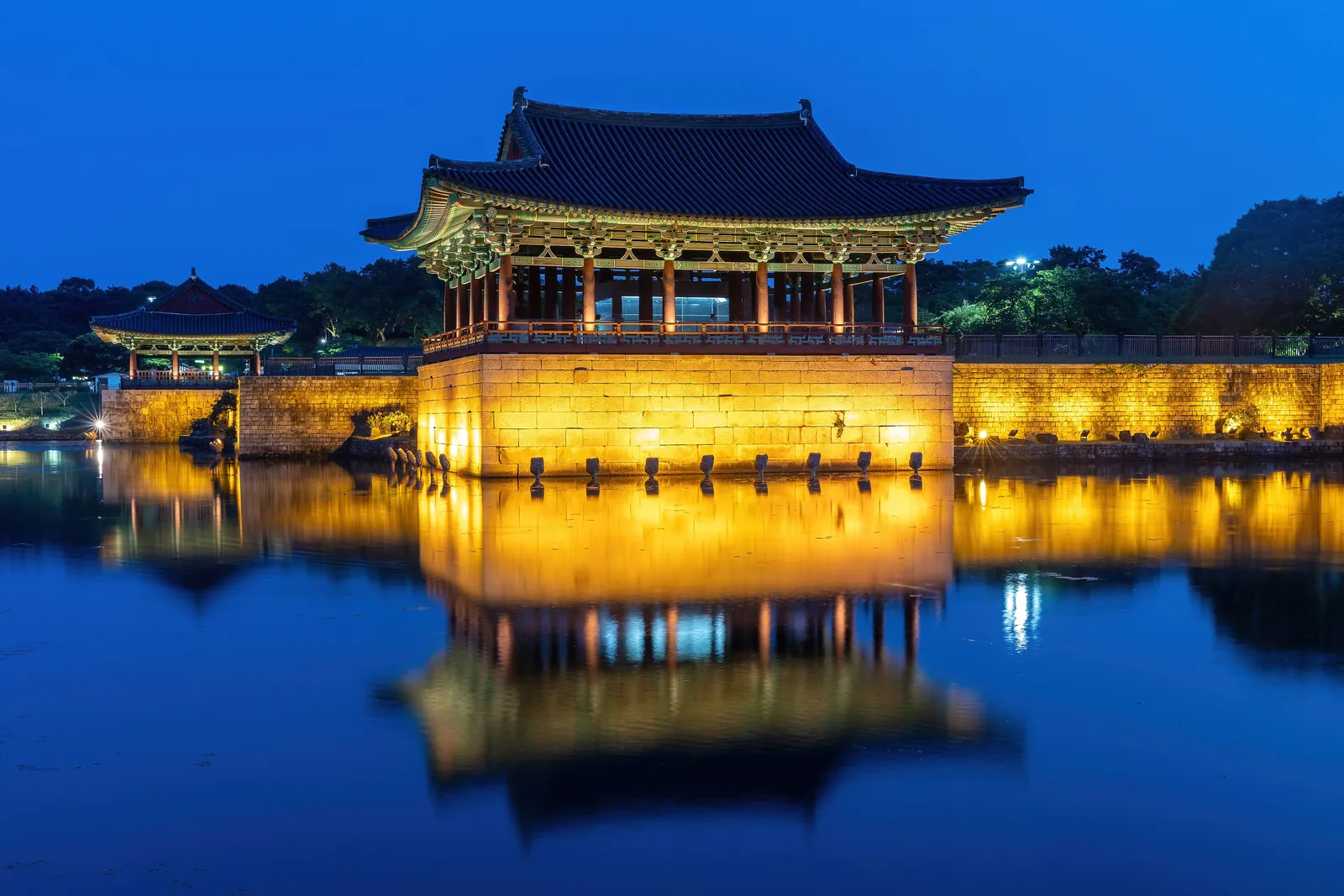
Gyeongju rewards the traveller who sleeps there. Its finest hour comes after dark: Donggung Palace & Wolji Pond is open until 22:00, with last admission at 21:30, and the reflection of its rebuilt halls in the pond is what Korea Tourism Organization calls the city's representative night sight. Cheomseongdae stays open until 22:00 in summer and 21:00 in winter, Woljeonggyo Bridge and Daereungwon until 22:00. A day trip ends just as the old town lights up.
The mornings matter just as much. Bulguksa and Seokguram both open at 09:00, and Seokguram sits 9 km by road above the temple. Gyeongju is also spread out in a way a map hides: Bomun Lake is about 10 km east of downtown, and Yangdong Village, the third UNESCO listing, is a trip of its own. Squeezing the temples, the tombs and the night view into one day means spending most of it on buses.
Our rule: two nights is the minimum that does Gyeongju justice. Give one evening to Wolji Pond and one morning to Seokguram, and choose your base by which of the two you want on foot.
Old town, Bomun Lake or Bulguksa: the three bases
The old town around Hwangnidan-gil and Daereungwon is the first-visit base. Daereungwon is a park of 23 ancient tombs with trails between them, and Cheonmachong, the one tomb you can enter, held the largest and most elaborate gold crown found in Korea. Cheomseongdae, Gyerim Forest, the Wolseong palace site and Donggung Palace & Wolji Pond follow on as a single walking course, with Gyochon Village and Woljeonggyo Bridge close by. VisitKorea's picks for an afternoon are Hwangnidan Street in hanbok, hanok cafés and Gyeongju's famous Hwangnam bread. The express and intercity bus terminals are downtown, which makes this the natural base for anyone arriving by coach.
Bomun Lake Resort is the base for families, spring blossom and easy train arrivals. VisitKorea calls Bomun Tourist Complex the international tourist district of Gyeongju: a luxury hotel of international scale, family condos, a golf range and walking paths around Bomunho, a man-made lake popular with cyclists and walkers. Gyeongju World is on Bomun-ro, the lakeside path is part of the city's barrier-free course, and routes 700 and 710 come straight from the KTX station.
Bulguksa is the base for temples and early starts. Bulguksa and Seokguram, inscribed together by UNESCO in 1995, are linked by a 3 km trail and by bus 12, and the Bulguksa stop is the turning point of buses 10 and 11 from Bomun and the old town. Routes 700 and 711 run direct from the KTX station.
Our rule: for a first trip, stay in the old town and treat Bomun and Bulguksa as a bus ride out. Arriving by KTX with children, or in April, choose Bomun. For a temple-first trip, sleep at Bulguksa. With three nights, split them: one or two in the old town for the night views, one at Bulguksa or Bomun.
Getting to Gyeongju
Start with the name of the station, because it changed. The KTX station opened in November 2010 as Singyeongju and was renamed on 28 December 2023, so today it is Gyeongju Station (KTX, formerly Singyeongju), and KTX and SRT tickets are sold to Gyeongju. The original downtown Gyeongju Station closed in December 2021. Any post-2023 reference to Gyeongju Station means the KTX station; older maps that still show a downtown station are out of date.
From Seoul, the KTX from Seoul Station reaches Gyeongju Station in around two hours. Express buses from Seoul Express Bus Terminal run to Gyeongju Express Bus Terminal downtown. Take the train for speed and the bus when you want to arrive in the old town without a change. From Incheon Airport, ride the AREX to Seoul Station, about an hour, and pick up the KTX there; an airport limousine runs direct in about five hours.
From Busan, the express bus is the most direct route into the old town: from Busan Central Bus Terminal, at Nopo Station on Busan Metro Line 1, to Gyeongju Express Bus Terminal in about 50 minutes. By rail, KTX-Eum services on the Donghae Line between Gangneung and Busan began on 30 December 2025, stopping at Gyeongju and at Bujeon in Busan.
From Gimhae Airport, VisitKorea's route is the intercity bus to Gyeongju Intercity Bus Terminal, about one hour. From Daegu International Airport, take the bus to Dongdaegu Station, about 15 minutes, then the KTX to Gyeongju Station, about 20 minutes. Express buses from Daegu's Dongyang terminal reach Gyeongju Express Bus Terminal in about 50 minutes.
The simplest arrival for each base:
- Old town: express bus from Seoul or Busan, or the intercity bus from Gimhae Airport, to the downtown terminals; by KTX, city bus 50, 51, 60, 61 or 70 from Gyeongju Station.
- Bomun Lake: KTX to Gyeongju Station, then route 700 or 710; by coach, bus 10 or 11 from the downtown terminals.
- Bulguksa: KTX to Gyeongju Station, then route 700 or 711; by coach, bus 10 or 11 to the end of the route.
Getting around: city buses and the City Tour
Buses 10 and 11 are the backbone of a Gyeongju trip. They run the same loop in opposite directions, from the intercity and express bus terminals past Jungang Market, the Wolseong-dong Community Centre stop for Cheomseongdae and Daereungwon, Bunhwangsa, Bomun Tourist Complex, Gyeongju World, the World Culture Expo Park and the Folk Craft Village to Bulguksa, where they turn. The first bus leaves the terminals at 06:00 and the last at 21:40, about every 20 minutes. Bus 10-1 follows the same road but turns at Gyeongju World. You get one transfer a day between different routes within 30 minutes of getting off.
From Gyeongju Station (KTX), routes 700 and 710 run to Bomun and routes 700 and 711 to Bulguksa; since February 2023 that corridor has had a bus about every 30 minutes. City circulation routes 50, 51, 60, 61 and 70 link the station with the city, and route 203 serves Yangdong Village and Oksan Seowon. From Bulguksa, bus 12 climbs to the Seokguram car park, about three minutes' walk from the grotto ticket office; the Bulguksa stop itself is about seven minutes on foot from the temple ticket office. For live arrivals on every route, the city points visitors to the nationwide Smart Bus app.
The Gyeongju City Tour adds commentary in English, Chinese and Japanese, booked at cmtour.co.kr. Its courses cover the East Coast, World Heritage (the Tomb of King Muyeol, Daereungwon and Cheonmachong, Bunhwangsa, Seokguram and Bulguksa), Silla history, and Yangdong Village with Namsan. The one to book is the Night City Tour: Donggung Palace & Wolji Pond, Cheomseongdae, Gyerim, Gyochon Village and Woljeonggyo Bridge after dark.
For help in English at any hour, call 1330, the Korea Travel Hotline: free, 24 hours a day, in Korean, English, Japanese and Chinese.
Gyeongju's three World Heritage listings
Gyeongju has a share in three UNESCO World Heritage listings, and they are the reason to stay more than a night. Seokguram Grotto and Bulguksa Temple came first, in December 1995. UNESCO describes the grotto, established in the 8th century on the slopes of Mount Toham, with its Buddha looking towards the sea, and the two sites as a religious architectural complex of exceptional significance. Bulguksa holds seven national treasures; it was damaged in the Imjin War of 1592–1598 and restored from 1920. Stay at Bulguksa to have both in the morning.
The Gyeongju Historic Areas followed in 2000, in five belts. The Tumuli Park Belt holds three groups of royal tombs, Daereungwon among them. The Wolseong Belt takes in the Wolseong palace site, Gyerim Forest, Anapji Pond, today's Wolji Pond, and Cheomseongdae Observatory. The Mount Namsan Belt counts the ruins of 122 temples, 53 stone statues, 64 pagodas and 16 stone lanterns; the Hwangnyongsa Belt has Bunhwangsa and the ruins of Hwangnyongsa, the largest temple ever built in Korea; and the Sanseong Fortress Belt includes Myeonghwal Mountain Fortress. Wolji Pond itself was dug in 674 under King Munmu beside Silla's secondary palace, and was known as Anapji until pottery inscribed 'Wolji', the pond that reflects the moon, turned up in the 1980s. The old town is the base for the first two belts on foot.
The third listing, in 2010, is shared with Andong: the Historic Villages of Korea, Hahoe and Yangdong. Yangdong is the Gyeongju half, which VisitKorea calls Korea's largest traditional village, with about 160 old houses. It is open 09:00–19:00 from April to September and 09:00–18:00 from October to March, with last tickets an hour before closing, and route 203 serves it from Gyeongju Station.
When to go: cherry blossoms, holidays and summer
Spring is Gyeongju's season. Cherry blossoms bloom from late March to mid-April, and Korea Tourism Organization ranks Bomun Lake among the best blossom spots in the country, with a lakeside walk that takes in Hoban Plaza and Bomunjeong pavilion. VisitKorea says Bomun draws crowds in April, when the blossoms are in full bloom, and the Gyeongju Cherry Blossom Marathon runs there in April too. In the old town, the trees line the wall by King Michu's tomb in Daereungwon. Book April stays first, lakeside rooms above all, and use the city's live cameras of Bomun Lake to follow the bloom.
The two great holidays bring a gift for anyone in hanbok: at Seollal and Chuseok, visitors wearing hanbok enter Donggung Palace & Wolji Pond, Daereungwon and Poseokjeong free, among other sites. Hanbok rental shops are common downtown, so an old-town stay makes the most of it.
Summer and winter belong to Bomun for families: Gyeongju World runs its California Beach water park in summer and a snow park in winter. The night sights work all year, with Cheomseongdae closing an hour earlier in winter, at 21:00.
Food, markets and evenings
VisitKorea's food advice for Gyeongju is simple: eat at the markets. Seongdong Market has about 300 stores and has traded since 1971, selling produce, fish, groceries, clothing and general goods; it was renovated with a design that highlights the city's history, and it opens 07:00–20:00, which makes it the early-breakfast answer. Jungang Market is the other pick, with its own stop on buses 10 and 11.
In the old town, the afternoon belongs to Hwangnidan Street, explored in hanbok, with hanok cafés and a box of Hwangnam bread. Gyochon Village, open 24 hours, is the home of Gyodong Beopju liquor and of the House of the Gyeongju Choi Clan. After dark the order is simple: Cheomseongdae, then Donggung Palace & Wolji Pond before the 21:30 last admission, then Woljeonggyo, open until 22:00. VisitKorea describes the lit pond as a mesmerising nightscape, and Korea Tourism Organization's advice is to see it from the north bank, facing the rebuilt halls.
Gyeongju after APEC, and on to Andong
Gyeongju hosted the APEC 2025 Economic Leaders' Meeting. Leaders met at the Hwabaek International Convention Center from 31 October, and the meeting closed on 1 November 2025 with the Gyeongju Declaration.
Andong is the natural next stop. Its Hahoe Village is the other half of the UNESCO listing Gyeongju shares through Yangdong, so a trip that starts with Silla's capital continues neatly into Korea's historic villages.
Every Gyeongju area guide
- Hwangnidan-gil & DaereungwonRoyal tombs, Cheomseongdae and Wolji Pond at night, all on foot from your door.
- Bomun Lake ResortGyeongju's lakeside resort district, with Gyeongju World and direct buses from the KTX.
- BulguksaSleep at the temple end of Gyeongju and be at Seokguram for the 09:00 opening.
Questions visitors ask
Which area is best for a first visit to Gyeongju?
The old town around Daereungwon and Hwangnidan-gil. Daereungwon, Cheomseongdae, Gyerim Forest and Donggung Palace & Wolji Pond link up as one walking course, the night views are on foot, and the downtown terminals put buses 10 and 11 to Bomun and Bulguksa on your doorstep.
Is Gyeongju Station the same as Singyeongju Station?
Yes. Singyeongju, the KTX station, was renamed Gyeongju Station on 28 December 2023, and KTX and SRT tickets are sold to Gyeongju. The old downtown Gyeongju Station closed in December 2021. City buses 50, 51, 60, 61 and 70 serve the station, with routes 700, 710 and 711 to Bomun and Bulguksa.
How many nights should I spend in Gyeongju?
Two at least. The night views at Wolji Pond, Woljeonggyo and Daereungwon run until 22:00, Seokguram and Bulguksa open at 09:00, and Bomun Lake is about 10 km east of downtown. Two nights give you one evening and one early morning without rushing either.
Where should I stay for the cherry blossoms?
Bomun Lake. The blossoms run from late March to mid-April, Korea Tourism Organization counts it among the best blossom spots in the country, and VisitKorea says it draws crowds in April at full bloom, so book early. In the old town, Daereungwon's cherry trees by King Michu's tomb make a fine second choice.
Can I get around Gyeongju without a car?
Yes. Buses 10 and 11 link the downtown terminals, the Wolseong sights, Bomun Lake and Bulguksa about every 20 minutes from 06:00, routes 700, 710 and 711 run from the KTX station, and bus 12 goes up to Seokguram. The Night City Tour covers the after-dark sights with English commentary.
Sources & review
Editorial review: · Korea Standard Time
- VISITKOREA — Gyeongju, the museum without walls
- Gyeongju City — Singyeongju Station renamed Gyeongju Station (press release, 28 December 2023)
- VISITKOREA — Donghae Line KTX-Eum, Gangneung to Busan
- Busan Metropolitan City — Public transportation
- Gyeongju City — Transportation (English site)
- Korea Tourism Organization — Gyeongju travel course (Korean)
- Gyeongju City — KTX station connecting transport (notice)
- Gyeongju City — New bus routes 710 and 711 (February 2023)
- Gyeongju City — Travel Gyeongju by bus
- Korea Tourism Organization — Bulguksa and Seokguram by bus (Korean)
- Gyeongju City — Gyeongju City Tour
- VISITKOREA — Unique Transportation
- UNESCO World Heritage Centre — Gyeongju Historic Areas
- UNESCO World Heritage Centre — Decision 24 COM X.C.1: Kyongju Historic Areas
- UNESCO World Heritage Centre — Republic of Korea: documents
- UNESCO World Heritage Centre — Seokguram Grotto and Bulguksa Temple
- UNESCO World Heritage Centre — Decision 34 COM 8B.21: Historic Villages of Korea
- UNESCO World Heritage Centre — Historic Villages of Korea: Hahoe and Yangdong
- VISITKOREA — Bulguksa Temple
- VISITKOREA — Seokguram Grotto
- VISITKOREA — Gyeongju Yangdong Village
- Visit Korean Heritage Campaign — Gyeongju heritage road
- VISITKOREA — Daereungwon Ancient Tombs (Cheonmachong)
- VISITKOREA — Cheomseongdae Observatory
- VISITKOREA — Gyeongju Donggung Palace and Wolji Pond
- VISITKOREA — Donggung Palace and Wolji Pond
- VISITKOREA — Woljeonggyo Bridge
- VISITKOREA — Gyerim Forest
- VISITKOREA — Gyochon Traditional Village
- VISITKOREA — Bomun Tourist Complex
- VISITKOREA — Bomunho Lake
- Gyeongju City — Barrier-free travel courses
- Gyeongju City — Live Gyeongju cameras
- VISITKOREA — Gyeongju World
- Korea Tourism Organization — Gyeongju cherry blossoms (Korean)
- VISITKOREA — Gyeongju Seongdong Market
- Ministry of Culture, Sports and Tourism — APEC 2025 in Gyeongju (webzine, November 2025)