
Busan · Where to stay
Where to stay in Busan
부산 숙소 지역
Busan gives you three kinds of base: the beaches of Haeundae and Gwangalli, the old downtown around Nampo, and the transport hubs of Seomyeon and Busan Station. Choose by how you arrive and how you want your evenings to look. Here is the quick answer for each trip, then everything behind it.
Quick pick
| Your trip | Stay in | Why |
|---|---|---|
| First visit | Haeundae | Korea's best-known beach, Dongbaekseom on foot, Line 2 at the door and a direct airport limousine. |
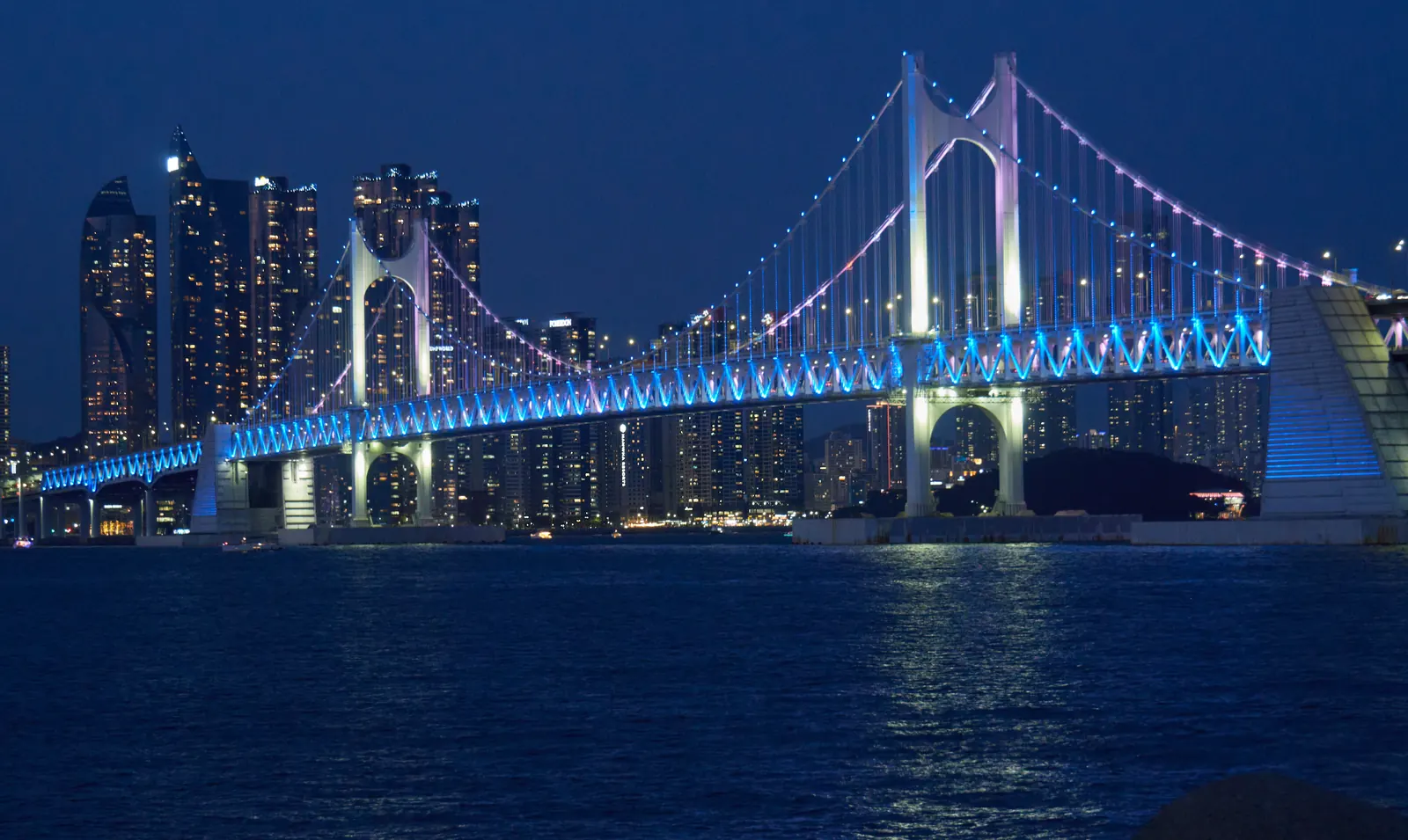
| Night views and bars | Gwangalli | The lit Gwangandaegyo Bridge over the bay, a strip of restaurants, cafés and bars, and a Saturday drone show. |
| Fireworks Festival | Gwangalli | The festival is staged along Gwangalli Beach, and roads close on the day, so a room within walking distance wins. |
| Film festival (BIFF) | Haeundae | Busan Cinema Center, the festival's main venue, is at Centum City Station, on the same Line 2 as Haeundae Station. |
| Short stay and easy connections | Seomyeon | Lines 1 and 2 meet here, the airport rail reaches it in about 30 minutes, and Limousine 2 stops at the station. |
| Markets and street food | Nampo & Jung-gu | Jagalchi, Gukje Market, BIFF Square and the Bupyeong night market are all on foot in the old downtown. |
| KTX arrival and ferries to Japan | Busan Station | Step off the train onto Line 1, with the international ferry terminal and Choryang Ibagu-gil close by. |
Beach side, old town or transport hub
Busan's neighbourhoods sort themselves into three types, and the right one depends on what you came for. The beach side is Haeundae and Gwangalli. Haeundae Beach is the most popular and best-known beach in Korea, set among towers, hotels and restaurants; Gwangalli is 1.4 kilometres of fine sand facing the Gwangandaegyo Bridge, and magnificent night views of the bridge. VisitKorea calls them the two must-visit places in Busan, and both are home to many guesthouses.
The old town is Nampo and Jung-gu, Busan's old downtown. This is the Busan of markets and history: Jagalchi, one of the largest seafood markets in Korea; Gukje Market; BIFF Square, where the film festival was born; the Bupyeong night market; and Yongdusan Park with Busan Tower above it all.
The transport hubs are Seomyeon and Busan Station. Seomyeon is where Metro Lines 1 and 2 meet, and Busan Station is where the KTX and SRT arrive from Seoul. They trade sea views for connections, and both make every other part of the city easy.
Our rule: for a first trip of three nights or more, stay on the beach side and treat the old town as a day out on the metro. For one or two nights between trains, stay at a hub. For markets, food and history, stay in Nampo, where the best of old Busan is on foot.
The metro map explains the whole city. Line 2 runs from Seomyeon through Gwangan, Centum City and Haeundae to Jangsan; Line 1 runs through the old town and Busan Station, via Jagalchi, Nampo and Choryang; and Seomyeon joins them. Busan Metro has four lines in all, announcements come in Korean, English, Japanese and Chinese, and transfer stations are signalled with birdsong.
Arriving from Gimhae Airport or by KTX
From Gimhae Airport, the train is the way in. VisitKorea calls the Busan-Gimhae Light Rail the fastest and most affordable route from the airport: ride it from Airport Station to Sasang, about 6 minutes, and change to Metro Line 2. The light rail also connects to Line 3 at Daejeo. By rail, VisitKorea puts Seomyeon about 30 minutes from the airport, Gwangalli about 50 and Haeundae about 70. For Nampo and Busan Station, change again at Seomyeon to Line 1; this is the city's own recommended route to City Hall.
Two airport limousines run from Platform 3, between Gates 2 and 3 on the first floor of the international terminal. Buy tickets in the Bustago app or at the kiosks near Gate 4 on the first floor; cash is not accepted, and each passenger carries up to two bags under 30 kg in total. Limousine 1 serves the beach side, with stops at Haeundae Beach, Dongbaekseom Island Entrance, BEXCO, Shinsegae Centum City and Jangsan Station; its Jangsan route takes about 90 minutes end to end. Limousine 2 serves Seomyeon and Bujeon, stopping at Seomyeon Station, every 60 to 80 minutes, with a full route of about 50 minutes.
By train from Seoul, the KTX and SRT both arrive at Busan Station, on Line 1. The SRT from Suseo takes about 2 hours 30 minutes. KTX-Eum is the exception: it runs to Bujeon Station, not Busan Station, and its Jungang Line also serves Shinhaeundae, Centum and Gijang. From Busan Station, Line 1 runs straight to Nampo and Seomyeon; for the beaches, change at Seomyeon to Line 2.
Arriving by intercity bus, the Seobu terminal is at Sasang (Line 2) and the Central Express and Dongbu terminals are at Nopo (Line 1). The simplest arrival for each base:
- Haeundae: Limousine 1 to Haeundae Beach, or light rail to Sasang and Line 2.
- Gwangalli: light rail to Sasang, then Line 2 to Gwangan Station.
- Seomyeon: light rail to Sasang and Line 2, about 30 minutes, or Limousine 2.
- Nampo: light rail to Sasang, Line 2 to Seomyeon, then Line 1; from Busan Station, Line 1 direct.
- Busan Station: KTX or SRT to the door; from the airport, light rail, Line 2 and Line 1 via Seomyeon.
The five areas in brief
Haeundae is the first-visit base and the city's glamour coast. Haeundae Station is on Line 2, and Exits 3 and 5 are about a 5-minute walk from the sand. Dongbaekseom Island sits at one end of the beach, with a walking path all the way round, camellias from winter to spring and Nurimaru APEC House. SEA LIFE Busan Aquarium faces the beach, Haeundae Market has its eel alley, and Haeridan Street, popular with younger crowds, is lined with shops and cafés. Blueline Park runs a beach train and sky capsules on the former Donghae Nambu Line railway between Mipo, Cheongsapo and Songjeong. The beach itself has a tourist information centre, showers and changing rooms.
Gwangalli is the base for evenings. Gwangan Station is on Line 2, and Exits 3 and 5 lead to the beach. VisitKorea describes it as the place where countless young people gather and the night sea meets dazzling lights, and the city calls it a hub for marine sports and nightlife, with restaurants, cafés and bars along the main strip. Gwangalli Beach Theme Street runs 1,250 metres along the shore in three sections: Romantic Street, Sunrise Square and Youth Street. The Gwangalli M Drone Light Show flies every Saturday, and Millak Waterfront Park, between Gwangalli and Haeundae, is open 24 hours.
Seomyeon is the base for a short stay and easy connections. Seomyeon Station is the transfer point for Lines 1 and 2, so the beaches, the old town and Busan Station are all one ride away. The underground shopping centre runs from 10:00 to 22:00 and closes on the first Tuesday of the month. Jeonpo Café Street, a former hardware district of cafés in renovated houses, factories and warehouses, made the New York Times list of 52 places to go in 2017.
Nampo is the base for markets, street food and old Busan. Nampo Station is on Line 1, as are Jagalchi and Jungang stations. Jagalchi Market opens from 05:00 to 22:00 and closes on the first and third Tuesdays; Gukje Market closes on the first and third Sundays. Bupyeong Kkangtong Market hosted Korea's first night market and runs its night market from 19:30 to 23:30. Busan Tower, 120 metres tall in Yongdusan Park, opens from 10:00 to 22:00, and Gamcheon Culture Village is reached from Toseong Station on the same Line 1.
Busan Station is the base for train arrivals and ferries to Japan. Busan Station and Choryang Station are both on Line 1. Busan Chinatown, open 24 hours, is in Choryang-dong; Choryang Ibagu-gil, near the station, climbs a hillside first settled in hard times; and Sanbok Road, along the hilltop, gives an open view over downtown that is at its best at night. Ferries to Hitakatsu, Fukuoka, Osaka and Shimonoseki leave from the Busan Port International Passenger Terminal, close to the KTX station.
Festival season
Busan's two big festivals both fall in autumn, and both reshape where you want to sleep. The Busan Fireworks Festival is held every autumn along Gwangalli Beach, and in recent years it has settled into early November. The 2026 edition, the 21st, is on Saturday 7 November at Gwangalli Beach, Igidae and Dongbaekseom. Hwangnyeongsan Mountain, Dongbaekseom Island and Igidae Coastal Park are the other great viewing spots.
On fireworks day, the roads around the beach close. In 2025, sections of Gwanganhaebyeon-ro closed from 10:00, Gwangnam-ro closed to all traffic including local buses from 18:00, and Gwangandaegyo Bridge closed in the Haeundae to Nam-gu direction. Book in Gwangalli within walking distance of the sand, or in Haeundae near Dongbaekseom, and you will not need a vehicle at all.
The Busan International Film Festival, the first international film festival in Korea and now one of the biggest in Asia, runs in September or October: 17 to 26 September in 2025, 6 to 15 October in 2026. Its main venue is Busan Cinema Center in Centum City, Exit 12 or 6 from Centum City Station on Line 2, which makes Haeundae the natural festival base. Nampo shares the festival too: BIFF Square hosts the Ground Opening on the festival's eve, and in 2025 it hosted Community BIFF.
Summer belongs to the beaches. In 2026, Haeundae Beach opened for swimming from 26 June to 15 September, 09:00 to 18:00, and Gwangalli from 1 July to 31 August. Winter has its own rituals: the Polar Bear Festival took over Gwangalli Beach in February 2025, and the New Year's bell rings at Yongdusan Park on 31 December.
Settling in: cards, phones and help in English
Your T-money card from Seoul works here too: T-money works on virtually all public transport in Korea, taxis included, and is sold and topped up at convenience stores nationwide. Gimhae Airport has roaming centres that sell prepaid SIM cards and hand over cards ordered online, and free Wi-Fi covers airports, subway stations and train stations.
Save your stay's road-name address in Korean before you arrive. Busan City Hall's own address, 1001 Jungang-daero, Yeonje-gu, shows the format: a road name and a building number, odd on one side of the street and even on the other. With it, a taxi app such as k.ride, built for foreign visitors and able to translate your destination, gets you to the door.
Keep 1330 in your phone. The Korea Travel Hotline answers in Korean, English, Japanese and Chinese 24 hours a day and is free through the Visit Korea app on Wi-Fi. Dial 1330 in Korea, or +82-2-1330 from a foreign phone. For trains, KORAIL runs a line for foreign visitors on 1599-7777.
Every Busan area guide
- HaeundaeKorea's best-known beach, a skyline of towers and the film festival next door.
- GwangalliBusan's night-view beach, with Gwangan Bridge lit up across the bay.
- SeomyeonBusan's transport hub, where Lines 1 and 2 meet beneath the shopping streets.
- Nampo & Jung-guBusan's old downtown: fish market, film street, hilltop tower and night market.
- Busan StationStep off the KTX into Chinatown, Ibagu-gil and the ferry port for Japan.
Questions visitors ask
Which area is best for a first visit to Busan?
Haeundae. It has Korea's best-known beach, Dongbaekseom Island and the aquarium on foot, Haeundae Station on Line 2, and Airport Limousine 1 stopping at Haeundae Beach. If you are in Busan for a night or two between trains, Seomyeon is the smarter pick, because Lines 1 and 2 meet there.
Haeundae or Gwangalli for nightlife?
Gwangalli. Its main strip of restaurants, cafés and bars faces the lit Gwangandaegyo Bridge, and the drone light show flies over the bay every Saturday at 20:00 and 22:00, or 19:00 and 21:00 from October to February. Haeundae is the better all-round base; Gwangalli is the better evening.
Is there a direct bus from Gimhae Airport to Haeundae?
Yes. Busan Airport Limousine 1 stops at Haeundae Beach, Dongbaekseom Island Entrance, BEXCO, Shinsegae Centum City and Jangsan Station. It boards at Platform 3 on the first floor of the international terminal. Buy your ticket in the Bustago app or at the kiosks near Gate 4; cash is not accepted.
Where should I stay if I arrive by KTX?
Busan Station for the shortest walk from the train, with Line 1 and Choryang Ibagu-gil on the doorstep. For a better base with the same easy start, stay in Seomyeon or Nampo: both are on Line 1 from Busan Station with no change. Note that KTX-Eum trains stop at Bujeon, not Busan Station.
Where should I stay for the Busan Fireworks Festival?
Gwangalli, within walking distance of the beach. The festival is staged along Gwangalli Beach, Igidae and Dongbaekseom, and on the day the roads close: in 2025, Gwangnam-ro was shut to all traffic, buses included, from 18:00. A room you can walk back to beats any taxi plan. The 2026 festival is on Saturday 7 November.
Sources & review
Editorial review: · Korea Standard Time
- Busan Metropolitan City — Public transportation
- VISITKOREA — Getting from the airport
- VISITKOREA — Busan from Gimhae Airport
- VISITKOREA — Busan travel guide
- VISITKOREA — Busan by train
- Busan Metropolitan City — Directions to City Hall
- Busan Transportation Corporation — Connection passages
- Busan Metropolitan City — Airport limousine routes from 5 January 2026
- Busan Metropolitan City — KTX-Eum Jungang Line
- Busan Metropolitan City — Busan Citizens Park directions
- Busan Metropolitan City — Haeundae Beach
- Busan Metropolitan City — Busan Cinema Center
- VISITKOREA — Haeundae Dongbaekseom Island
- VISITKOREA — The glamorous side of Busan
- VISITKOREA — Haeundae Blueline Park
- VISITKOREA — Haeridan Street
- Busan Metropolitan City — 100 must-visit places
- VISITKOREA — Guesthouses in Korea
- Busan Metropolitan City — Gwangalli Beach
- VISITKOREA — Gwangalli Beach
- VISITKOREA — Millak Waterfront Park
- VISITKOREA — Gwangalli M Drone Light Show
- Busan Metropolitan City — Daily Busan: Haeundae and Gwangalli summer
- VISITKOREA — Seomyeon Underground Shopping Center
- VISITKOREA — Jeonpo Café Street
- Busan Metropolitan City — Enjoy Busan: Jeonpo Café Street
- VISITKOREA — Jagalchi Market
- VISITKOREA — BIFF Square
- VISITKOREA — Busan Gukje Market
- VISITKOREA — Bupyeong Kkangtong Market
- VISITKOREA — Old downtown Busan course
- Busan Metropolitan City — Yongdusan Park
- VISITKOREA — Busan Tower
- VISITKOREA — Gamcheon Culture Village
- Busan Metropolitan City — Getting to Gamcheon Culture Village
- VISITKOREA — Busan Chinatown
- VISITKOREA — Choryang Ibagu-gil
- VISITKOREA — Busan Port International Passenger Terminal
- VISITKOREA — Accommodation near Busan Station
- VISITKOREA — Busan Fireworks Festival
- Busan Fireworks Festival — Overview
- VISITKOREA — Gwangalli Beach Theme Street
- Busan Metropolitan City — Fireworks Festival traffic controls 2025
- VISITKOREA — Busan International Film Festival
- Busan Metropolitan City — 30th BIFF press release
- Busan International Film Festival — 2026 dates
- Busan Metropolitan City — Haeundae Beach opening 2026
- Busan Metropolitan City — Gwangalli Beach opening 2026
- Busan Metropolitan City — Festival calendar news
- Busan Metropolitan City — New Year bell at Yongdusan Park
- VISITKOREA — Transportation Cards
- VISITKOREA — Electricity & Communications
- Busan Metropolitan City — 1330 Korea Travel Hotline
- Busan Metropolitan City — Road-name addresses
- VISITKOREA — Ride-hailing Apps in Korea