
Andong · Where to stay
Where to stay in Andong
안동 숙소 지역
Andong rewards a night far more than a day. You have three bases: Hahoe Village, where you sleep inside a UNESCO-listed clan village; the old downtown, with the Old Market's jjimdak alley and the Maskdance Festival; and Woryeonggyo, where relocated hanok sit beside a lit wooden bridge. Here is the quick answer for each trip, then everything behind it.
Quick pick
| Your trip | Stay in | Why |
|---|---|---|
| First visit | Hahoe Village | A night inside the UNESCO-listed clan village, with the lanes to yourself after it closes to visitors. |
| A night in an old house | Hahoe Village | Some of Hahoe's old houses run minbak, so you sleep in the village itself rather than near it. |
| Mask dance and museums | Hahoe Village | The 14:00 Hahoe Byeolsingut Tallori and the Hahoe Mask Museum are both at the village entrance. |
| Maskdance Festival | Andong Old Town | The venues are the old downtown, Mask Dance Park and Jungang Line 1942 Andong Station, not Hahoe. |
| Food and evenings out | Andong Old Town | Around 30 jjimdak restaurants in the Old Market alley, with the makchang alley about 50 m away. |
| Early train | Andong Old Town | Book on the Songhyeon-dong station side, where the KTX-Eum station and the bus terminal stand together. |
| City-bus day trips | Andong Old Town | The first buses to Dosan Seowon, Bongjeongsa and Manhyujeong leave the station area from 06:10. |
| Hanok with a modern bathroom | Woryeonggyo & Andong Folk Village | Historic houses relocated from the dam site, fitted with hotel-style bathrooms, beside the Folk Village. |
| Night walks | Woryeonggyo & Andong Folk Village | Korea's longest wooden pedestrian bridge is lit at night, right outside your door. |
Why stay the night in Andong
Andong is easy to see in a day, and a night is what turns it from a checklist into a memory. Hahoe Village closes to visitors at 18:00 from April to September and at 17:00 from October to March. Some of its old houses run minbak, and VisitKorea lists hanok stays among the village's facilities, so a guest who sleeps inside has the lanes, the thatched roofs and the river bend once the day visitors have gone. That evening, and the quiet morning after it, is the best thing Andong has to offer.
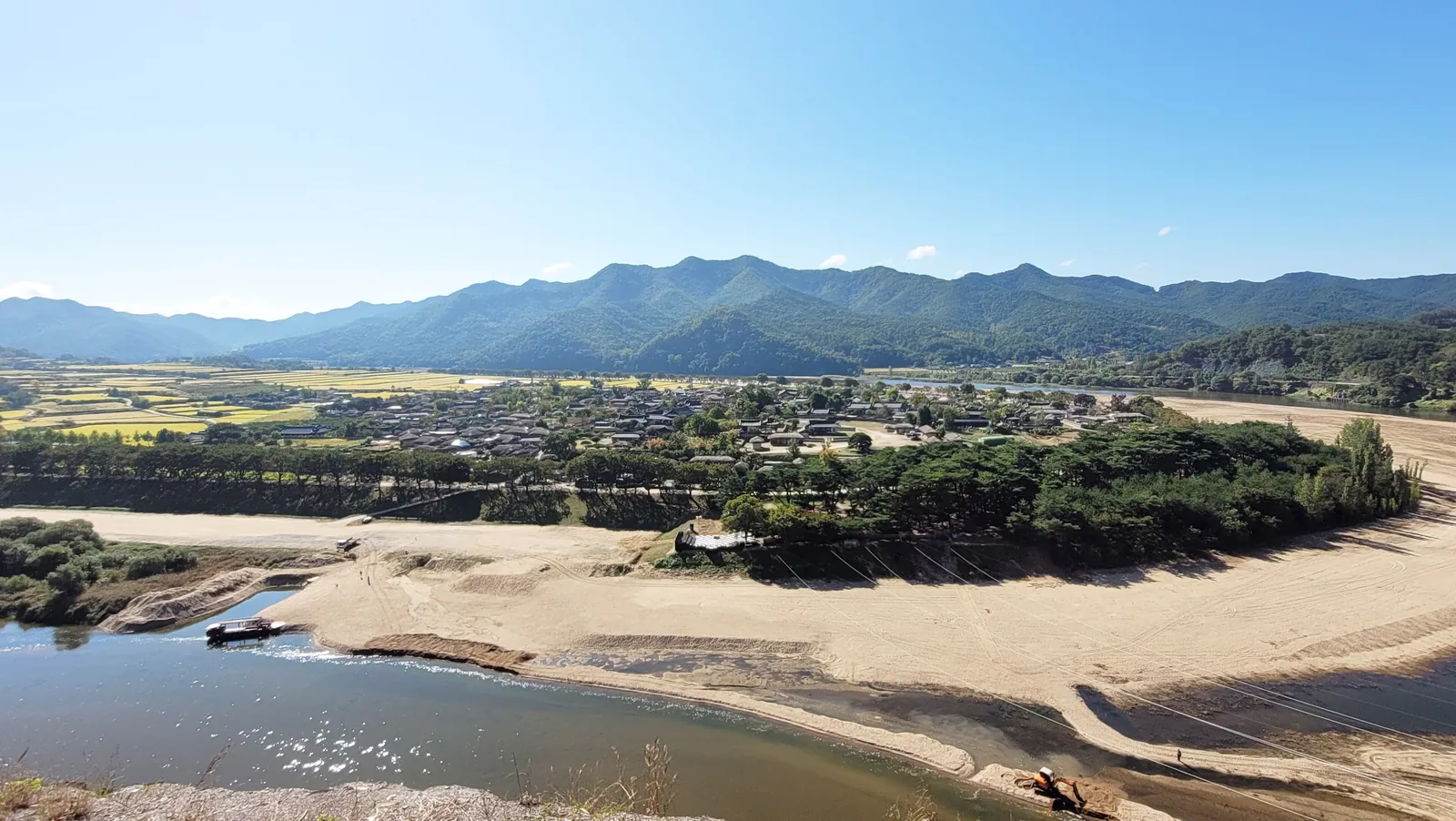
Hahoe is not a museum piece. It is the clan village of the Pungsan Ryu, founded in the 14th to 15th centuries, and UNESCO describes Hahoe and Yangdong as the two most representative historic clan villages in Korea. The Nakdong River flows round it in an S-shape, and it holds about 100 tiled-roof houses and about 130 thatched ones. Folk performances such as the Hahoe mask dance and Seonyu Julbul Nori, the village's traditional fireworks, are still held there.
The second reason to stay is the festival. Each year in late September and early October, the Andong Maskdance Festival, which Andong City calls Korea's largest culture tourism festival, fills the old downtown, Mask Dance Park and Jungang Line 1942 Andong Station. It ran from 26 September to 5 October in 2025 and from 24 September to 4 October in 2026, and its evenings belong to people with a room they can walk back to.
The third is the bridge. Woryeonggyo, Korea's longest wooden pedestrian bridge, is lit at night, and the lights reflect on the Nakdong. Sleep beside it and the evening walk needs no bus home.
The three bases compared
Andong's stay areas are spread out, so choosing one is choosing what you will have on foot. Our rule: for one night, stay in Hahoe. For two nights, add a night in town or at Woryeonggyo. For the Maskdance Festival, stay downtown.
Hahoe Village is the stay for history and atmosphere. You sleep in a minbak inside the village, watch the Hahoe Byeolsingut Tallori at 14:00 at the theatre by the entrance, and head up Buyongdae, a cliff about 64 metres high, for the panoramic view of the village in its river bend. The trade-offs are distance, about 30 minutes by car from Andong Station and downtown Andong, and traditional rooms: many hanok put guests on mats and blankets on the floor rather than in beds.
Andong Old Town is the stay for food, the festival and convenience. The Old Market, Gu-sijang, is the oldest market in the region, and its jjimdak alley has around 30 restaurants. The KTX-Eum station is not downtown: since 17 December 2020 it has stood in Songhyeon-dong, next to the intercity bus terminal, about 20 minutes from the market by bus. That gives this base two halves. Stay downtown for evenings; stay on the station side for early trains and city-bus day trips.
Woryeonggyo and the Andong Folk Village are the stay for comfort with character. Hanok lodging here includes historic houses moved from the dam site and fitted with hotel-style bathrooms, next to the Folk Village, the Andong Folk Museum and the 387-metre wooden bridge. The bridge is named after Woryeongdae, a site submerged by the dam, and its shape recalls the mituri sandals a wife made from her own hair for her late husband. Nakgang Mulgil Park, nicknamed the secret forest, is a five-minute drive away. City bus 112 links it to the station, and Hahoe is 37 minutes away by car.
Two nights is the sweet spot. Arrive on KTX-Eum and ride Express 2, 210 or Pungcheon 2 out to Hahoe for the 14:00 show and a night in the village, take bus 210 to Byeongsan Seowon the next morning, then spend the second night downtown for jjimdak at the Old Market or at Woryeonggyo for the lit bridge. Beyond the three bases, Andong Gunja Village in Waryong-myeon, a cluster of around twenty hanok, also offers hanok stays.
- Hahoe Village: a night inside a UNESCO clan village, the 14:00 mask dance and Buyongdae; about 30 minutes by car from the station.
- Andong Old Town: the jjimdak alley and the Maskdance Festival downtown, plus early trains and first buses from 06:10 on the station side.
- Woryeonggyo & Andong Folk Village: relocated hanok with hotel-style bathrooms and the lit bridge; city bus 112 from the station.
Getting to Andong
Everyone arrives at the same place. Andong Station moved to 122-16 Gyeongdong-ro in Songhyeon-dong on 17 December 2020, rebuilt with the double-tracking of the Jungang Line, and KTX-Eum service began on 5 January 2021. The station sits next to the intercity bus terminal, which makes it the transport hub of northern Gyeongbuk. It is not in the old downtown: the Old Market is about 20 minutes away by bus.
From Seoul, take KTX-Eum. It runs to Andong from Cheongnyangni, Seoul Station and Sangbong. From Cheongnyangni the trip takes about 1 hour 50 minutes. Trains that start at Seoul Station take longer, over two hours on Andong City's published timetable, so Cheongnyangni is the faster place to board. By bus, Dong Seoul to Andong takes 3 hours and the Seoul Gyeongbu terminal 2 hours 40 minutes.
From Busan, KTX-Eum runs direct from Bujeon Station to Andong. Korail's KTX-Eum route runs from Cheongnyangni through Wonju, Jecheon, Andong, Gyeongju and Ulsan to Bujeon, and Andong City's tourism office puts the Busan trip at about two hours. Intercity buses also leave for Andong from Busan's Dongbu terminal.
From Gyeongju, Andong City gives the bus as 1 hour 40 minutes, and Korail's 2024 KTX-Eum route list names both cities on the same line. From Daegu, intercity buses run from Dongdaegu to Andong Bus Terminal, and Daegu Airport is about 15 minutes from Dongdaegu Station by city bus 101 or 401.
- Seoul (Cheongnyangni): KTX-Eum, about 1 hour 50 minutes.
- Seoul Station: KTX-Eum, over two hours.
- Busan (Bujeon): KTX-Eum, about two hours by Andong City's figure.
- Gyeongju: bus, 1 hour 40 minutes.
- Dong Seoul: bus, 3 hours; Seoul Gyeongbu: bus, 2 hours 40 minutes.
Getting around by city bus
Andong's great sights are scattered across the countryside, and the city bus network reaches the major ones. Transfers between city buses are free within an hour if you tag your card when you get off, and the Andong Bus Information System, in Korean, shows routes and live bus positions.
At Hahoe, cars stop at the first car park, and a free shuttle bus runs from in front of the ticket office to the village entrance, about 1.2 km. Vehicles registered to disabled drivers are allowed on to the tourist-information car park at the village entrance after a check at the vehicle control point.
Byeongsan Seowon is 4 km east of Hahoe, and bus 210 serves both, which makes it the natural morning-after trip from a Hahoe minbak. The Hahoe Mask Museum, at the village entrance, opens 09:30–18:00 and closes on 1 January, Seollal and Chuseok.
The first buses leave the station and terminal area early: Express 3 at 06:10, and 112, Express 2, 310 and 610 from about 07:20–07:30. That is the strongest argument for a station-side room on a day-trip day. Bus 610 is the one for Manhyujeong, the pavilion with a single-log bridge that appeared in the drama Mr. Sunshine (2018). The routes to know:
- Hahoe Village: Express 2, 210, Pungcheon 2 and the Hahoe Shuttle.
- Byeongsan Seowon: 210.
- Dosan Seowon: Express 3 and 512.
- Bongjeongsa: Express 2 and 310.
- Manhyujeong: 610.
- Woryeonggyo: 112.
UNESCO in and around Andong
Andong has a share in three UNESCO World Heritage listings, all within reach by city bus, and one entry on the list of Intangible Cultural Heritage.
- 2010: Hahoe Village, inscribed with Yangdong as Historic Villages of Korea: Hahoe and Yangdong. UNESCO notes the setting, sheltered by forested mountains and facing a river and open fields.
- 2018: Bongjeongsa, one of the seven temples of Sansa, Buddhist Mountain Monasteries in Korea. Its Geungnakjeon Hall is considered Korea's oldest surviving wooden building.
- 2019: Dosan Seowon and Byeongsan Seowon, two of the nine academies in Seowon, Korean Neo-Confucian Academies.
- 2022: Hahoe Byeolsingut Tallori, the village's mask dance, inscribed as Intangible Cultural Heritage of Humanity.
The Andong Maskdance Festival
The Andong Maskdance Festival is held every year from late September into early October, and Andong City calls it Korea's largest culture tourism festival. In 2025 it ran from 26 September to 5 October; in 2026 from 24 September, the first day of Chuseok, to 4 October. It includes the World Maskplay Competition.
The festival is staged in town, not at Hahoe. Its 2026 venues were the old downtown, Mask Dance Park and Jungang Line 1942 Andong Station, a festival venue rather than the KTX-Eum station in Songhyeon-dong. For festival nights, book in the old downtown, and book early.
Outside the festival, Hahoe keeps the tradition alive. The Hahoe Byeolsingut Tallori, a masked ritual of about 800 years that began as a dance for the village's guardian deity and satirises the aristocracy, is performed at 14:00 at the theatre at the village entrance, Tuesday to Sunday from March to December and at weekends in January and February. The show lasts about an hour, with subtitles in English, Chinese and Japanese.
What to eat in Andong
Andong jjimdak is the dish to plan an evening around: chicken, glass noodles and vegetables braised in a sweet, savoury and mildly spicy soy-based sauce. Its origins are unclear, but Andong City's most plausible account places its birth in the Old Market's chicken alley in the 1980s, when the merchants there answered the Western fried-chicken shops with a dish of their own. Today the Old Market's Jjimdak Alley has around 30 restaurants that specialise in it, which is reason enough to spend a night in town.
The Old Market, Gu-sijang, sits in the centre of the original town, about 20 minutes by bus from the station. It is open 09:00–22:00 and runs from Tteokbokki Alley to Jjimdak Alley, with a makchang alley about 50 m from the jjimdak restaurants. Sinsijang, the New Market across from Seongso Hospital, grew up after Andong-eup became Andong-si in 1962.
Heotjesabap is Andong's own bibimbap, made with soy sauce instead of gochujang: namul over white rice, seasoned with soy sauce and sesame salt, served with grilled fish, jeon, sanjeok and a mixed broth. The name means food for a fake jesa, an ancestral rite. One story says Confucian scholars held mock rites to share the ritual food; another says commoners prepared rite food simply to eat rice.
Andong soju is the drink, known for its high alcohol content of over 40% ABV and its rich aroma. Andong is also known for salted mackerel (gangodeungeo), Andong hanwoo beef and Andong guksi noodles.
Queen Elizabeth II in Hahoe
Queen Elizabeth II visited Hahoe Village on 21 April 1999, and her 73rd birthday was celebrated at a hanok in the village that year. VisitKorea still presents Hahoe as the main traditional Korean village that Britain's Queen visited.
Every Andong area guide
- Hahoe VillageSleep inside a Joseon-era clan village and have its lanes to yourself after closing.
- Andong Old TownThe jjimdak alley, the region's oldest market and the Maskdance Festival on your doorstep.
- Woryeonggyo & Andong Folk VillageKorea's longest wooden footbridge, lit at night, beside a village of relocated hanok.
Questions visitors ask
Where should I stay in Andong for one night?
Hahoe Village. Some of its old houses run minbak, and staying inside gives you the lanes after the village closes to visitors, at 18:00 from April to September and 17:00 from October to March, plus the 14:00 mask dance without a dash for the bus. City buses Express 2, 210 and Pungcheon 2 run there from Andong Station.
Is Andong Station in the old downtown?
No. Since 17 December 2020, Andong Station has stood in Songhyeon-dong, next to the intercity bus terminal, and the Old Market is about 20 minutes away by bus. Stay downtown for jjimdak dinners and festival nights, and on the station side for early trains and city-bus day trips.
How long does it take to get from Seoul to Andong?
About 1 hour 50 minutes by KTX-Eum from Cheongnyangni. KTX-Eum also runs from Seoul Station, but those trains take longer, over two hours on Andong City's published timetable. By bus, Dong Seoul to Andong takes 3 hours and the Seoul Gyeongbu terminal 2 hours 40 minutes.
Where should I stay for the Andong Maskdance Festival?
In the old downtown. The festival is staged in the old downtown, at Mask Dance Park and at Jungang Line 1942 Andong Station, not at Hahoe, so a downtown room puts you close to every venue. It runs from late September into early October: 26 September to 5 October in 2025, and 24 September to 4 October in 2026.
Which hanok stay suits a first-timer best?
For the full experience, Hahoe: you sleep inside a living clan village, though many hanok put guests on mats and blankets on the floor. For a gentler first hanok night, Woryeonggyo: the lodging by the Folk Village uses relocated historic houses with hotel-style bathrooms, and the lit bridge is outside the door.
Sources & review
Editorial review: · Korea Standard Time
- VISITKOREA — Andong travel guide (2026)
- VISITKOREA — Daegu Airport and Andong trip guide
- VISITKOREA — Andong Hahoe Village
- VISITKOREA (Korean) — Andong Hahoe Village
- VISITKOREA (Korean) — Andong accessible travel course
- VISITKOREA — Hanok stays
- VISITKOREA — Hahoe Byeolsingut Tallori
- Andong City Tourism — Hahoe Byeolsingut Tallori performance
- VISITKOREA — Hahoe Mask Museum
- VISITKOREA — Buyongdae Cliff
- VISITKOREA — Byeongsanseowon Confucian Academy
- VISITKOREA — Andong Old Market
- VISITKOREA — Spend a Cozy Night in a Hanok in Andong
- VISITKOREA — Andong Gunja Village
- VISITKOREA — Andong course: Woryeonggyo and Andong Folk Village
- VISITKOREA — Bongjeongsa course
- VISITKOREA — Andong Maskdance Festival
- VISITKOREA — Andong Maskdance Festival 2025
- VISITKOREA — TOP 14 Autumn Festivals in 2026
- Korea.net — Andong Maskdance Festival 2026
- VISITKOREA — Kim Ga-ran's Pick: Andong
- VISITKOREA — Visit the main traditional Korean village, which Britain's Queen Elizabeth II visited
- Andong City — Tourist attractions
- Andong City — Sightseeing
- Andong City — Local food
- Andong City — Traditional markets
- Andong City Agricultural Technology Centre — Heotjesabap
- Andong City — Transportation
- Andong City Tourism — Andong Station–Woryeonggyo course
- Andong City Tourism — Andong night-view course
- Andong City Tourism — Getting to Andong by train and bus
- Andong City Tourism — City buses to major sights
- Andong City Tourism — Local food streets
- Andong City Tourism — Woryeonggyo Bridge
- Korea National Railway — Andong Station relocation
- Korail — KTX-Eum Jungang Line route
- UNESCO World Heritage Centre — Historic Villages of Korea: Hahoe and Yangdong
- UNESCO World Heritage Centre — Decision 34 COM 8B.21
- UNESCO World Heritage Centre — Sansa, Buddhist Mountain Monasteries in Korea
- UNESCO World Heritage Centre — Decision 42 COM 8B.23
- UNESCO World Heritage Centre — Seowon, Korean Neo-Confucian Academies
- UNESCO World Heritage Centre — Decision 43 COM 8B.21