
Gangneung · Where to stay
Where to stay in Gangneung
강릉 숙소 지역
Gangneung gives you the East Sea, a lake behind the beach, a coffee coast and Joseon heritage, at the end of the KTX line from Seoul. You have three bases: Gyeongpo and Anmok for the beach, the lake and Coffee Street; Gangneung Station and Jungang Market for trains, the old town and Danoje; and Jumunjin for the port and the northern beaches. Quick answers first, then the detail.
Quick pick
| Your trip | Stay in | Why |
|---|---|---|
| First visit | Gyeongpo & Anmok | Gyeongpo Beach, Gyeongpodae and Ojukheon are three of the places VisitKorea's first-time course calls the most notable in Gangneung. |
| Travelling without a car | Gangneung Station & Jungang Market | The KTX from Seoul and the Donghae Line both arrive at Gangneung Station, and the bus terminal stop is a 7 to 10 minute walk from City Hall. |
| Short stay or an early train | Gangneung Station & Jungang Market | Gangneung Station is the end of the KTX Gangneung Line from Seoul Station and Cheongnyangni. |
| Danoje week | Gangneung Station & Jungang Market | In 2026 the evening parade ran from the Daedohobu government office along Geumseong-ro, the street of Jungang Market. |
| Beach and lake | Gyeongpo & Anmok | A sand bank between Gyeongpoho Lake and the sea, VisitKorea says, with a 4 km lake promenade behind it. |
| Coffee lovers | Gyeongpo & Anmok | Coffee Street runs along Anmok Beach on Changhae-ro, the same coast road as Gyeongpo Beach. |
| Joseon heritage | Gyeongpo & Anmok | Ojukheon, Gyeongpodae and the Heo Gyun and Heo Nanseolheon Memorial Park, with Chodang tofu for lunch. |
| Seafood | Jumunjin | A port of about 350 fishing boats, Gangneung City says, and a fish market founded in 1936. |
| Families at the beach | Jumunjin | VisitKorea calls Jumunjin Beach shallow and good for families, with pines and a campsite nearby. |
Why stay the night in Gangneung
Gangneung is a coast city with mountains at its back. Gangneung City gives it a 77.61 km coastline on the East Sea and sets it in the middle of the Taebaek Mountains, with peaks over 1,000 m to the west, among them Odaesan, Daegwallyeong and Seokbyeongsan. Four things bring people here, and each rewards a night rather than a day trip.
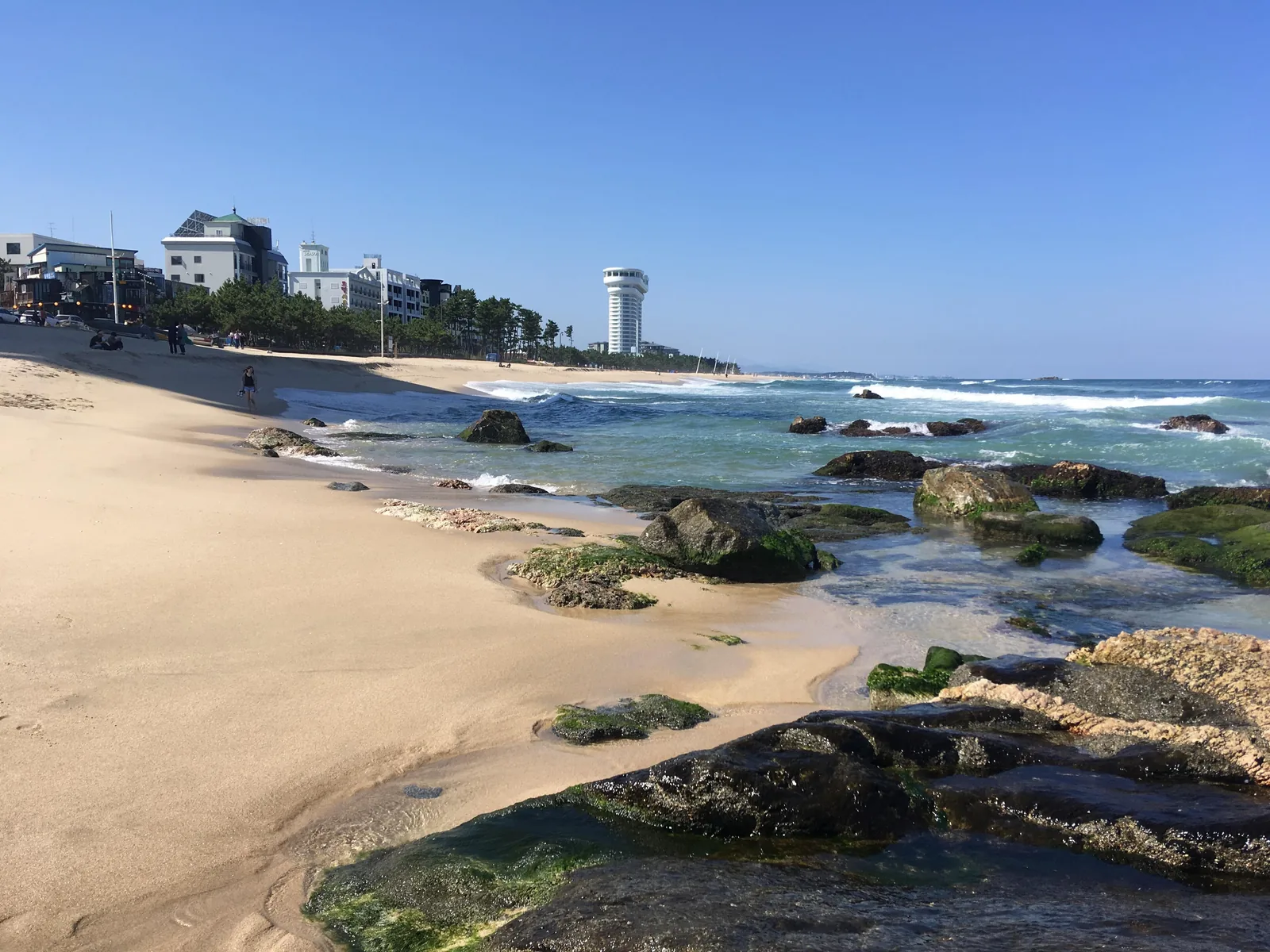
The first is the sea. Gyeongpo Beach, which VisitKorea describes as a sand bank formed between Gyeongpoho Lake and the ocean, has shallow water and a pine forest alongside, and Gangneung City's creative-city site calls it the largest beach on the east coast. Further north, Jumunjin Beach, in what VisitKorea calls the northernmost part of Gangneung, is the family beach in the pines.
The second is the lake. Gyeongpoho Lake, VisitKorea says, is a naturally formed lake of 1,256,204 m² connected to the ocean and famous for migratory birds in winter. Gangneung City adds spring cherry blossoms and a 4 km promenade, and Gyeongpodae Pavilion, on a hill north of the water, is famous for the moon reflected on the lake.
The third is coffee. VisitKorea calls Gangneung a city of coffee, known for coffee expertise since the 1980s and the first local district in Korea to host a coffee festival, and Coffee Street, Gangneung City says, runs along Anmok Beach.
The fourth is Joseon heritage: Ojukheon House, birthplace of the scholar Yulgok and a Treasure since 1963; the memorial park to Heo Gyun and his sister Heo Nanseolheon; and the Daedohobu government office in the old town. Above all, there is Danoje, the festival UNESCO proclaimed a Masterpiece of the Oral and Intangible Heritage of Humanity in 2005.
Time your trip by the calendar, from Gangneung City, VisitKorea and the Danoje Festival Committee:
- Spring: cherry blossoms around Gyeongpoho Lake (Gangneung City).
- April and September: the Nanseolheon Cultural Festival at the Heo Gyun and Heo Nanseolheon Memorial Park (VisitKorea).
- Danoje, set by the lunar calendar: in 2026 the Gangneung Danoje Festival ran from 15 to 22 June on the Namdaecheon (Danoje Festival Committee).
- July: the Gangneung Beach Beer Festival on Gyeongpo Beach (Gangneung City).
- September: the Gangneung Cultural Heritage Night Tour at the Daedohobu government office (Gangneung City).
- October: the Gangneung Coffee Festival, every October (Gangneung City), and the Yulgok memorial ceremony at Ojukheon on 25–26 October (VisitKorea).
- Winter: migratory birds on Gyeongpoho Lake (VisitKorea).
The three bases compared
Our rule: stay in Gyeongpo and Anmok for a first visit, the beach and the heritage sights; by Gangneung Station and Jungang Market for a trip without a car, a short stay or Danoje; and in Jumunjin for seafood and a family beach, ideally as a second night.
Gyeongpo and Anmok is the all-round base for the sea. The beach, Gyeongpoho Lake and Gyeongpodae Pavilion sit together, with the pavilion about 1 km from the beach by VisitKorea's figure, and VisitKorea's first-time course links Ojukheon, the beach and the pavilion on a route of about 8.9 km. The Heo memorial park and Chodang's tofu village are both in Chodang-dong, and Coffee Street, at 17 Changhae-ro, is on the same coast road as Gyeongpo Beach at 514 Changhae-ro. The trade-off is distance from the trains: VisitKorea puts the beach about 6 km from downtown Gangneung, so plan on taxis or a car.
Gangneung Station and Jungang Market is the base for trains and the old town. The KTX Gangneung Line ends at Gangneung Station, and the Donghae Line runs south from it along the coast. Wolhwa Street, a 2.6 km trail on a former railway, starts at the station; Jungang Market has been a permanent market since 1980; and the Daedohobu government office hosts the September night tour and, in 2026, the start of the Danoje parade. The trade-off is the sea, which is a taxi ride away.
Jumunjin is the stay for the port and the northern beaches. Gangneung City counts about 350 fishing boats at Jumunjin Port, with fresh raw fish sold from the boats, and VisitKorea dates the fish market next to the port to 1936. Jumunjin Beach is shallow and family-friendly, the BTS Stop at Hyangho-ri is a fan photo spot, and the Jumunjin Sand Protection Dam is a filming location from the drama Goblin. Come with a car: it is the wrong base for the rest of the city.
Two nights is the right shape for most trips: one in Gyeongpo, one downtown. Add Jumunjin for a third night if you have a car and an appetite for seafood.
- Gyeongpo & Anmok: the beach, the lake, Gyeongpodae, Ojukheon, the Heo memorial park, Chodang tofu and Coffee Street; taxi or car to the station.
- Gangneung Station & Jungang Market: the KTX and Donghae Line, Wolhwa Street, Jungang Market, the Daedohobu and Danoje.
- Jumunjin: the port, the 1936 fish market, a shallow family beach, the BTS Stop and the Goblin sand dam; bring a car.
Getting to Gangneung
From Seoul, take the KTX. VisitKorea's train guide, updated in August 2026, lists the Gangneung Line as a 237.7 km line that runs from Cheongnyangni Station in Seoul all the way to Gangneung Station, with Seowonju and Pyeongchang among its major stops. The same guide names Seoul Station as a starting point of the Gangneung Line and lists KTX departures for Gangneung from Seoul Station and Cheongnyangni, so board at whichever is closer to you. Gangneung Station is the end of the line.
From Incheon Airport, travel into Seoul and take the KTX on the Gangneung Line from Seoul Station, which VisitKorea's train guide names as a starting point of the line.
Yangyang International Airport is in Yangyang-gun, Gangwon State, says VisitKorea's domestic flights guide, updated in June 2026, and the Yangyang Intercity Bus Terminal is 20 minutes from the airport by city bus.
Along the coast, the Donghae Line runs south from Gangneung via Donghae and Samcheok. A December 2025 city release on the line gives its opening date as 1 January 2025 and lists ITX-Maum trains making four round trips a day, plus six KTX-Eum runs a day, three each way.
By road, Gangneung City's directions to City Hall, at 33 Gangneung-daero in Hongje-dong, tell you to get off at the Intercity/Express Bus Terminal stop and walk for 7 to 10 minutes, which puts the bus terminal close to City Hall.
Once you are here, taxis or a car link the three bases. VisitKorea puts Gyeongpo Beach about 6 km from downtown Gangneung, and Jumunjin is the city's northernmost part.
- Seoul Station or Cheongnyangni to Gangneung Station: KTX, Gangneung Line, 237.7 km from Cheongnyangni (VisitKorea, 2026).
- Incheon Airport: into Seoul, then the KTX on the Gangneung Line from Seoul Station (VisitKorea, 2026).
- Yangyang International Airport: in Yangyang-gun, Gangwon State; 20 minutes by city bus to the Yangyang Intercity Bus Terminal (VisitKorea, 2026).
- Donghae Line, via Donghae and Samcheok: ITX-Maum four round trips a day and KTX-Eum six runs a day on the line (December 2025 figures).
- Intercity/Express Bus Terminal stop: a 7 to 10 minute walk from City Hall (Gangneung City).
The Gangneung Danoje Festival
Danoje is Gangneung's great festival. UNESCO originally proclaimed the Gangneung Danoje festival a Masterpiece of the Oral and Intangible Heritage of Humanity in 2005, and inscribed it on the Representative List of the Intangible Cultural Heritage of Humanity in 2008. Gangneung City's creative-city site dates the proclamation to November 2005, and the Danoje Festival Committee notes that it has been National Intangible Cultural Heritage No. 13 since 1967.
UNESCO describes a four-week-long festival in the town of Gangneung and its surroundings that begins with the brewing of a sacred liquor and includes a shamanistic ritual on the Daegwallyeong Ridge. The Committee counts it as an extensive journey of approximately 40 days, from the brewing of the liquor on the 5th day of the fourth lunar month, with the main shamanic rites from the 3rd to the 8th day of the fifth lunar month. The Committee records that Heo Gyun wrote of a Dano ritual in 1603, that the venue moved to the banks of the Namdaecheon during the colonial era, and that the Committee has run the festival since 1975.
In 2026 the festival ran from 15 to 22 June at the Danoje festival grounds along the Namdaecheon Stream, closing with the Sonshinjae rite on the evening of 22 June. Its evening parade set off from the Daedohobu government office and ran via Okcheon junction and Geumseong-ro to Seongnae-dong plaza. The dates of the 2027 festival had not been published at the end of October 2026.
For Danoje, stay by Gangneung Station and Jungang Market: the parade runs through downtown, and the KTX from Seoul ends at Gangneung Station. Book festival week as early as you can.
Coffee city: Anmok and the Coffee Festival
VisitKorea calls Gangneung a city of coffee, known for its coffee expertise since the 1980s, and says it was the first local district in Korea to host a coffee festival. The heart of it is Gangneung Coffee Street: coffee shops of every size along Anmok Beach, many with ocean views, at 17 Changhae-ro, says Gangneung City, whose creative-city site places the street in Songjeong-dong and describes it as revived as a popular tourist attraction. Each café sets its own hours.
The Gangneung Coffee Festival is held every October, says Gangneung City, on Anmok Beach Coffee Street and in other parts of the city, where cafés roast their own beans; the city lists the venue as all across Gangneung. The 2027 dates had not been published at the end of October 2026.
Coffee Street is on Changhae-ro, the same coast road as Gyeongpo Beach, which is why we fold Anmok into the Gyeongpo base. Stay there for a sea-view coffee in the morning and the beach in the afternoon, and in October pair the festival with the Yulgok memorial ceremony at Ojukheon, held on 25–26 October.
Joseon heritage: Yulgok, the Heo family and the old town
Ojukheon House was where Yi I, the Joseon scholar and politician known as Yulgok, was born, says VisitKorea. Built in the early Joseon dynasty and designated a Treasure in 1963, it keeps Mongryongsil, the birth room, beside the Yulgok Memorial Hall and the Gangneung Municipal Museum; VisitKorea's first-time course calls it the historic birthplace of the figures in Korea's bills. It opens 09:00–18:00, last admission 17:00, all year, and holds a memorial ceremony every year on 25–26 October, a tradition VisitKorea dates to 1961.
Gyeongpodae Pavilion, on a hill north of Gyeongpoho Lake, is one of the eight scenic sites of Gwangdong, the north-eastern coast, VisitKorea says. First built in 1326 and moved to its present site in 1508, it holds calligraphy and poems, including works by King Sukjong and Yulgok, and the area around it became a provincial park in 1981.
The Heo Gyun and Heo Nanseolheon Memorial Park honours a brother and sister: Heo Gyun, author of the Story of Hong Gildong, which VisitKorea calls the first of its kind written in Hangeul, and Heo Nanseolheon, one of Korea's most esteemed female writers. It has a memorial hall, the site of her birth home and a traditional tea experience; the park is open 24 hours, and the hall opens 09:00–18:00 and closes on Mondays, 1 January, Seollal and Chuseok. Chodang's tofu village shares the name of their father: Korea's culture ministry webzine (2019) says Chodang was the pen name of Heo Yeop, though it calls that story a legend, and that the tofu is set with East Sea seawater.
Gangneung City's creative-city site adds two more: Seongyojang House, designated National Folklore Cultural Heritage in 1965, and Gangneung Hyanggyo, first founded in 1313, destroyed in 1411 and restored. In the old town, the Daedohobu government office hosts the Cultural Heritage Night Tour every September. Stay in Gyeongpo for Ojukheon, Gyeongpodae and the Heo park, and downtown for the Daedohobu.
The 2018 Olympic ice venues
Gangneung City calls itself the host city of the ice skating events in the PyeongChang 2018 Olympic Winter Games. The IOC groups its venues as the Gangneung coastal cluster, for ice events: the Gangneung Oval, the Gangneung Curling Centre, the Gangneung Hockey Centre, the Gangneung Ice Arena and the Kwandong Hockey Centre.
The IOC reported in February 2026 that the Gangneung Ice Arena has been renovated for public multi-sport use, with a swimming pool and concerts, and that the 8,000-seat Gangneung Oval has been used as a film studio and an ice-sports experience centre. The Curling Centre, the Hockey Centre and the Ice Arena were used again for the Gangwon 2024 Winter Youth Olympic Games, and the Hockey Centre hosted the Gangwon 2024 closing ceremony. The Kwandong Hockey Centre has been transferred to Catholic Kwandong University.
Day trips and onward travel
Jeongdongjin, in Gangdong-myeon, is the classic day trip: Gangneung City's creative-city site calls it well-known as the best sunrise spot in the country. Gangneung City lists the Jeongdong Badabuchae-gil, a 2.86 km coastal trail between Jeongdongjin and Simgok Port that it describes as a designated natural monument, and the Jeongdongjin Rail Bike, an electric rail bike between Jeongdongjin Station and Moraesigye (Hourglass) Park.
Inland, Gangneung City calls Solhyang Arboretum, at 156 Sumogwon-gil in Gujeong-myeon, Korea's only pine-themed arboretum, and lists Nochusan Mojeongtap-gil in Wangsan-myeon, with about 3,000 stone towers. Its creative-city site adds Anbandegi, a highland farming village formed in 1965. Go by car for these.
Onward, the KTX Gangneung Line calls at Pyeongchang and Seowonju among its major stops, VisitKorea's train guide says, and the Donghae Line runs south along the coast to Donghae and Samcheok. See our other Gangwon guides for the next stop.
Every Gangneung area guide
- Gyeongpo & AnmokGangneung's beach and lake, Yulgok's birthplace, Chodang tofu and Anmok's coffee street.
- Gangneung Station & Jungang MarketThe end of the KTX line and the old town: Jungang Market, Wolhwa Street and Danoje.
- JumunjinGangneung's northern port: a fish market from 1936, a family beach and the BTS bus stop.
Questions visitors ask
Where should I stay in Gangneung for a first visit?
In Gyeongpo. Gyeongpo Beach, Gyeongpodae and Ojukheon are three of the places VisitKorea's first-time course calls the most notable in Gangneung, Gyeongpoho Lake has a 4 km promenade, and Chodang tofu and the Heo memorial park are in Chodang-dong. Anmok's Coffee Street is on the same coast road. Take a taxi from Gangneung Station: VisitKorea puts the beach about 6 km from downtown.
Where should I stay in Gangneung without a car?
By Gangneung Station. The KTX Gangneung Line ends there, and Donghae Line trains run south to Donghae and Samcheok. Wolhwa Street starts at the station, and Jungang Market and the Daedohobu are in the old town. Take taxis out to Gyeongpo and the beaches.
How do I get from Seoul to Gangneung?
By KTX on the Gangneung Line from Seoul Station or Cheongnyangni. VisitKorea's 2026 train guide lists the line as running 237.7 km from Cheongnyangni all the way to Gangneung Station, with Seowonju and Pyeongchang among its major stops. From Incheon Airport, travel into Seoul and take the KTX from Seoul Station.
When is the Gangneung Danoje Festival?
By the lunar calendar: the Danoje Festival Committee puts the main shamanic rites on the 3rd to the 8th day of the fifth lunar month. In 2026 it ran from 15 to 22 June on the Danoje festival grounds along the Namdaecheon Stream, and the dates of the 2027 festival had not been published at the end of October 2026. UNESCO proclaimed it a Masterpiece of the Oral and Intangible Heritage of Humanity in 2005 and inscribed it on the Representative List in 2008. Stay downtown for it.
When is the Gangneung Coffee Festival?
Every October, says Gangneung City, on Anmok Beach Coffee Street and across the city, where cafés roast their own beans. VisitKorea says Gangneung was the first local district in Korea to host a coffee festival. Stay in Gyeongpo and Anmok for it: Coffee Street is on the same coast road as Gyeongpo Beach.
Sources & review
Editorial review: · Korea Standard Time
- Gangneung City — About Gangneung
- Gangneung City — Gangneung Tourism: attractions
- Gangneung City — Directions to City Hall
- Gangneung City (Creative City) — Resources
- Gangneung City (Creative City) — Gastronomy
- Gangneung City — Gangneung Coffee Festival
- Gangneung City — Gangneung Cultural Heritage Night Tour
- Gangneung City — Gangneung Beach Beer Festival
- VISITKOREA — Train (updated 2026)
- VISITKOREA — Domestic Flights (updated 2026)
- Busan Metropolitan City — Donghae Line ITX-Maum and KTX-Eum services (December 2025)
- VISITKOREA — Welcome, is this your first time in Gangneung? (course)
- VISITKOREA — Gyeongpo Beach
- VISITKOREA — Gyeongpoho Lake
- VISITKOREA — Gyeongpodae Pavilion
- VISITKOREA — Ojukheon House
- VISITKOREA — Heo Gyun and Heo Nanseolheon Memorial Park
- KOREA webzine (KOCIS) — Chodang tofu (2019)
- VISITKOREA — Gangneung Coffee Street
- VISITKOREA — Gangneung Jungang Market
- VISITKOREA — Jumunjin Fish Market
- VISITKOREA — Jumunjin Beach
- Gangneung City — Webzine (2023)
- UNESCO Intangible Cultural Heritage — Gangneung Danoje festival
- Gangneung Danoje Festival Committee — History
- Gangneung Danoje Festival Committee — Festival information
- Gangneung Danoje Festival Committee — 2026 programme
- Gangneung Danoje Festival Committee — 2026 programme (English)
- Gangneung Danoje Festival Committee — 2026 programme: evening parade
- IOC — Gangneung coastal cluster (2026)
- IOC — PyeongChang 2018 Olympic venues overview (2026)