
Sokcho · Where to stay
Where to stay in Sokcho
속초 숙소 지역
Sokcho gives you the East Sea and Seoraksan in one city: a beach with a Ferris wheel, a covered seafood market and a refugee village across a 50 m channel, and the Sogongwon entrance to the national park that KTO calls Korea's first UNESCO Biosphere Reserve. You have two bases: Sokcho Beach and the harbour, or Seorak-dong. Here is the quick answer, then everything behind it.
Quick pick
| Your trip | Stay in | Why |
|---|---|---|
| First visit | Sokcho Beach & the Harbour | Both bus terminals, the beach, Sokcho Eye and the Tourist & Fishery Market, with buses 7 and 7-1 to Seoraksan from the intercity terminal. |
| Travelling by bus, without a car | Sokcho Beach & the Harbour | The beach is about 5 minutes on foot from the express terminal (KTO, 2025) and the market about 5 minutes from the intercity terminal (KTO, 2023). |
| Hiking Seoraksan | Seorak-dong | The Sogongwon entrance is KTO's starting point for both the Ulsanbawi and Daecheongbong trails, with entry from 03:00 in summer. |
| Autumn foliage | Seorak-dong | The Korea Meteorological Administration gives Seoraksan's normal foliage peak as 17 October; sleep at the gate and start early. |
| Temples and the cable car | Seorak-dong | Sinheungsa, founded in 652, is on the Ulsanbawi trail, and the cable car reaches Gwongeumseong in about 10 minutes. |
| Beach and summer | Sokcho Beach & the Harbour | In 2026 the Sokcho Summer Festival ran around Sokcho Beach from 31 July to 2 August. |
| Seafood | Sokcho Beach & the Harbour | The Tourist & Fishery Market, Dongmyeong Port's live-fish centre and its street-stall alley. |
| Sunrise over the sea | Sokcho Beach & the Harbour | KTO's Korean guide groups Yeonggeumjeong and Dongmyeong Port as a sunrise spot, by the Sokcho Lighthouse. |
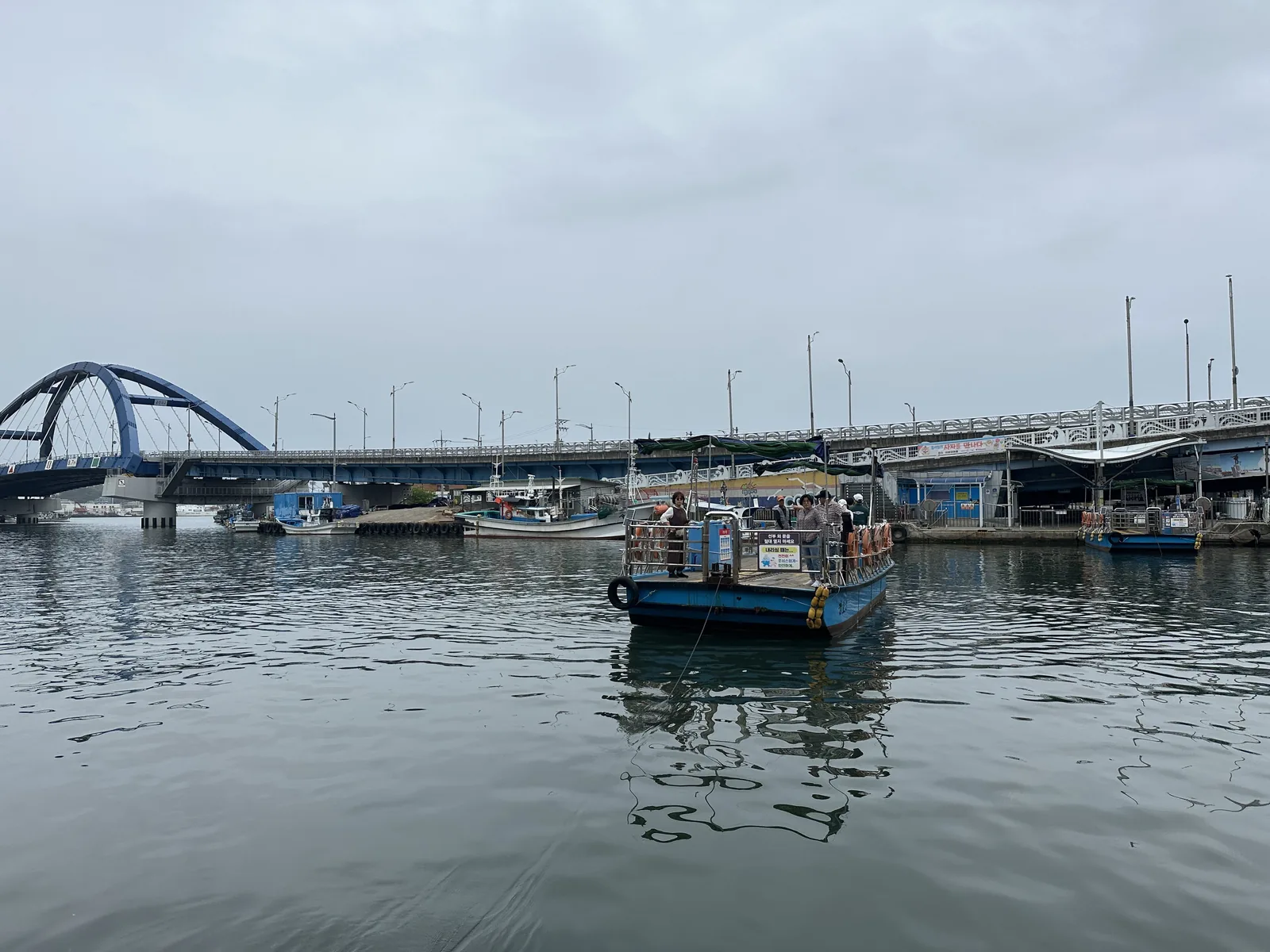
| Abai Village and its history | Sokcho Beach & the Harbour | The gaetbae crosses the 50 m channel from downtown to Abai Village in about 5 minutes. |
Why stay the night in Sokcho
Sokcho puts the East Sea and Seoraksan in the same city, and the reason to stay the night is to have both. On the coast, KTO describes Sokcho Beach, opened in 1976, as close to downtown and popular all year round; its Korean guide gives about a kilometre of white sand and pine forest running to Oeongchi Beach, and Sokcho Eye, a Ferris wheel about 65 m tall, stands on the sand. The Sokcho Tourist & Fishery Market, the former Jungang Market, brings East Coast seafood and local specialities together under covered walkways. Dongmyeong Port has its live-fish centre and street-stall alley, and Yeonggeumjeong's pavilion stands at the end of a 50 m bridge on the shore by the Sokcho Lighthouse, built in 1957.
Across the 50 m channel is Abai Village, formed by refugees of the Korean War from North Korea, KTO says, and in the heart of the city lies Cheongchoho Lake, a natural lagoon 5 km around that KTO calls Sokcho's finest night-view spot. KTO's Haeparang Trail course 45 ties the coast together on foot: 17.6 km, about six hours and mostly flat, from Seorak Sunrise Park through Abai Village and the Sokcho Lighthouse Observatory to Beombawi Rock on Yeongnangho Lake and on to Jangsahang Port.
Then there is Seoraksan. KTO lists Seoraksan National Park as Korea's first UNESCO Biosphere Reserve and, in its 2024 guide, Korea's second-largest national park, and gives Daecheongbong, at 1,708 m, as the third-highest peak in Korea. The park's Sogongwon entrance in Seorak-dong is the start of the Ulsanbawi and Daecheongbong trails, with Sinheungsa on the way and the cable car to Gwongeumseong inside the park. A night by the sea and a night under the mountain is the shape of a good Sokcho trip.
The two bases compared
Our rule: stay by Sokcho Beach and the harbour for a first visit, a trip by bus or a holiday by the sea; stay in Seorak-dong when Seoraksan is the reason you came.
Sokcho Beach and the harbour is the all-round base, and the one for arriving by bus. KTO's 2025 beach guide puts the beach about 5 minutes on foot from Sokcho Express Bus Terminal, where KTO's 2021 timetable has the Seoul buses arriving, and its 2023 market guide puts the Tourist & Fishery Market about 5 minutes from Sokcho Intercity Bus Terminal and about 15 from the express terminal. Sokcho Eye and the 1.74 km Oeongchi Badahyanggiro trail start at the beach, Yeonggeumjeong and Dongmyeong Port are by the lighthouse, and the gaetbae crosses to Abai Village. Daepo Port, at what KTO calls the southernmost point of Sokcho, marks the city's southern end. City buses 7 and 7-1 to Seoraksan's Sogongwon stop leave from the intercity terminal (KTO, September 2024), so the mountain is a day trip. The trade-off is the early start for the long trails.
Seorak-dong is the stay for the mountain. The Sogongwon entrance at 1055 Seoraksan-ro is KTO's starting point for both the Ulsanbawi and Daecheongbong trails; Sinheungsa is on the way to Ulsanbawi, the cable car reaches Gwongeumseong in about 10 minutes, and Biryong Falls is about an hour's walk from the ticket booth. KTO lists the park's entry hours as 03:00–14:00 in summer and 04:00–12:00 in winter, and a 16 km, 10-hour Daecheongbong crossing has to start early, which is the case for a night at the gate. The Cheoksan Hot Springs Zone, which KTO describes as a village dedicated to hot spring tourism, is in Nohak-dong. The trade-off is the sea: the beach, the market and the harbour's seafood evenings are a bus ride away.
Two nights is a good shape for most trips: one by the beach, one in Seorak-dong. In October, Seoraksan's foliage month, make the Seorak-dong night the one before your big hike.
- Sokcho Beach & the Harbour: both bus terminals, Sokcho Eye, the Tourist & Fishery Market, Yeonggeumjeong, Dongmyeong Port and the gaetbae to Abai Village; buses 7 and 7-1 to Seoraksan.
- Seorak-dong: the Sogongwon entrance, Sinheungsa, the cable car to Gwongeumseong, Ulsanbawi, Biryong Falls and the Daecheongbong trail; buses 7 and 7-1 from the intercity terminal.
Getting to Sokcho
From Seoul, take an express bus. KTO's bus guide, updated in June 2026, lists Sokcho among the destinations of both Seoul Express Bus Terminal, at Express Bus Terminal Station on Lines 3, 7 and 9, and Dong Seoul Terminal, at Gangbyeon Station on Line 2; it notes that express and intercity buses to the same place can leave from different terminals. KTO's Korean article of November 2021 gives the journey to Sokcho Express Bus Terminal as about 2 hours 20 minutes from Seoul Express Bus Terminal and about 2 hours 30 minutes from Dong Seoul. From Sokcho Express Bus Terminal, the beach is about a 5-minute walk (KTO, 2025).
By car, the road is the Seoul–Yangyang Expressway. Its last section, Donghongcheon to Yangyang, opened at 20:00 on 30 June 2017, completing a 150.2 km road, and the government's release put Seoul to Yangyang at about 90 minutes and Incheon Airport to Yangyang at 2 hours 20 minutes.
There is no train yet. Sokcho has no railway station, and the Korea National Railway lists two lines under construction: Chuncheon to Sokcho, 93.7 km, and Gangneung to Jejin, which its 2023 release describes as running from Gangneung through Yangyang and Sokcho to Goseong. No confirmed opening date has been announced for either, so plan on the bus or a car.
The nearest airport is Yangyang International Airport, which KTO calls the lone international airport in Gangwon State. KTO's 2026 guides give 30 to 40 minutes to Sokcho by intercity bus and about 30 minutes by taxi.
- Seoul Express Bus Terminal to Sokcho: about 2 hours 20 minutes by express bus (KTO, November 2021).
- Dong Seoul Terminal to Sokcho: about 2 hours 30 minutes by express bus (KTO, November 2021).
- By car: the Seoul–Yangyang Expressway, open in full since 30 June 2017; Seoul to Yangyang about 90 minutes (government release, 2017).
- Yangyang Airport to Sokcho: 30 to 40 minutes by intercity bus, about 30 minutes by taxi (KTO, 2026).
- Rail: none yet; the Chuncheon–Sokcho and Gangneung–Jejin lines are under construction.
Seoraksan: the park, the trails and the seasons
Seoraksan became a national park in 1970, the country's fifth, KTO says, and in 1982 it became Korea's first UNESCO Biosphere Reserve; the Ministry of Foreign Affairs lists it on the Man and the Biosphere register as Mount Sorak (1982). The IUCN Green List added it in 2014, giving its area as 398.24 km². KTO divides the park into Inner, South and Outer Seorak, and the park service's spring 2025 closure notice lists the Sogongwon trails under Outer Seorak.
From Sogongwon, the trails fan out. Ulsanbawi Rock is six massive peaks, each reaching about 900 m and spread out like a fence; KTO's 2025 guide gives the route as 3.8 km and about two hours each way, past Sinheungsa and Heundeulbawi Rock, and its 2024 guide gives the loop back to Sogongwon as 7.6 km and 4 hours. Biryongpokpo Falls, a 16 m waterfall, is 2.4 km south of the ticket booth, about an hour's walk, and the round trip with Towangseong and Yukdam Falls takes about three hours. The big day is the Daecheongbong trail: 16 km and 10 hours by KTO's 2024 figure, from Sogongwon by Biseondae and Huiungak Shelter to the 1,708 m summit and down to Osaek. For the view without the climb, the cable car runs from inside the park to Gwongeumseong, a Goryeo stone fortress, in about 10 minutes; KTO says it sells no one-way tickets and announces each day's hours on its website the day before.
Sinheungsa, on the way to Ulsanbawi, was founded as Hyangseongsa by the monk Jajang in 652, in the Silla dynasty, KTO says; its heritage includes Geungnakbojeon Hall, a wooden building from the mid-Joseon period, and the three-storey stone pagoda at the Hyangseongsa Temple site.
Time your hike around the park's rules. KTO lists entry hours of 03:00–14:00 in summer and 04:00–12:00 in winter. Its 2024 guide gives the fire-prevention closures as 2 March to 15 May and 15 November to 15 December, when the upper Biseondae–Daecheongbong section closes and Sogongwon to Biseondae stays open; in spring 2025, from 4 March to 15 May, the park service also kept Sogongwon to Ulsanbawi, the Towangseong Falls observatory route and Gwongeumseong open. In both sets of closures, the short walks from Sogongwon stayed open and the ridge to Daecheongbong closed.
Autumn is the high season. The Korea Meteorological Administration recorded Seoraksan's first autumn colour on 28 September 2026, the same as the normal date and four days earlier than in 2025, and gives the normal peak as 17 October. Book October weekends early, and stay in Seorak-dong if you want to be on the trail at first light.
Abai Village and Sokcho's displaced people
Abai Village, in Cheongho-dong, bears a history of displaced people's distress, in KTO's words. It was formed during the Korean War by refugees from North Korea, who settled near the beach, and its name is a word from their home dialect: KTO's English page glosses abai as a friendly old man like a grandfather, its Korean page as father.
KTO's Korean guide says the village was designated an Open Tourism Destination in 2020, and that the house of Jeon Sang-su survives close to its wartime form; the heroine's house from the 2000 drama Autumn in My Heart, filmed here, still stands. KTO names Abai sundae and squid sundae as the local dishes. You reach the village from downtown on the gaetbae, an engine-less boat pulled along a steel wire across the 50 m channel in about 5 minutes; KTO's 2023 guide gives its hours as 05:00–23:00 in summer and 05:30–22:30 in winter, all year.
The Sokcho City Museum tells the story too. Its Displaced People's Culture Village recreates the Cheongho-dong alleys where refugees from the North lived after the war, along with the old Sokcho Station building, demolished in 1978; the museum is open 09:00–18:00 from March to October and 09:00–17:00 from November to February, and closed on Mondays and 1 January. The city's Displaced People's Culture Festival, which KTO calls the only displaced people's culture festival in the country, is themed on the life and memory of the displaced community centred on Abai Village; in 2026 the 11th festival ran on 12 and 13 June at the Sokcho Expo lawn plaza.
Sokcho's festivals in 2026
Sokcho City's festivals run from spring blossom to the autumn colours. These are the 2026 dates from KTO's festival pages; all four have now taken place:
- April: the 3rd Yeongnangho Cherry Blossom Festival ran on 11 and 12 April 2026 at the Yeongnangho grass plaza, with a blossom tunnel along the lakeside trail and night lighting. Yeongnangho is 7.8 km around, KTO says.
- June: the 11th Displaced People's Culture Festival ran on 12 and 13 June 2026 at the Sokcho Expo lawn plaza.
- July and August: the Sokcho Summer Festival ran from 31 July to 2 August 2026 around Sokcho Beach, with games and water play by day and music and a DJ festival in the evening.
- October: the 61st Seorak Cultural Festival ran from 2 to 4 October 2026 at 72 Expo-ro, the Expo Tower's address, with a street parade, rites and performances. It was first held in 1966 as the Seorak Festival.
Onward to Yangyang and Gangneung
Yangyang International Airport, in Yangyang-gun, links Sokcho to its neighbours: intercity buses run from the airport to Sokcho and Gangneung, and by taxi KTO puts Naksansa and Hajodae about 10 minutes from the airport, Sokcho about 30 and Gangneung about 45. KTO's Seorak Special Tourist Zone spans Sokcho, Goseong and Yangyang, about 138.2 km² in all, with Sokcho its largest part. The Gangneung–Jejin line under construction is planned, in the Korea National Railway's 2023 release, to run from Gangneung through Yangyang and Sokcho. See our Yangyang and Gangneung guides for the next stop.
Every Sokcho area guide
- Sokcho Beach & the HarbourSand, the Ferris wheel, the seafood market and both bus terminals: Sokcho's easy base.
- Seorak-dongThe Sogongwon gate to Seoraksan: Sinheungsa, the cable car and Ulsanbawi at first light.
Questions visitors ask
Where should I stay in Sokcho for a first visit?
By Sokcho Beach and the harbour. Both bus terminals are here: the beach is about 5 minutes on foot from the express terminal (KTO, 2025) and the Tourist & Fishery Market about 5 minutes from the intercity terminal (KTO, 2023). Sokcho Eye, Yeonggeumjeong, Dongmyeong Port and the gaetbae to Abai Village are close, and buses 7 and 7-1 run from the intercity terminal to Seoraksan.
Where should I stay for hiking Seoraksan?
In Seorak-dong, at the Sogongwon entrance, which KTO gives as the starting point for both the Ulsanbawi and Daecheongbong trails. KTO lists entry hours of 03:00–14:00 in summer and 04:00–12:00 in winter, and the Daecheongbong trail as 16 km and 10 hours, so a night at the gate gives you the early start. Buses 7 and 7-1 run there from Sokcho Intercity Bus Terminal.
How do I get from Seoul to Sokcho?
By express bus from Seoul Express Bus Terminal or Dong Seoul Terminal. KTO's Korean article of November 2021 gives about 2 hours 20 minutes and about 2 hours 30 minutes respectively to Sokcho Express Bus Terminal, about a 5-minute walk from the beach. By car, take the Seoul–Yangyang Expressway, open in full since 30 June 2017.
Is there a train to Sokcho?
Not yet. Sokcho has no railway station. The Korea National Railway lists the Chuncheon–Sokcho line and the Gangneung–Jejin line, which runs through Yangyang and Sokcho, as under construction, and no confirmed opening date has been announced for either. Come by express bus from Seoul or by car on the Seoul–Yangyang Expressway.
How do I get from Yangyang Airport to Sokcho?
By intercity bus, 30 to 40 minutes, or by taxi, about 30 minutes, according to KTO's 2026 airport guides. KTO calls Yangyang the lone international airport in Gangwon State. For Seoraksan, carry on from Sokcho Intercity Bus Terminal on city bus 7 or 7-1 to the Seoraksan Sogongwon Park stop.
When is the best time for Seoraksan's autumn colours?
Mid-October. The Korea Meteorological Administration gives the normal peak as 17 October, and in 2026 it recorded the first colour on 28 September, the normal date. Stay in Seorak-dong for dawn starts on the trails, and book October weekends early.
Sources & review
Editorial review: · Korea Standard Time
- VISITKOREA — Sokcho Beach
- VISITKOREA — Best Summer Beach Destinations (2025)
- VISITKOREA (Korean) — Sokcho travel guide (November 2021)
- VISITKOREA — Sokcho Eye
- VISITKOREA — Sokcho Tourist & Fishery Market
- VISITKOREA — Sokcho Tourism and Fisheries Market (2023)
- VISITKOREA — Ultimate Seafood Experience in Sokcho
- VISITKOREA — Oeongchi Badahyanggiro Trail
- VISITKOREA — Yeonggeumjeong
- VISITKOREA — Sokcho Lighthouse Observatory
- VISITKOREA — Daepohang Port
- VISITKOREA — Haeparang Trail course 45
- VISITKOREA — Yeongnangho Lake
- VISITKOREA — Abai Village
- VISITKOREA — Gaetbae
- VISITKOREA (Korean) — Abai Village and Seoraksan guide (November 2023)
- VISITKOREA — Cheongchoho Lake
- VISITKOREA Accessible Travel (Korean) — Sokcho City Museum
- VISITKOREA — Express Bus & Intercity Bus (updated 2026)
- VISITKOREA — International Flights (2026)
- VISITKOREA — Domestic Flights (2026)
- VISITKOREA — Airport Transportation Guide (2026)
- Korea.kr — Seoul–Yangyang Expressway fully open (2017)
- Korea National Railway — Projects under construction
- Korea National Railway — Gangneung–Jejin line (2023)
- VISITKOREA — Seoraksan National Park
- VISITKOREA — Reach New Heights with Korea's National Parks! (2024)
- VISITKOREA LuxuryKorea — Seoraksan (2025)
- Ministry of Foreign Affairs — UNESCO Man and the Biosphere
- IUCN Green List — Seoraksan National Park
- VISITKOREA — Sinheungsa Temple
- VISITKOREA — Seoraksan Cable Car
- VISITKOREA — Gwongeumseong Fortress
- VISITKOREA — Ulsanbawi Rock
- VISITKOREA — Biryongpokpo Falls
- VISITKOREA — Cheoksan Hot Springs Zone
- Korea National Park Service — Seoraksan spring 2025 trail closures
- Korea Meteorological Administration — Seoraksan first foliage (2026)
- VISITKOREA (Korean) — Yeongnangho Cherry Blossom Festival 2026
- VISITKOREA (Korean) — Displaced People's Culture Festival 2026
- VISITKOREA (Korean) — Sokcho Summer Festival 2026
- VISITKOREA — Sokcho Summer Festival
- VISITKOREA (Korean) — Seorak Cultural Festival 2026
- VISITKOREA — Sokcho Expo Tower
- VISITKOREA — Seorak Special Tourist Zone