
Pyeongchang · Where to stay
Where to stay in Pyeongchang
평창 숙소 지역
Pyeongchang is mountain country: the 2018 Winter Olympic venues at Alpensia, Yongpyong's ski slopes and the cable car up Balwangsan, and the temples of Odaesan National Park. You have three bases: Daegwallyeong and Alpensia, Yongpyong and Balwangsan, or Jinbu and Odaesan, home to the KTX station both resorts use. Here is the quick answer for each trip, then everything behind it.
Quick pick
| Your trip | Stay in | Why |
|---|---|---|
| First visit | Daegwallyeong & Alpensia | The ski jump and its ski history museum, bobsleigh at the Sliding Centre and the sheep at Yangtte Ranch. |
| Skiing and snowboarding | Yongpyong & Balwangsan | The IOC calls it the largest ski and snowboard resort in the Republic of Korea, with 28 runs and night skiing to 23:30 (KTO). |
| Mountain views without a climb | Yongpyong & Balwangsan | The Balwangsan Cable Car runs to Balwangsan, 1,458 m above sea level by KTO's figure. |
| Families | Daegwallyeong & Alpensia | Hay for the sheep at Yangtte Ranch, a tractor tour at Sky Ranch and the resort's Ocean700 water park. |
| Public bus from Seoul | Daegwallyeong & Alpensia | Alpensia names a bus from Dong Seoul to Hoenggye, where the resort is located. |
| Temples and forest walks | Jinbu & Odaesan | Woljeongsa's fir-forest path, the Woljeongsa Museum and Sangwonsa, 8 km north. |
| Travelling by KTX | Jinbu & Odaesan | Jinbu Station is the KTX stop both resorts' own sites send travellers to. |
| January trout festival | Jinbu & Odaesan | The Pyeongchang Trout Festival is held on the frozen Odaecheon Stream in Jinbu-myeon (KTO). |
| Daegwallyeong Snow Festival | Daegwallyeong & Alpensia | The Daegwallyeong Snow Festival is held by Songcheon Stream in Daegwallyeong-myeon (KTO). |
Why stay the night in Pyeongchang
Pyeongchang is high, snowy and spread across the mountains, and its three draws sit in three different places. The first is the mountains themselves. Alpensia's own site sets the resort at an altitude of 700 m in Daegwallyeong, and Yongpyong's site calls Daegwallyeong the Roof of Korea. KTO puts Daegwallyeong Yangtte Ranch at 920 m, Balwangsan at 1,458 m and Birobong, the highest peak of Odaesan, at 1,563 m. Yongpyong, KTO says, sits at the centre of the Baekdudaegan mountain range and averages 250 cm of snow a season.
The second is the 2018 Winter Olympics. The IOC says the Games were held in two clusters: the PyeongChang mountain cluster for the snow events and the Gangneung coastal cluster for the ice events. In Pyeongchang, the ski jump, the biathlon, cross-country and sliding centres at Alpensia, the Yongpyong Alpine Centre and Phoenix Snow Park in Bongpyeong are all still in use, and the park on the former Olympic Stadium site holds the PyeongChang Olympic Museum.
The third is Odaesan. KTO says Odaesan National Park is renowned for the Sangwonsa and Woljeongsa temples. Woljeongsa's name means 'where the moon stops', in the KOCIS webzine's 2018 feature, and more than 2,000 firs line its forest path, the forest path of a thousand years. Sangwonsa, 8 km to the north, houses what KTO calls the oldest bronze bell in the nation.
No single base puts all three on your doorstep, which is why we split Pyeongchang into three, and why a car makes the trip. The resorts' own shuttles run between Jinbu Station and the resorts, for their guests only.
The three bases compared
Our rule: stay at Alpensia for the Olympic venues, the ranches and a bus from Seoul; at Yongpyong for skiing and the Balwangsan Cable Car; and in Jinbu for Odaesan's temples and the KTX.
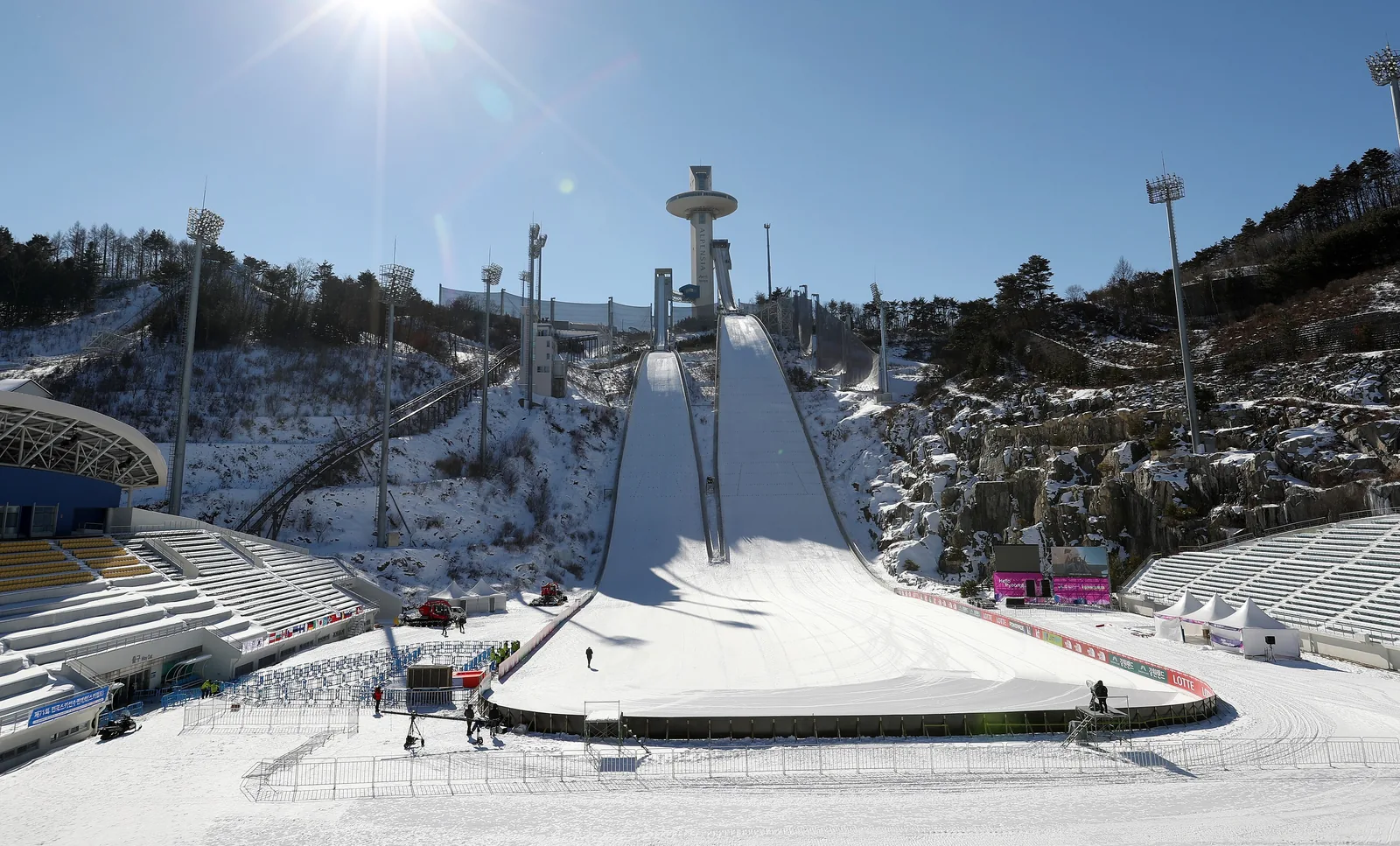
Daegwallyeong and Alpensia is the Olympic base. The ski jumping hills stand at the heart of the Alpensia Sport Park, and the IOC says the Ski Jumping Centre is now the main training facility for Korea's national ski jumping teams, with a ski history museum. At the Sliding Centre, which reopened in October 2019, visitors can try bobsleigh in summer and winter, and the PyeongChang 2018 Legacy Foundation runs laser-gun biathlon at the Biathlon Centre. Daegwallyeong Yangtte Ranch, where KTO says the sheep graze freely except in winter, and Daegwallyeong Sky Ranch, with its 45-minute tractor tour, are in the same district. The resort has its own ski area, Ski700, with six slopes, plus the Ocean700 water park and the Alpine Coaster. It is also the base with a public bus from Seoul: Alpensia names a route from Dong Seoul to Hoenggye.
Yongpyong and Balwangsan is the ski base. The IOC calls it the largest ski and snowboard resort in the Republic of Korea, with 28 runs; CONI's venue page lists the 2018 men's and women's giant slalom and slalom; and KTO lists night skiing until 22:00, with a later session to 23:30. The Balwangsan Cable Car runs to the 1,458 m top of Balwangsan, and KTO lists a water park and a 45-hole golf course for the summer. KTO calls it a mecca for skiing in Korea.
Jinbu and Odaesan is the base for the temples and the trains. Jinbu Station is the KTX stop both resorts' shuttles start from, and Jinbu-myeon is home to Odaesan National Park, Woljeongsa, the Woljeongsa Museum, Sangwonsa and, in January, the Trout Festival on the frozen Odaecheon Stream. It is the wrong base for skiing from your door.
Two nights is a good shape for most trips: one at a resort, one in Jinbu for Odaesan. Skiers can stay at Yongpyong and spend a day at Alpensia's Olympic venues, which are in the same district, Daegwallyeong-myeon.
- Daegwallyeong & Alpensia: the ski jump, bobsleigh, the ranches and the Daegwallyeong Snow Festival; bus from Dong Seoul to Hoenggye.
- Yongpyong & Balwangsan: 28 runs, the 2018 slalom venue, night skiing to 23:30 and the Balwangsan Cable Car; guest shuttle from Jinbu.
- Jinbu & Odaesan: Woljeongsa, its fir-forest path and museum, Sangwonsa, and the January Trout Festival; the KTX station for Pyeongchang.
Getting to Pyeongchang
By rail, take the KTX on the Gyeonggang Line to Jinbu Station. Korea.net's 2017 announcement of the line lists trains from Seoul Station and Cheongnyangni, stopping at Pyeongchang and Jinbu on the way to Gangneung, and gave 1 hour 54 minutes for the full run from Seoul to Gangneung, the end of the line beyond Jinbu. Alpensia's own introduction puts the resort itself about one to two hours from Seoul, by the Second Yeongdong Expressway or by KTX via Jinbu Station. Both resorts' own sites send KTX travellers to Jinbu Station, not Pyeongchang Station.
At Jinbu, both resorts run shuttles for their guests, and only for their guests. Alpensia's takes about 20 minutes and runs twice a day, from Jinbu at 11:00 and 14:10 and back at 10:30 and 13:40; board with a reservation voucher or facilities ticket. Yongpyong's takes 20 minutes each way, from Jinbu at 11:00 and 15:00 and from the resort at 12:00 and 16:00, on its schedule from 1 March 2024; board with a reservation or membership card. Book your room at the resort and time your train to those departures.
By bus, Alpensia's public-transport page names a route from Dong Seoul, the eastern Seoul terminal by Gangbyeon Station on subway Line 2, to Hoenggye, where Alpensia is located. In the ski season, Alpensia's shuttle page lists a private ski-bus operator with pick-ups in Seoul and at Incheon Airport, booked with the operator, and KTO's December 2025 winter article says shuttle buses run from Seoul and the greater metropolitan area to Mona YongPyong.
From Incheon International Airport, the IOC says a 22 km expressway link cut the drive to PyeongChang and Gangneung to around 95 minutes. Without a car, take Alpensia's seasonal ski bus from the airport, or go into Seoul and take the KTX from Seoul Station to Jinbu.
By car from Seoul, Yongpyong's own site gives about 200 km and two and a half hours, leaving the expressway at the Daegwallyeong Interchange. Alpensia puts Yangyang International Airport about 40 minutes away and the East Sea coast about 30.
- KTX: Seoul Station or Cheongnyangni to Jinbu Station on the Gyeonggang Line (korea.net, 2017); Alpensia resort about one to two hours from Seoul by expressway or KTX via Jinbu (Alpensia).
- Alpensia shuttle: Jinbu 11:00 and 14:10, about 20 minutes, guests only (Alpensia).
- Yongpyong shuttle: Jinbu 11:00 and 15:00, 20 minutes, guests only (Yongpyong, schedule from March 2024).
- Bus: Dong Seoul to Hoenggye for Alpensia (Alpensia).
- Seasonal ski buses: Seoul and Incheon Airport to Alpensia (Alpensia); Seoul and the metropolitan area to Mona YongPyong (KTO, 2025).
- Incheon Airport by road: around 95 minutes (IOC).
- Seoul by car: about 200 km, two and a half hours, via the Daegwallyeong Interchange (Yongpyong).
PyeongChang 2018: what is left to see
The IOC's legacy series sets out what happened to the venues. The Games used 12 competition venues in two clusters, the PyeongChang mountain cluster for snow and the Gangneung coastal cluster for ice; six of the 12 already existed and six were new, and ten of the 12 are in use all year. The ice events were all on the coast in Gangneung, so Pyeongchang is the place for the snow venues.
At Alpensia, the Ski Jumping Centre is now the main training facility for Korea's national ski jumping teams, used all year, with a ski history museum. The Sliding Centre reopened after the Games in October 2019, and visitors can try bobsleigh there in summer and winter. The Biathlon and Cross-Country Centres serve winter training and youth sports camps, and the PyeongChang 2018 Legacy Foundation runs leisure activities including wheel bobsleigh and laser-gun biathlon.
The opening and closing ceremonies were held in the temporary PyeongChang Olympic Stadium, which was dismantled after the Games. Its site has since been turned into a park that is home to the PyeongChang 2018 Legacy Foundation, the PyeongChang Olympic Museum, managed by the Foundation, and the Wall of Champions. The two Olympic Villages, in PyeongChang and Gangneung, are now used for housing.
Yongpyong Alpine Centre is, in the IOC's words, the largest ski and snowboard resort in the Republic of Korea, with 28 runs and what the IOC calls the longest gondola course in Asia, at 7.4 km; the IOC notes that it hosted the FIS 2020 Alpine Skiing Far East Cup. Phoenix Snow Park, the venue for freestyle skiing and snowboarding, is now a well-established tourist destination itself, the IOC says, with 21 runs, a halfpipe and a golf course.
The venues came back into play for the Gangwon 2024 Winter Youth Olympic Games, held from 19 January to 2 February 2024, for the first time in Asia, in the IOC's words. The Alpensia biathlon, ski jumping and sliding centres were used again, and the IOC says the biathlon and cross-country centres hosted biathlon, cross-country and Nordic combined.
Winter festivals: trout and snow
Pyeongchang's two big winter festivals follow the ice and the snow, one in each of two bases, and both 2026 editions have now run.
The Pyeongchang Trout Festival is held on the frozen Odaecheon Stream at 3562 Gyeonggang-ro, Jinbu-myeon. KTO's festival listing gave 9 January to 9 February 2026, 09:00–17:00, while the introduction on the same page describes it as running from late December through late January; KTO's 2024 winter festivals guide gave 3 January to 2 February for the 2025 edition. Expect ice fishing, tent fishing, a kids' zone and bare-hand catching of golden trout. KTO's 2024 guide calls Pyeongchang-gun the largest trout producer in Korea and puts the festival venue close to Alpensia and Yongpyong. Stay in Jinbu for it.
The Daegwallyeong Snow Festival, which began in 1993, is held by Songcheon Stream at 135-9 Daegwallyeong-ro, Daegwallyeong-myeon. In 2026 it ran from 13 to 22 February, 10:00–18:00, by KTO's listing, with a snow tunnel, sledding and folk activities. Stay in Daegwallyeong and Alpensia for it, and book early for its weekends.
- Pyeongchang Trout Festival, Jinbu-myeon: 9 January to 9 February in 2026 (KTO listing).
- Daegwallyeong Snow Festival, Daegwallyeong-myeon: 13 to 22 February in 2026 (KTO listing).
- Hyoseok Cultural Festival, Bongpyeong-myeon: 4 to 13 September in 2026 (KTO); see the day trip below.
A day trip to Bongpyeong
Bongpyeong-myeon is the hometown of the writer Lee Hyo-seok (1907–1942), KTO says, and makes a full day out from any of the three bases. The Lee Hyo-seok Culture Village is the place where he was born and raised, the setting of 'When the Buckwheat Blossoms', and was designated a national cultural village in 1990. KTO lists his birthplace at 33-11 Ihyoseok-gil, with a watermill house, thatched houses, Gasan Park and a memorial hall (Gasan was his pen name), and says the buckwheat flowers peak in early autumn. The village closes on Mondays, New Year's Day and Chuseok.
For lunch, the Hyoseok Culture Village Buckwheat Food Street at 31 Gipung 3-gil serves buckwheat dishes all year round, in KTO's words. The Pyeongchang Mooee Arts Center, a former elementary school turned arts centre with an outdoor sculpture park, opened on 18 April 2001 at 233 Saripyeong-gil; KTO lists it as open 10:00–20:00, closed on Wednesdays.
The Hyoseok Cultural Festival, first held in 1999, is Bongpyeong's big week: in 2026 it ran from 4 to 13 September, 10:00–17:00, at 157 Ihyoseok-gil, by KTO's listing. In winter, Bongpyeong has its own Olympic venue: Phoenix Snow Park, at 200 Taegi-ro, hosted freestyle skiing and snowboarding at PyeongChang 2018, the IOC says.
When to come
Winter is the headline. KTO gives Yongpyong an average of 250 cm of snow a season, the Trout Festival and the Snow Festival filled January and February in 2026, and the Sliding Centre's bobsleigh runs in winter as well as summer. Book the festival weekends early.
The green months have their own reasons. KTO says the sheep at Yangtte Ranch graze freely except in winter, and Sky Ranch stays open until 18:00 from April to September, against 17:30 from October to March. The Balwangsan Cable Car, the resorts' water parks and golf courses and Woljeongsa's fir-forest path make a summer stay. Early autumn brings the buckwheat flowers to Bongpyeong, KTO says, with the Hyoseok Cultural Festival in early September.
Every Pyeongchang area guide
- Daegwallyeong & AlpensiaOlympic ski jumps, sheep on the high pastures and the Daegwallyeong Snow Festival.
- Yongpyong & BalwangsanSki where the 2018 slalom was raced, then ride the cable car up Balwangsan.
- Jinbu & OdaesanThe KTX town for Odaesan, Woljeongsa's fir forest and January's trout festival.
Questions visitors ask
Where should I stay in Pyeongchang for skiing?
At Yongpyong. The IOC calls it the largest ski and snowboard resort in the Republic of Korea, with 28 runs; KTO gives it an average of 250 cm of snow a season and lists night skiing until 22:00 and 23:30; and it was the 2018 giant slalom and slalom venue, by CONI's venue page. Alpensia, with its own Ski700 area, suits families and Olympic fans better.
Which KTX station should I use for Pyeongchang?
Jinbu Station. Both Alpensia's and Yongpyong's own sites send KTX travellers there, and each runs a shuttle for its guests, about 20 minutes, twice a day. Korea.net's 2017 announcement lists Gyeonggang Line trains from Seoul Station and Cheongnyangni. Stay in Jinbu itself for Odaesan, Woljeongsa and Sangwonsa.
How do I get from Incheon Airport to Pyeongchang?
By road, the IOC says a 22 km expressway link cut the drive to around 95 minutes. Without a car, take the seasonal private ski bus listed on Alpensia's shuttle page, from bus stop 1C at Terminal 1 or platforms 2B and 3A at Terminal 2, or go into Seoul and take the KTX from Seoul Station to Jinbu.
Can I still visit the 2018 Olympic venues?
Yes. The IOC says ten of the 12 competition venues are in use all year. At Alpensia, you can try bobsleigh at the Sliding Centre in summer and winter and see the ski jump and its ski history museum. The IOC says the former Olympic Stadium site is now a park with the PyeongChang Olympic Museum. Yongpyong and Phoenix Snow Park are working ski resorts.
Where should I stay for Woljeongsa and Odaesan?
In Jinbu. Odaesan National Park, Woljeongsa and the Woljeongsa Museum are in Jinbu-myeon, Sangwonsa is 8 km north of Woljeongsa, and Jinbu Station is on the KTX line from Seoul. Plan the temple day by car, and note that the museum closes on Mondays, Seollal and Chuseok.
When are Pyeongchang's winter festivals?
In 2026 the Pyeongchang Trout Festival ran from 9 January to 9 February on the Odaecheon Stream in Jinbu, by KTO's listing, and the Daegwallyeong Snow Festival from 13 to 22 February by Songcheon Stream. Stay in Jinbu for the trout and at Alpensia for the snow, and book their weekends early.
Sources & review
Editorial review: · Korea Standard Time
- Olympics.com (IOC) — PyeongChang 2018 Olympic venues overview (2026)
- Olympics.com (IOC) — PyeongChang mountain cluster (2026)
- Olympics.com (IOC) — Gangneung coastal cluster (2026)
- Olympics.com (IOC) — PyeongChang Olympic Stadium (2026)
- Olympics.com (IOC) — Keeping the spirit of PyeongChang 2018 alive (2026)
- Olympics.com (IOC) — Tourism and winter sports participation on the up and up (2026)
- Olympics.com (IOC) — Developments in urban infrastructure (2026)
- Olympics.com (IOC) — Legacy of PyeongChang 2018 continues to grow (2020)
- Olympics.com (IOC) — Keeping the legacy alive at Gangwon 2024
- CONI PyeongChang 2018 — Yongpyong Alpine Centre
- Korea.net — Gyeonggang Line KTX to start in December (2017)
- Alpensia Resort — Introduction
- Alpensia Resort — Facilities
- Alpensia Resort — Shuttle bus
- Alpensia Resort — Public transport
- Yongpyong Resort — Directions and shuttle bus
- Yongpyong Resort — Local attractions
- VISITKOREA — Yongpyong Resort
- VISITKOREA — Mona YongPyong Mt. Balwangsan
- VISITKOREA — Winter ski resorts and festivals (December 2025)
- VISITKOREA — Daegwallyeong Yangtte Ranch
- VISITKOREA — Daegwallyeong Sky Ranch
- VISITKOREA — Odaesan National Park
- KOCIS webzine — Travelling to Gangwon-do (February 2018)
- VISITKOREA — Woljeongsa Museum
- VISITKOREA — Sangwonsa Temple (Odaesan)
- VISITKOREA — Pyeongchang Trout Festival
- VISITKOREA — Winter festivals guide (December 2024)
- VISITKOREA — Daegwallyeong Snow Festival
- VISITKOREA — Lee Hyo-seok Culture Village
- VISITKOREA — Birthplace of Lee Hyo-seok
- VISITKOREA — Hyoseok Culture Village Buckwheat Food Street
- VISITKOREA — Pyeongchang Mooee Arts Center
- VISITKOREA — Hyoseok Cultural Festival