
Jeju · Area guide
Jeju Old Town & Dongmun Market
제주 원도심·동문시장
Dongmun's night market, Gwandeokjeong and the express buses, under 3 km from the airport.
The short answer
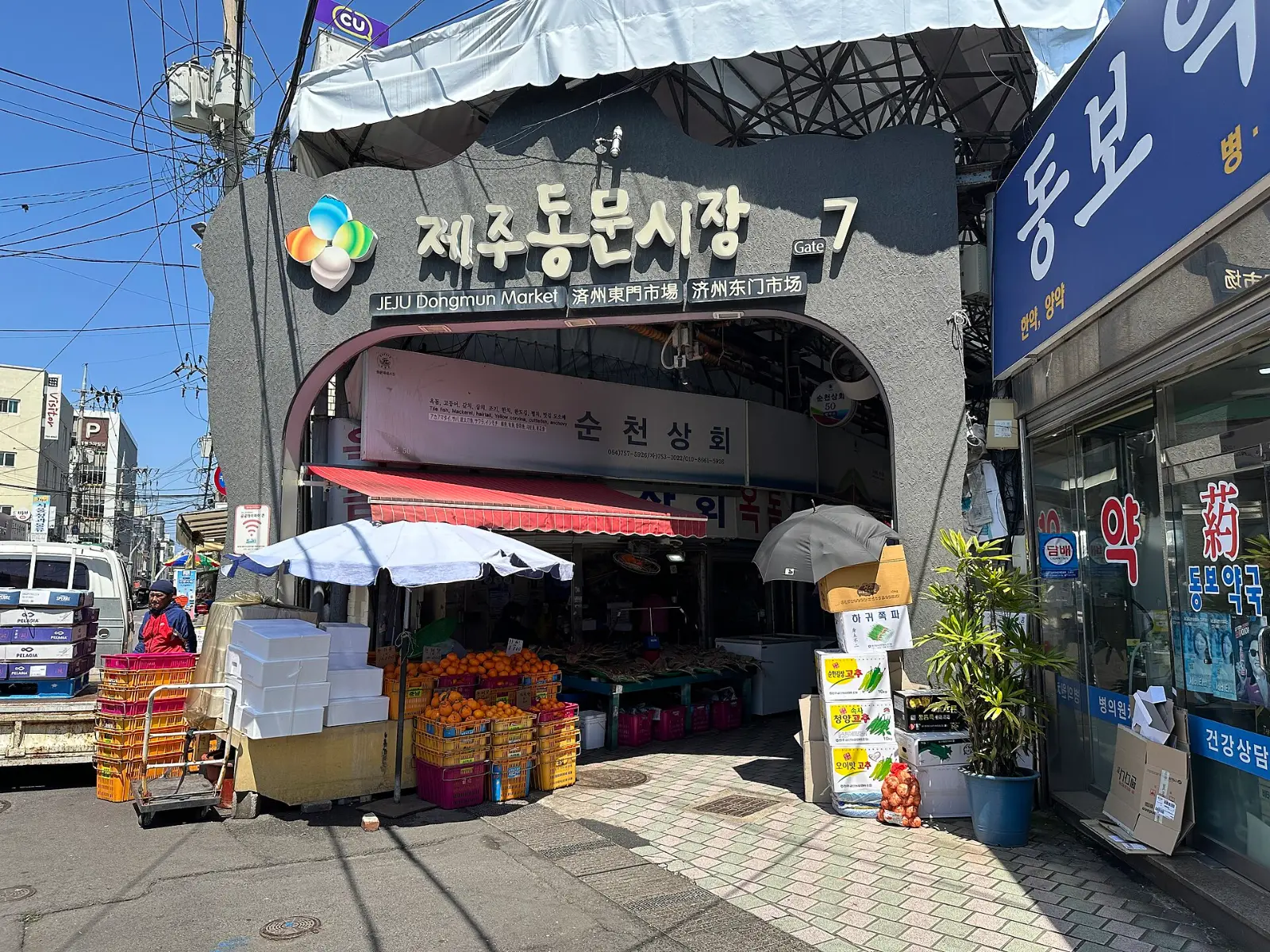
Stay in Jeju's old downtown if you are flying in for a short trip, travelling by bus, or want your evenings in a market. Dongmun Traditional Market, which VisitJeju calls the biggest permanent traditional market on the island with the longest history, trades by day and turns into a night market of local food after dark. Gwandeokjeong Hall, built in 1448 and Treasure No. 322, stands at the centre of downtown beside Jejumok-Gwana, the seat of island government from the Tamna kingdom to the Joseon dynasty. Sanjicheon Stream runs past the market to Jeju Port, and Olle Routes 17 and 18 pass through.
It is also the shortest ride from the plane. Jeju International Airport is under 3 km from Gwandeokjeong in a straight line, the closest of any base on the island, and the express network starts here: buses 181 and 182 loop between the airport, Jeju Bus Terminal and Seogwipo, 201 follows the east coast to Seongsan Ilchulbong, and 202 the west coast. The trade-off is the beach. The old town faces a working port, and the island's famous sands are a bus ride away.
Best for
- Short trips and late flights
- Travelling the island by bus
- Dongmun's night market
- Jeju history on foot
- Hallasan by the Gwaneumsa or Seongpanak trails
Think twice if
- Beach holidays
- Travellers who want a resort pool and gardens
- Sunrise at Seongsan Ilchulbong
Getting here
| Station | Lines |
|---|---|
| Jeju International Airport | Express buses 181, 182 (via Jeju Bus Terminal to Seogwipo) · 111 (Seongsan Port) · 101 (east coast) · Airport limousines 600, 800 |
| Jeju Bus Terminal | Express buses 181, 182 · 102 (west coast) · Intercity buses 201 (east coast to Seongsan Ilchulbong), 202 (west coast), 212 (Seongsan Port) · Airport limousines 800, 801 (Seogwipo) |
| Daecheon Transit Center (east) | Express buses 111, 121, 122 · Tourist shuttle 810 |
From Jeju International Airport
The airport is the closest of any base: under 3 km from Gwandeokjeong in a straight line, so a taxi is the simplest ride with luggage. VisitJeju recommends a T-money card for the buses: card fares give two free transfers within 40 minutes of getting off, and Kakao Map shows Jeju's buses in real time.
From Seoul
Fly. Jeju to Seoul Gimpo was the busiest airline route in the world in 2025, with 14.4 million seats scheduled, OAG reports. Gimpo is on AREX and Seoul Subway Lines 5 and 9, and the old town is the first stop after landing.
To the rest of the island
Jeju's express buses are red and numbered in the 100s. From the airport and Jeju Bus Terminal, 181 and 182 loop to Seogwipo, one by the 5.16 Road and one by Pyeonghwa-ro; 111 runs to Seongsan Port via Songdang; 102 follows the west coast to Moseulpo's Unjin Port. Blue intercity buses 201 and 202 take the coast roads east and west.
Getting around town
Buses start at around 06:00 and the last ones leave at around 22:00, VisitJeju says, and every bus and many stops have free Wi-Fi. The old town is compact: Dongmun Market, Gwandeokjeong, Jejumok-Gwana and Sanjicheon Stream sit within a few minutes of each other on foot.
On your doorstep
- Dongmun Traditional Market A well-established market in central Jeju City selling Jeju specialties, produce, seafood and souvenirs by day; in the evening its night market serves food made with local Jeju ingredients. VisitJeju calls it the island's biggest permanent traditional market, with the longest history.
- Dongmun Fish Market The largest fish market in Jeju, established in 1970, VisitJeju says, beside the main market.
- Gwandeokjeong Hall Built in 1448 by the Jeju moksa Sin Suk-cheong to train soldiers, and designated Treasure No. 322. Open all year, 09:00–18:00.
- Jejumok-Gwana The centre of island government from the Tamna kingdom to the Joseon dynasty, beside Gwandeokjeong; excavations from 1991 to 1998 found the remains of 30 buildings. Open all year, 09:00–18:00.
- Sanjicheon Stream Flows from the foot of Hallasan through downtown to Jeju Port, beside Dongmun Market. The stretch by the market and Chilseong-ro, where Jeju Olle Route 18 starts, is always busy.
- Samseonghyeol Shrine The three sacred holes from which, by legend, Go Eul-na, Yang Eul-na and Bu Eul-na, the founders of the Tamna kingdom, emerged. In the old downtown, open all year.
- Yongduam Rock Dragon Head Rock, a wave-carved lava formation on the coast north-east of the airport in Yongdam 2-dong. Open at all times, with free viewing.
- Iho Tewoo Beach The closest beach to Jeju City, known for its red and white pony lighthouses. At low tide you can see the wondam, stone walls the islanders built to trap fish.
One easy day from here
- Morning Gwandeokjeong and Jejumok-Gwana from their 09:00 opening, then Samseonghyeol, the shrine of Jeju's founding legend.
- Midday Dongmun Traditional Market and the fish market for lunch, then a walk along Sanjicheon Stream towards the port.
- Afternoon Yongduam Rock on the coast north-east of the airport, or Iho Tewoo Beach and its pony lighthouses for the late light.
- Evening Back to Dongmun for the night market and dinner from its stalls.
Before you book
- Stay here if you plan to see Jeju by bus: the express buses 181 and 182 call at both the airport and Jeju Bus Terminal, and 201 and 202 start at the terminal.
- Hallasan's summit needs a reservation. The Seongpanak and Gwaneumsa trails to Baengnokdam are booked through the Hallasan Trail Reservation System, visithalla.jeju.go.kr; the other trails need none.
- Book a night here before an early flight: the airport is the closest it gets, under 3 km from Gwandeokjeong.
- Landing late? Jeju City runs night buses numbered in the 3000s, and route 3001 loops from the airport through Nohyeong and Jungang-ro, the old town's main street.
- The old town is a city base, not a beach base. For swimming, plan a day at Iho Tewoo in the city or the beaches east and west along the coast buses.
Questions visitors ask
Is Jeju City a good base for a first visit?
Yes, if you travel by bus or have a short trip. The old town around Dongmun Market is under 3 km from the airport, Gwandeokjeong and Jejumok-Gwana are on foot, the night market takes care of dinner, and the express buses to Seogwipo, Seongsan and the west coast leave from the airport and Jeju Bus Terminal.
Where is the Dongmun night market?
Inside Dongmun Traditional Market in central Jeju City. The market trades by day, and in the evening its night market serves food made with local Jeju ingredients, VisitJeju says. Sanjicheon Stream runs past the market, and Tapdong Square is close by.
Can I climb Hallasan from Jeju City?
Yes. The two summit trails, Seongpanak and Gwaneumsa, start on the Jeju City side of the mountain, and both need an advance reservation for the final section to Baengnokdam, through visithalla.jeju.go.kr. At 1,950 m, Hallasan is the highest mountain in South Korea. The Eorimok and Yeongsil trails need no reservation.
Old town or Yeon-dong?
The old town for history, the market and the buses; Yeon-dong, the newer centre just south of the airport, for its shopping street, Nuwemaru, formerly Baozen Street, with restaurants, cafés, shops and hotels. Both are a short ride from the airport, and our guide covers the old town because it has the sights and the bus terminal.
Sources & review
Editorial review: · Korea Standard Time
- VISITJEJU — Dongmun Traditional Market
- VISITJEJU — Traditional Permanent Markets in Jeju City
- VISITJEJU — Gwandeokjeong Hall
- VISITJEJU — Jejumok-Gwana Government Office
- VISITJEJU — Sanjicheon Stream
- VISITJEJU — Samseonghyeol Shrine
- VISITJEJU — Yongduam Rock
- VISITJEJU — Iho Tewoo Beach
- VISITJEJU — Nuwemaru Street (formerly Baozen)
- VISITJEJU — Jeju International Airport
- VISITJEJU — Public Transportation in Jeju
- Jeju Bus Information System — Jeju bus routes and schedules
- OAG — The busiest flight routes of 2025
- VISITJEJU — Hallasan National Park