
Jeju · Where to stay
Where to stay in Jeju
제주 숙소 지역
Jeju is an island with Hallasan in the middle, and where you sleep decides which coast you wake up on. Stay in Jeju City's old town for the airport and the buses, Seogwipo for the waterfalls, Jungmun for a resort, Seongsan for the sunrise and Udo, and Hyeopjae for the west-coast beaches. Split a longer trip between two of them.
Quick pick
| Your trip | Stay in | Why |
|---|---|---|
| First visit by bus | Jeju Old Town & Dongmun Market | The express buses to every coast leave from the airport and Jeju Bus Terminal, and the old town is under 3 km from the airport. |
| Short trip or late flight | Jeju Old Town & Dongmun Market | The closest base to the airport, with Dongmun's night market for dinner. |
| Waterfalls and markets | Seogwipo Old Town | Cheonjiyeon Falls is open until 22:00, and Olle Market and Arang Joeul Street are in the centre. |
| Walking Jeju Olle | Seogwipo Old Town | Routes 6 and 7 run through the old town, past Chilsimni Park to Oedolgae. |
| Families and resort hotels | Jungmun Resort | Saekdal Beach, Yeomiji and the Teddy Bear Museum, with limousine 600 to the hotel doors. |
| Sunrise | Seongsan & Udo | Seongsan Ilchulbong opens at 04:30 from May to August, a walk from your bed. |
| Udo | Seongsan & Udo | Ferries cross from Seongsan Port in about 10 to 15 minutes. |
| Beach holiday | Hyeopjae & Hallim | Hyeopjae and Geumneung, the twin beaches, with evening swimming in high summer. |
| Sunsets | Hyeopjae & Hallim | The sun goes down behind Biyangdo, off the west coast. |
One island, two cities, one mountain
Jeju is a self-governing province of two cities: Jeju-si on the north coast, with the airport and the old capital, and Seogwipo-si on the south, with the waterfalls and the resort quarter of Jungmun. Between them rises Hallasan, at 1,950 m the highest mountain in South Korea. Around it stand some 360 oreum, the small volcanic cones that shape the island's skyline, VisitJeju says.
The island is a UNESCO listing in its own right. Hallasan, Seongsan Ilchulbong and the Geomun Oreum lava tube system were inscribed together on 27 June 2007 as Jeju Volcanic Island and Lava Tubes, Korea's first World Natural Heritage site, and Jeju was certified a Global Geopark on 4 October 2010. Seongsan Ilchulbong's sunrise has long been counted among the Ten Scenic Views of Jeju.
That geography decides where you stay. The mountain sits between the two coasts, so a base on one side puts the other a long bus ride away. Pick the coast you want to wake up on, and let the other be a day out or a second base.
Five bases, five trips
Jeju City's old town is the practical choice. The airport is under 3 km from Gwandeokjeong, Dongmun Traditional Market turns into a night market after dark, and the express buses to every coast leave from the airport and Jeju Bus Terminal. It is the best first night on the island, and the best last one before an early flight.
Seogwipo's old town is the south coast on foot. Olle Market and Arang Joeul Street feed you, Lee Jung-seop Street climbs from the market, Cheonjiyeon Falls stays open until 22:00 and Jeongbang Falls drops straight into the sea. Jungmun, just west along the same coast, is the resort quarter: Saekdal Beach, the basalt columns of Daepo Jusangjeolli, Yeomiji and the hotels on limousine 600.
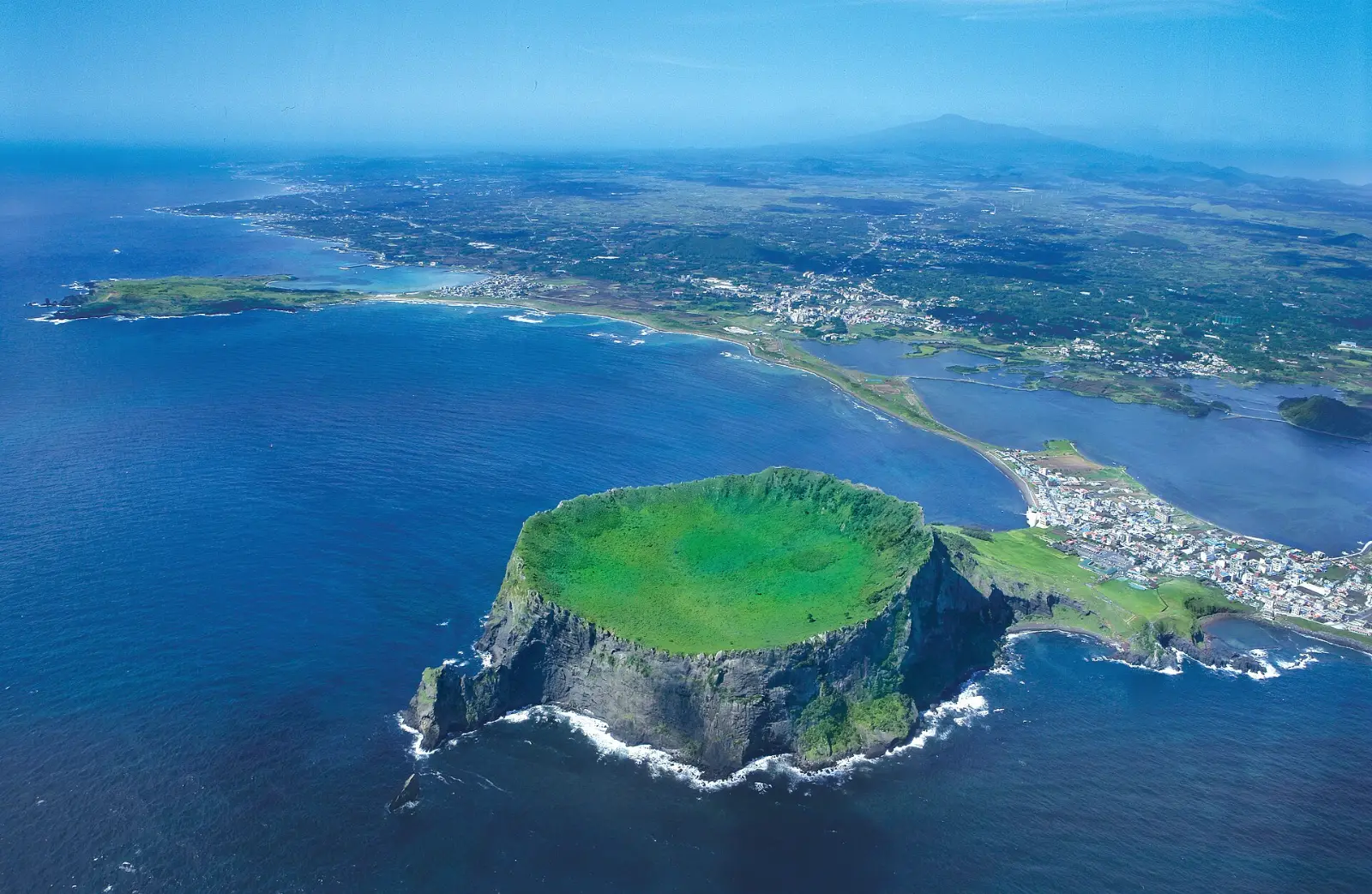
Seongsan, at the eastern tip, is for the sunrise from Seongsan Ilchulbong and the ferry to Udo. Hyeopjae and Hallim, on the west coast, are for the beaches: emerald water, Hallim Park and the sunset behind Biyangdo.
- Arrival, buses and a late flight: Jeju City's old town.
- Waterfalls, markets and Jeju Olle: Seogwipo's old town.
- Resort hotel and a family beach: Jungmun.
- Sunrise and Udo: Seongsan.
- Beach and sunsets: Hyeopjae and Hallim.
Getting to Jeju
You fly. Jeju to Seoul Gimpo was the busiest airline route in the world in 2025, with 14.4 million seats scheduled, OAG reports, so flights from Seoul are frequent through the day. Gimpo sits on AREX and Seoul Subway Lines 5 and 9.
Jeju International Airport is at 2 Gonghang-ro in Jeju City, on the north coast, with baggage storage and delivery services in the terminal, VisitJeju says. That matters for your first night: the old town is under 3 km away, while Seogwipo, Jungmun, Seongsan and Hyeopjae are each between about 27 and 41 km in a straight line, across the mountain or along the coast.
Getting around without a car
Jeju's buses reach the far corners of the island. The province rebuilt the network in 2017, and VisitJeju explains it by colour: red express buses, numbered in the 100s, link the four sides of the island and stop only at hubs and major sights; blue intercity and city buses are numbered in the 200s, 300s and 500s; green branch buses, in the 400s, 600s and 700s, serve the villages and run less often. Buses and many stops have free Wi-Fi, and Kakao Map shows the buses in real time.
Five routes carry most visitors. Airport limousine 600 runs from the airport through the Jungmun hotels to Seogwipo KAL Hotel, about 50 minutes to Jungmun and 80 to the end. Limousines 800 and 801 run from Jeju Bus Terminal and the airport to the old terminal in Seogwipo's centre, the 800 by way of Seogwipo Bus Terminal. Express buses 181 and 182 loop between the airport, Jeju Bus Terminal and Seogwipo across Hallasan, one by the 5.16 Road, the other by Pyeonghwa-ro. Express bus 111 runs from the airport to Seongsan Port, and 102 from Jeju Bus Terminal along the west coast through Hallim.
Two transit centres serve the tourist shuttles: Daecheon in the east, for the 810 through the oreums, and Donggwang in the west, for the 820 past the museums. A day pass is sold at both. Buses start at around 06:00 and the last ones leave at around 22:00, VisitJeju says, and pay by T-money card: card fares give two free transfers within 40 minutes of getting off.
Our rule: if you travel by bus, give your first night to Jeju City and choose your second base on a limousine or express route, Seogwipo's old town, Jungmun or Seongsan Port. The buses run along the coasts and across the middle, from around 06:00.
Hallasan
Two trails lead to the summit crater, Baengnokdam: Seongpanak and Gwaneumsa. Both need an advance reservation for their final sections, Jindallaebat to Baengnokdam on Seongpanak and Samgakbong to Baengnokdam on Gwaneumsa, booked through the Hallasan Trail Reservation System at visithalla.jeju.go.kr. The Eorimok, Yeongsil, Donnaeko, Eoseungsaengak and Seokguram trails, and the lower sections of the two summit trails, need no reservation.
Both summit trails start on the Jeju City side of the mountain, which makes the old town the base for a Hallasan day. Book the trail first, then the room.
Beaches, seasons and dates
Summer is beach season. In 2026 Jeju's supervised season at Hamdeok, Hyeopjae and Geumneung ran from 24 June to 6 September, 10:00–19:00, and Hyeopjae added evening swimming until 21:00 from 15 July to 15 August. Hamdeok, on the north-east coast beside the Seoubong cone, became in 2025 the first beach on Jeju to let visitors swim with their dogs, in a designated zone.
Spring belongs to the east: canola flowers light up Seopjikoji and Gwangchigi Beach, with Seongsan Ilchulbong behind them. Two closures to plan around: Seongsan Ilchulbong and the Jeju Haenyeo Museum both close on the first Monday of each month.
Jeju also carries the memory of the April 3rd Incident. VisitJeju marks its sites across the island, among them the Cheonjeyeon car park in Jungmun, where 36 residents of Jungmun-myeon were killed on 4 January 1949, and the Teojinmok area at Seongsan Ilchulbong.
How many nights
Give Jeju at least three nights, and two bases if you are on the buses. The mountain stands between the north and south coasts, and the sunrise at Seongsan and the sunset at Hyeopjae are at opposite ends of the island.
Our rule: one or two nights in Jeju City for the arrival and the market, then two on the south coast, in Seogwipo for the waterfalls or Jungmun for the beach. Add a night in Seongsan for the sunrise and Udo, or on the west coast for the beaches in summer.
Every Jeju area guide
- Jeju Old Town & Dongmun MarketDongmun's night market, Gwandeokjeong and the express buses, under 3 km from the airport.
- Seogwipo Old TownOlle Market, Cheonjiyeon Falls open until 22:00 and Jeongbang falling into the sea.
- Jungmun ResortJeju's resort quarter: Saekdal Beach, the columnar cliffs and the 600 from the airport.
- Seongsan & UdoSunrise from Seongsan Ilchulbong, then the 10-minute ferry to Udo.
- Hyeopjae & HallimEmerald water at Hyeopjae, Biyangdo offshore and Hallim Park next door.
Questions visitors ask
Where should I stay in Jeju for the first time?
Start in Jeju City's old town, around Dongmun Market. It is under 3 km from the airport, the express buses to every coast leave from the airport and Jeju Bus Terminal, and the night market takes care of dinner. Then move to the south coast, Seogwipo's old town or Jungmun, for the rest of the trip.
Jeju City or Seogwipo?
Jeju City for the airport, the buses and a short trip; Seogwipo for the waterfalls, Olle Market and the south coast. With three nights or more, stay in both: limousines 800 and 801 link the airport with Seogwipo's old terminal, and express buses 181 and 182 cross the mountain between them.
Can I visit Jeju without a car?
Yes. VisitJeju calls the bus network one that reaches into the far corners of the island. Airport limousine 600 serves Jungmun and Seogwipo, limousines 800 and 801 Seogwipo's centre, express bus 111 Seongsan Port and 102 the west coast. Choose a base on one of those routes.
Where should I stay for the Seongsan Ilchulbong sunrise?
In Seongsan, within walking distance of the peak. The gate opens at 04:30 from May to August, 05:00 in spring and autumn and 06:00 in winter, earlier than Jeju's buses generally start, and the climb takes 30 to 40 minutes.
Do I need to book to climb Hallasan?
Yes, for the summit. The final sections of the Seongpanak and Gwaneumsa trails to Baengnokdam need an advance reservation through visithalla.jeju.go.kr. The other trails, including Eorimok and Yeongsil, need none.
Sources & review
Editorial review: · Korea Standard Time
- VISITJEJU — Public Transportation in Jeju
- Jeju Bus Information System — Jeju bus routes and schedules
- Jeju Bus Information System — Airport limousines 600 and 800
- OAG — The busiest flight routes of 2025
- VISITJEJU — Jeju International Airport
- VISITJEJU — Hallasan National Park
- VISITJEJU — Dongmun Traditional Market
- VISITJEJU — Seogwipo Maeil Olle Market
- VISITJEJU — Cheonjiyeon Falls
- VISITJEJU — Jeongbangpokpo Falls
- VISITJEJU — Jungmun Tourist Complex
- VISITJEJU — Daepo Jusangjeolli Cliff
- VISITJEJU — Seongsan Ilchulbong
- VISITJEJU — Udo Island (Maritime Park)
- VISITJEJU — Hyeopjae Beach
- VISITJEJU — Geumneung Beach
- VISITJEJU — Hamdeok Beach (Hamdeok Seoubong Beach)
- VISITJEJU — Seopjikoji
- VISITJEJU — Gwangchigi Beach
- VISITJEJU — Jeju Haenyeo Museum
- VISITJEJU — Cheonjeyeon Waterfall & Jeju April 3rd Jungmun-myeon site
- VISITJEJU — Biyangdo Island