
Sokcho · Area guide
Seorak-dong
설악동
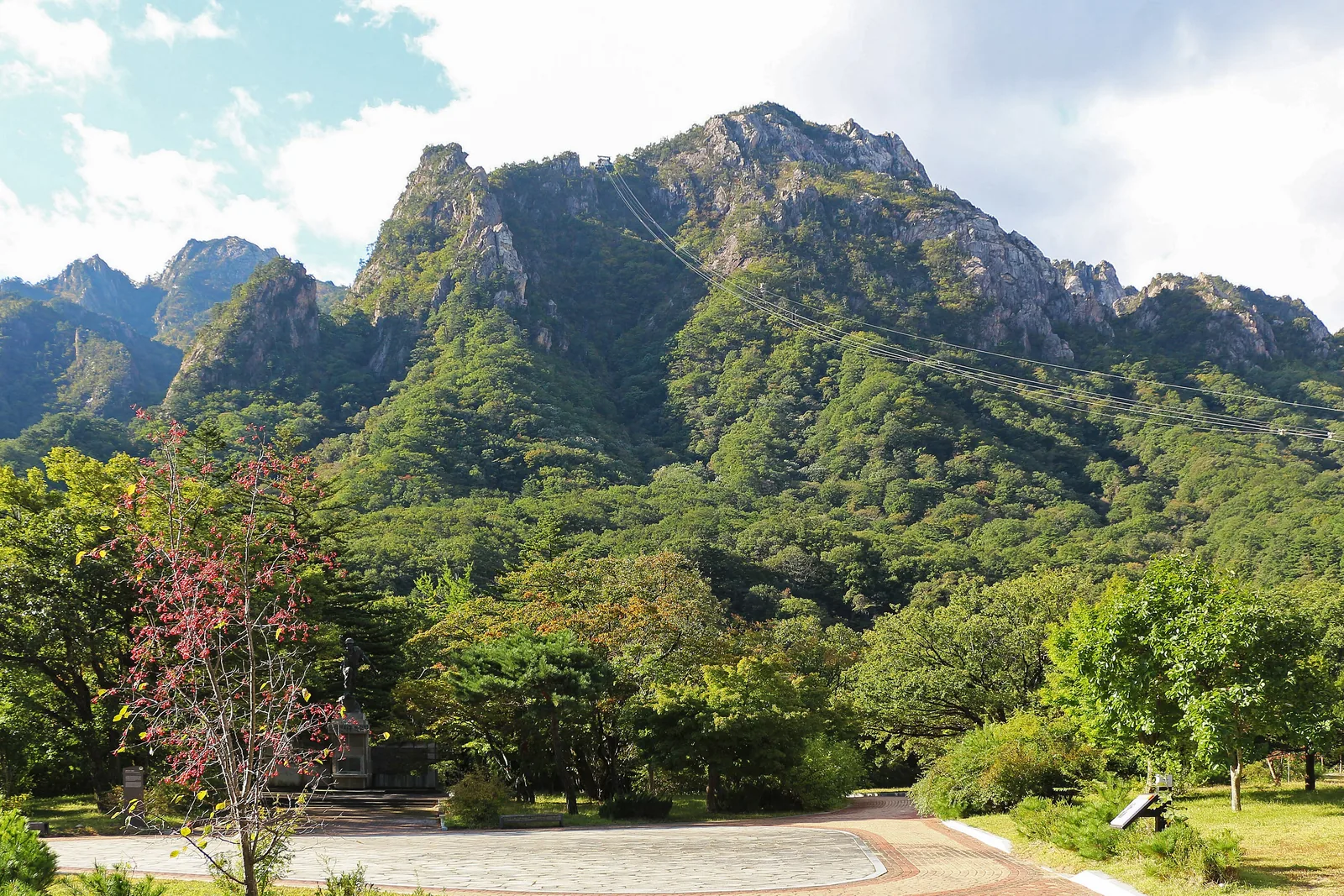
The Sogongwon gate to Seoraksan: Sinheungsa, the cable car and Ulsanbawi at first light.
The short answer
Stay in Seorak-dong to wake up at the foot of Seoraksan. This is the park's Sogongwon entrance, at 1055 Seoraksan-ro, which KTO gives as the starting point for both the Ulsanbawi and Daecheongbong trails. The trail to Ulsanbawi's six rock peaks passes Sinheungsa, founded as Hyangseongsa by the monk Jajang in 652; the cable car climbs to the Goryeo stone fortress of Gwongeumseong in about 10 minutes; and the paths run on to Biryong Falls and Biseondae. KTO calls Seoraksan Korea's first UNESCO Biosphere Reserve, named in 1982, and it has been a national park since 1970.
The reason to sleep here rather than downtown is time. KTO lists the park's entry hours as 03:00–14:00 in summer and 04:00–12:00 in winter, and its 2024 guide gives the Daecheongbong trail as 16 km and 10 hours. A night at the gate gives you the early start that long days need. City buses 7 and 7-1 run here from Sokcho Intercity Bus Terminal (KTO, September 2024).
Best for
- Hiking Ulsanbawi, Biseondae or Daecheongbong
- Pre-dawn starts on the long trails
- Autumn foliage in October
- Sinheungsa and the cable car to Gwongeumseong
- The waterfall walk to Biryong Falls
Think twice if
- Beach days and the Sokcho Summer Festival
- Harbour seafood evenings at Dongmyeong Port
- A trip without hiking
Getting here
| Station | Lines |
|---|---|
| Seoraksan Sogongwon Park stop | City buses 7 and 7-1 from Sokcho Intercity Bus Terminal (KTO, September 2024) |
| Sokcho Intercity Bus Terminal | Start of buses 7 and 7-1 to Sogongwon; about 5 min on foot from the Tourist & Fishery Market (KTO, 2023) |
| Sokcho Express Bus Terminal | Express buses from Seoul Express Bus Terminal (about 2 h 20 min) and Dong Seoul Terminal (about 2 h 30 min), KTO's November 2021 figures |
| Seoraksan Cable Car | From its station inside the park at 1085 Seoraksan-ro to Gwongeumseong Fortress in about 10 min; return tickets only, with each day's hours announced on its website the day before (KTO) |
From Seoul
Take an express bus from Seoul Express Bus Terminal or Dong Seoul Terminal; KTO's Korean article of November 2021 gives about 2 hours 20 minutes and 2 hours 30 minutes to Sokcho Express Bus Terminal. For Seorak-dong, take city bus 7 or 7-1 from Sokcho Intercity Bus Terminal to the Seoraksan Sogongwon Park stop (KTO, 2024). The intercity terminal is about 5 minutes on foot from the market, and the market about 15 from the express terminal (KTO, 2023).
From Yangyang Airport
KTO's 2026 guides give 30 to 40 minutes from the airport to Sokcho by intercity bus and about 30 minutes by taxi. From Sokcho Intercity Bus Terminal, city buses 7 and 7-1 run to the Seoraksan Sogongwon Park stop (KTO, 2024).
From downtown Sokcho
City bus 7 or 7-1 from Sokcho Intercity Bus Terminal to the Seoraksan Sogongwon Park stop, KTO's September 2024 national parks guide says, for both the Ulsanbawi and Daecheongbong trails. The terminal is about 5 minutes on foot from the Tourist & Fishery Market (KTO, 2023).
By car
Come up Seoraksan-ro to the park; KTO lists parking at the park, with fees that change by season. KTO's Korean guide of November 2023 puts the cable car 8.1 km, about 13 minutes, by car from the Sokcho City Museum.
On your doorstep
- Sinheungsa Temple Founded as Hyangseongsa by the monk Jajang in the Silla dynasty, in 652, KTO says. Its heritage includes Geungnakbojeon Hall, a wooden building from the mid-Joseon period, and the three-storey stone pagoda at the Hyangseongsa Temple site. It is at 1137 Seoraksan-ro, on the trail to Ulsanbawi.
- Seoraksan Cable Car and Gwongeumseong The cable car connects Sinheungsa and Gwongeumseong Fortress, a stone fortress from the Goryeo dynasty, in about 10 minutes. KTO says one-way tickets are not sold and the hours are announced on its website the day before.
- Ulsanbawi Rock Six massive rock peaks, each reaching about 900 m, named for the way they spread out like a fence. KTO's 2025 guide gives the route from Sogongwon as 3.8 km and about two hours each way, past Sinheungsa and Heundeulbawi Rock; its 2024 guide gives the loop back to Sogongwon as 7.6 km and 4 hours.
- Biryongpokpo Falls A 16 m waterfall 2.4 km south of the Sogongwon ticket booth, about an hour's walk. KTO gives about 3 hours for the round trip taking in Towangseong Falls and Yukdam Falls.
- Biseondae and Daecheongbong Daecheongbong, at 1,708 m, is the third-highest peak in Korea, KTO says. Its 2024 guide gives the Daecheongbong trail as 16 km and 10 hours, from Sogongwon by Biseondae and Huiungak Shelter to the summit and down to Osaek; Sogongwon to Biseondae stays open during the fire-prevention closures (KTO, 2024).
- Cheoksan Hot Springs Zone A village in Nohak-dong that KTO describes as dedicated to hot spring tourism, with views of the snow-capped Seoraksan.
- Sokcho City Museum Home to the Displaced People's Culture Village, which recreates the Cheongho-dong alleys where refugees from the North lived after the war, and the old Sokcho Station building, demolished in 1978. Open 09:00–18:00 from March to October and 09:00–17:00 from November to February; closed on Mondays and 1 January. KTO puts it 8.1 km, about 13 minutes by car, from the cable car.
- Downtown Sokcho The beach, the Tourist & Fishery Market and Dongmyeong Port are the other half of Sokcho. Buses 7 and 7-1 start at the intercity terminal, about 5 minutes on foot from the market (KTO, 2023).
One easy day from here
- Early morning Through the Sogongwon entrance once it opens (03:00 in summer, 04:00 in winter, KTO) and up to Ulsanbawi past Sinheungsa and Heundeulbawi Rock: about two hours each way by KTO's 2025 figure.
- Late morning Back down to Sogongwon, with Sinheungsa's Geungnakbojeon Hall on the way.
- Afternoon The cable car to Gwongeumseong, about 10 minutes up, with that day's hours posted on its website the day before; or the walk to Biryong Falls, about an hour each way from the ticket booth.
- Evening A soak in the Cheoksan Hot Springs Zone in Nohak-dong, then an early night for the next day's trail.
Before you book
- October is the peak. The Korea Meteorological Administration recorded Seoraksan's first autumn colour on 28 September 2026, the normal date, and the normal peak is 17 October. Book October weekends well ahead.
- Plan long ridge walks around the fire-prevention closures. KTO's 2024 guide gives them as 2 March to 15 May and 15 November to 15 December, when the upper Biseondae–Daecheongbong section closes and Sogongwon to Biseondae stays open. In spring 2025 (4 March to 15 May), the park service kept Sogongwon to Ulsanbawi and Sogongwon to Biseondae open as well.
- Entry hours set the day. KTO lists 03:00–14:00 in summer and 04:00–12:00 in winter, so a 10-hour Daecheongbong crossing starts before dawn: exactly why you sleep at the gate.
- The cable car runs to a daily timetable announced on its website the day before, and sells return tickets only (KTO). Keep the afternoon flexible.
Questions visitors ask
How do I get to Seoraksan from Sokcho by bus?
Take city bus 7 or 7-1 from Sokcho Intercity Bus Terminal and get off at the Seoraksan Sogongwon Park stop, KTO's September 2024 national parks guide says. That stop is the starting point for both the Ulsanbawi and Daecheongbong trails, at 1055 Seoraksan-ro. The intercity terminal is about 5 minutes on foot from the Tourist & Fishery Market.
How long is the Ulsanbawi hike?
KTO's 2025 guide gives the route from Sogongwon as 3.8 km and about two hours each way, past Sinheungsa and Heundeulbawi Rock. Its 2024 guide gives the full loop, Sogongwon to Ulsanbawi and back by Sinheungsa and Heundeulbawi, as 7.6 km and 4 hours. Start early: KTO lists entry from 03:00 in summer and 04:00 in winter.
Are Seoraksan's trails closed in spring and autumn?
The upper trails are. KTO's 2024 guide gives the fire-prevention closures as 2 March to 15 May and 15 November to 15 December; the Biseondae–Daecheongbong section shuts and Sogongwon to Biseondae stays open. In spring 2025 (4 March to 15 May), the park service also kept Sogongwon to Ulsanbawi open, so Seorak-dong's short walks stayed open through that closure.
When is the autumn foliage at Seoraksan?
It starts in late September and peaks in mid-October. The Korea Meteorological Administration recorded Seoraksan's first autumn colour on 28 September 2026, the same as the normal date, and gives the normal peak as 17 October. Stay in Seorak-dong for the early trails in those weeks, and book ahead.
Sources & review
Editorial review: · Korea Standard Time
- VISITKOREA — Seoraksan National Park
- VISITKOREA — Reach New Heights with Korea's National Parks! (2024)
- VISITKOREA LuxuryKorea — Seoraksan (2025)
- VISITKOREA — Sinheungsa Temple
- VISITKOREA — Seoraksan Cable Car
- VISITKOREA — Seoraksan course
- VISITKOREA — Gwongeumseong Fortress
- VISITKOREA — Ulsanbawi Rock
- VISITKOREA — Biryongpokpo Falls
- VISITKOREA — Cheoksan Hot Springs Zone
- VISITKOREA Accessible Travel (Korean) — Sokcho City Museum
- VISITKOREA (Korean) — Abai Village and Seoraksan guide (November 2023)
- VISITKOREA (Korean) — Sokcho travel guide (November 2021)
- VISITKOREA — Express Bus & Intercity Bus (updated 2026)
- VISITKOREA — Sokcho Tourism and Fisheries Market (2023)
- VISITKOREA — International Flights (2026)
- VISITKOREA — Airport Transportation Guide (2026)
- Korea National Park Service — Seoraksan spring 2025 trail closures
- Korea Meteorological Administration — Seoraksan first foliage (2026)
- Ministry of Foreign Affairs — UNESCO Man and the Biosphere