
Gongju · Where to stay
Where to stay in Gongju
공주 숙소 지역
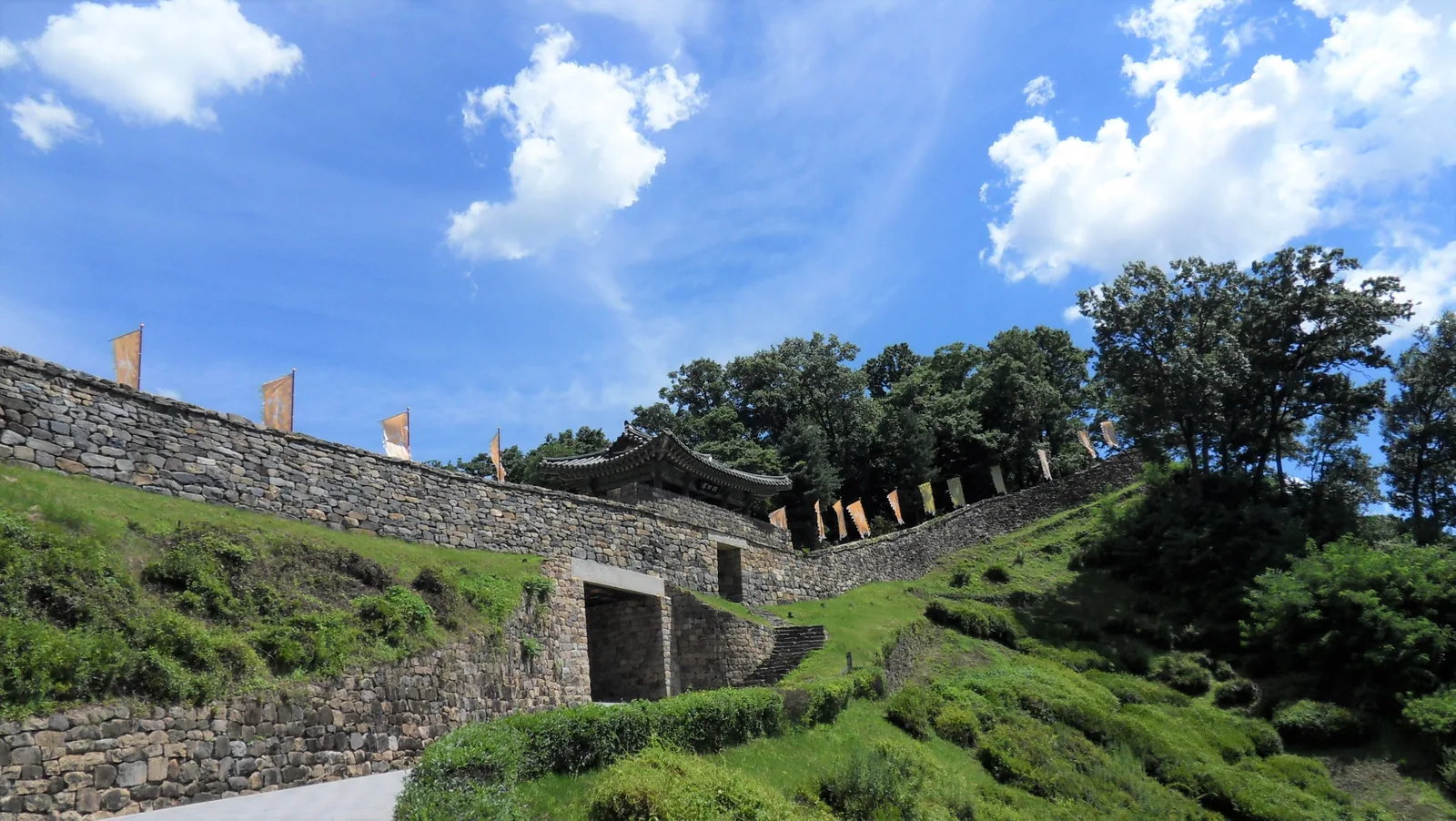
Gongju was Baekje's capital from 475 to 538, and its old town still holds that capital: Gongsanseong Fortress and the Royal Tombs of King Muryeong, both World Heritage since 2015, with Gongju National Museum, the Hanok Village and Sanseong Market's night market close by. The answer to where to stay is simple: the old town. Here is why, and how to get there.
Quick pick
| Your trip | Stay in | Why |
|---|---|---|
| First visit to the Baekje sites | Gongju Old Town | Gongsanseong, the Royal Tombs of King Muryeong and Gongju National Museum are all in the old town. |
| Travelling without a car | Gongju Old Town | Express buses run from Seoul's Central terminal every 30 minutes (Gongju City), and city bus 108 runs direct from the terminal to Gongju National Museum (museum directions). |
| Arriving by KTX | Gongju Old Town | Gongju Station is outside town, so ride city bus 201, 202, 250 or 251 in (Gongju City's 2025 timetable) and sleep in the old town rather than by the tracks. |
| Evenings out | Gongju Old Town | Sanseong Market's night market, Jemincheon Stream and the Geumgang, which Gongju City calls especially striking at sunset. |
| Gongju and Buyeo together | Gongju Old Town | The wide-area bus to Buyeo leaves Gongju Bus Terminal four times a day and takes about 50 minutes by Gongju City's timetable. |
| Festival week | Gongju Old Town | In 2026 the Baekje Cultural Festival ran from 3 to 11 October at Geumgang Singwan Park, Mirseom and Gongsanseong. |
Why stay the night in Gongju
Gongju was Baekje's Ungjin capital. VisitKorea writes that Gongsanseong Fortress sits in central Gongju, which was the capital from 475 to 538 (Gongju City notes the city was then called Ungjin), and that Silla, Goryeo and Joseon all kept Gongju as a regional centre, so historic sites built up there over the centuries. UNESCO's Baekje Historic Areas, inscribed in 2015 by decision 39 COM 8B.16, include two components in Gongju: Gongsanseong Fortress and the royal tombs at Songsan-ri, which Gongju City's tomb page and VisitKorea call the Tomb of King Muryeong and Royal Tombs. UNESCO says the property represents the later period of the Baekje Kingdom, which lasted 700 years, from 18 BCE to 660 CE.
Day-trippers see the fortress and the tombs and leave. Stay the night and Gongju opens up. You can walk the fortress wall at its 09:00 opening and take in the views over the city centre and the Geumgang, then follow VisitKorea's official Gongju course from the Royal Tombs through the Baekje Experience Center, the Hanok Village and Gongju National Museum to Sanseong Market, approximately 3.3 km in all. In the evening there is the night market at Sanseong Market, which VisitKorea calls Gongju's own, and the Geumgang River, which Gongju City says is especially striking at dawn and sunset.
Gongju is also the natural partner for Buyeo, the later Sabi capital. A wide-area tourism bus links the two bus terminals four times a day, by Gongju City's timetable, and in 2026 the Baekje Cultural Festival was held in both cities on the same dates. Two nights, one in each town, is a good shape for a Baekje trip.
The base: Gongju Old Town
Stay in the old town. It holds everything a visitor comes for: Gongsanseong Fortress, the Royal Tombs of King Muryeong at Songsan-ri, Gongju National Museum, Gongju Hanok Village and Jemincheon Stream, which Gongju City says flows through the downtown area before joining the Geumgang in Geumseong-dong. VisitKorea's course ties the tombs, the museum and the market together in approximately 3.3 km, and Gongsanseong looks down over the centre.
The two transport hubs are not in the old town. KTX Gongju Station is outside town, linked by city buses 200 to 202, 250 and 251 (Gongju City's 2025 timetable). Gongju Bus Terminal is apart from the old town too: Gongju National Museum's own directions give about 15 minutes by taxi from the terminal, against about 5 minutes from the Sanseong-dong intercity bus stop. Neither is a place to stay. Arrive, ride in, and sleep where the sights are.
Gongju Hanok Village, a modern hanok complex of pine and cedar with ondol heating, is a landmark of the old town in its own right. VisitKorea lists Baekje history, pottery and hanji craft programmes there, it has guest rooms of its own, and Gongju City lists its winter chestnut festival in front of it.
One night covers the fortress, the tombs and the museum at an easy pace. Add a second for Magoksa Temple on Taehwasan, outside the old town, or move on to Buyeo for the Sabi-capital sites.
- Gongju Old Town: Gongsanseong, the Royal Tombs, the National Museum, the Hanok Village, Sanseong Market and Jemincheon Stream.
- Gongju Bus Terminal: express buses from Seoul and the wide-area bus to Buyeo (Gongju City); city bus 108 to the museum (museum directions).
- Gongju Station: KTX from Yongsan and SRT to Suseo, outside town; city buses 200 to 202, 250 and 251 (Gongju City, 2025).
Getting to Gongju
From Seoul, the express bus is the simplest way in. Gongju City gives about 1 hour 30 minutes from Seoul Express Bus Terminal (Central) to Gongju Bus Terminal, with buses every 30 minutes, and 1 hour 30 minutes to 2 hours 30 minutes from Nambu Terminal, also every 30 minutes. From the terminal, by the museum's own directions, city bus 108 runs direct to Gongju National Museum and bus 125 stops at the arts centre, about 800 m from the museum on foot; bus 200 runs via Gongsanseong on holidays, by Gongju City's 2025 timetable.
By rail, KTX trains run from Yongsan to Gongju Station in 58 minutes to 1 hour 9 minutes, Gongju City says. Its station timetable, dated 30 December 2025, has the first southbound KTX leaving Yongsan at 05:08 and reaching Gongju at 06:12. SRT trains stop too: the timetable has a late train from Gongju at 22:50 reaching Suseo at 23:51. Gongju Station is outside town, and Gongju City's 2025 timetable lists these city buses from it into town: 201 direct to Sanseong-dong; 202 to Sanseong-dong and on to the Tancheon industrial complex; 250 and 251 to Sanseong-dong via Iin, with 251 a loop; and 200 to Gongju Bus Terminal via Gongsanseong and City Hall, on holidays only and not at Seollal or Chuseok. Gongju City's directions page gives the bus leg into Gongju as 60 minutes.
From Incheon Airport, Gongju City lists airport bus services for Gongju Bus Terminal and Incheon Airport's Terminals 1 and 2, with their phone numbers. The alternative is AREX into Seoul, about 43 minutes on the express train from Terminal 1 to Seoul Station and 51 from Terminal 2 by VisitKorea's May 2026 figures, then the express bus from the Central terminal.
- Seoul (Central) to Gongju Bus Terminal by express bus: about 1 h 30 min, every 30 min (Gongju City).
- Seoul (Nambu) to Gongju: 1 h 30 min to 2 h 30 min, every 30 min (Gongju City).
- Yongsan to Gongju Station by KTX: 58 min to 1 h 9 min (Gongju City); first train 05:08, arriving 06:12 (timetable dated 30 December 2025).
- Gongju Station to town: city buses 200 (holidays only), 201, 202, 250 and 251 (Gongju City's 2025 timetable); Gongju City gives 60 minutes.
- Incheon Airport: airport buses listed by Gongju City for Gongju Bus Terminal; or AREX to Seoul Station, about 43 min from Terminal 1 (VisitKorea, May 2026).
The sights: Baekje's Ungjin capital
Gongsanseong Fortress is the place to start. Gongju City gives the wall as about 2,660 m long, mostly stone, with a 735 m earthen section on the east side, much of it rebuilt after the Joseon period, and notes the royal palace site in front of Ssangsujeong Pavilion, overlooking the Songsan-ri tombs. VisitKorea lists it as open 09:00–18:00 from March to October and 09:00–17:00 from November to February, with last entry 30 minutes before closing, and closed on New Year's Day, Seollal and Chuseok.
The Royal Tombs of King Muryeong at Songsan-ri are Historic Site No. 13, with seven restored tombs. King Muryeong's tomb, the resting place of the 25th Baekje king and his queen, was discovered by chance in 1971 during drainage work near Tombs 5 and 6, and Gongju City says it held about 4,600 artefacts, 12 of them National Treasures. VisitKorea calls it the only royal tomb in Korea that keeps its appearance from 1,500 years ago, and its 2019 Gongju article describes a restored exhibit that lets you see inside.
Gongju National Museum, which VisitKorea says showcases significant artefacts unearthed in Chungcheongnam-do, is open 09:00–18:00, weekends and holidays included, and closed on Mondays (or the next weekday when Monday is a holiday), 1 January, Seollal and Chuseok; its Saturday night opening is suspended. Between the tombs and the museum, VisitKorea's course takes in the Baekje Experience Center, for hands-on activities with Baekje's heritage, and Gongju Hanok Village, with its history, pottery and hanji programmes.
Sanseong Market ends the course. VisitKorea describes Gongju's own night market there, with local food and cultural performances, and its 2024 guide to Chungcheongnam-do's markets calls it Bammasil and points to local chestnut products. Jemincheon Stream, restored as an ecological stream with trails, green space and rest areas, is open all year and makes the evening walk through town.
Outside the old town, Magoksa Temple on Taehwasan was founded in the 9th century and restored in the 18th after damage in the Imjin War, and keeps a 14th-century five-storey stone pagoda. Gongju City lists it in its UNESCO section as one of seven Sansa, Buddhist mountain monasteries.
Seasons and festivals
Gongju's festivals run through the year, by Gongju City's list. The big one is the Baekje Cultural Festival, first held in 1955 and free to attend, VisitKorea says. In 2026 the 72nd festival ran for nine days, from Saturday 3 to Sunday 11 October, at Geumgang Singwan Park, Mirseom Island, Gongsanseong and the old royal-capital area around them, with Buyeo holding its side of the festival on the same dates.
Winter brings the Winter Gongju Roasted Chestnut Festival, which Gongju City places around Goma, in front of Gongju Hanok Village. Summer has the Geumgang Summer Festival around the Goma Center, and spring has Magoksa's Fresh Verdure Festival.
Plan around the hours. Gongsanseong closes an hour earlier from November to February, at 17:00, and the National Museum closes on Mondays all year, so make a Monday a day for Gongsanseong, not the museum.
- Spring: the Fresh Verdure Festival at Magoksa Temple.
- Summer: the Geumgang Summer Festival around the Goma Center.
- Autumn: the Baekje Cultural Festival; in 2026 it ran from 3 to 11 October at Geumgang Singwan Park, Mirseom and Gongsanseong.
- Winter: the Winter Gongju Roasted Chestnut Festival in front of Gongju Hanok Village; Gongsanseong closes at 17:00 from November to February.
One day in the old town
Start at Gongsanseong Fortress when it opens at 09:00. Walk a stretch of the wall for the views over the city centre and the Geumgang, and look for the royal palace site in front of Ssangsujeong Pavilion, which Gongju City says overlooks the Songsan-ri tombs.
Late morning, go to the Royal Tombs of King Muryeong, the first stop on VisitKorea's Gongju course, and see the restored tomb exhibit. Then follow the course on through the Baekje Experience Center and Gongju Hanok Village to Gongju National Museum, which is open until 18:00 and closed on Mondays. The whole course, from the tombs to Sanseong Market, is approximately 3.3 km by VisitKorea's figure.
In the evening, walk along Jemincheon Stream, which Gongju City says flows through the downtown area, and end at Sanseong Market for the night market's local food and performances. If the day allows, catch the Geumgang at sunset, the time of day Gongju City singles out. The next morning, take the 09:20 or 11:10 wide-area bus to Buyeo (Gongju City's timetable), or the express bus back to Seoul.
Onward to Buyeo
Buyeo, Baekje's capital from 538 to 660 under the name Sabi, holds the rest of the story: Busosanseong and the Gwanbuk-ri site, the Jeongnimsa Temple Site, the royal tombs in Neungsan-ri and the Naseong city wall, all Baekje Historic Areas components. The wide-area tourism bus leaves Gongju Bus Terminal from platform 1 at 09:20, 11:10, 15:20 and 17:10 and reaches Buyeo Intercity Bus Terminal at 10:10, 12:00, 16:10 and 18:00 by Gongju City's timetable, about 50 minutes; northbound buses leave Buyeo at 05:10, 11:10, 13:00 and 19:00. Take the morning bus after a night in Gongju and you reach Buyeo in time for Busosanseong. See our Buyeo guide for where to stay there.
Every Gongju area guide
- Gongju Old TownBaekje's Ungjin capital: Gongsanseong, the royal tombs and the museum in one old town.
Questions visitors ask
Where should I stay in Gongju?
In the old town. Gongsanseong Fortress, the Royal Tombs of King Muryeong, Gongju National Museum, the Hanok Village and Sanseong Market are all there, and VisitKorea's course links the tombs, the museum and the market in approximately 3.3 km. Gongju Station and the bus terminal are outside the old town, so ride in and sleep where the sights are.
Is it better to arrive in Gongju by bus or by KTX?
By express bus for most trips. Buses from Seoul's Central terminal reach Gongju Bus Terminal in about 1 hour 30 minutes, every 30 minutes, Gongju City says. The KTX from Yongsan is faster to Gongju Station, at 58 minutes to 1 hour 9 minutes, but the station is outside town and Gongju City gives the city-bus leg in as 60 minutes.
How many nights do I need in Gongju?
One night covers Gongsanseong at opening time, the Royal Tombs, the National Museum and an evening at Sanseong Market. Add a second for Magoksa Temple, or move on to Buyeo by the wide-area bus, about 50 minutes by Gongju City's timetable.
Is Gongju a UNESCO World Heritage site?
Two of its sites are. Gongsanseong Fortress and the royal tombs at Songsan-ri are components of the Baekje Historic Areas, inscribed by UNESCO in 2015, and Gongju City ties them to Ungjin, Gongju's name as Baekje's capital from 475 to 538.
When is the Baekje Cultural Festival?
In 2026 the 72nd festival ran from 3 to 11 October, in Gongju at Geumgang Singwan Park, Mirseom and Gongsanseong, and in Buyeo on the same dates. Stay in Gongju's old town for the festival venues.
Sources & review
Editorial review: · Korea Standard Time
- UNESCO World Heritage Centre — Baekje Historic Areas
- UNESCO World Heritage Centre — Decision 39 COM 8B.16
- Gongju City — World Heritage: Baekje Historic Areas
- VISITKOREA — Gongsanseong Fortress
- Gongju City — Gongsanseong Fortress
- Gongju City — Royal Tombs in Songsan-ri
- Gongju City (Vietnamese) — Tomb of King Muryeong and Royal Tombs
- VISITKOREA (Korean) — Gongju travel article (2019)
- VISITKOREA — Gatsaeng Tour in Gongju, the city of Baekje
- Gongju National Museum — Visitor information
- Gongju National Museum — Directions
- Gongju City — Jemincheon Stream
- VISITKOREA — Gongju Hanok Village
- VISITKOREA — Chungcheongnam-do traditional markets (2024)
- Gongju City — Top 10 sights
- Gongju City — Magoksa Temple
- Gongju City — Festivals
- Baekje Cultural Festival — 72nd festival, Gongju (2026)
- VISITKOREA — Baekje Cultural Festival
- Gongju City — Directions
- Gongju City (Korean) — KTX Gongju Station timetable (December 2025)
- Gongju City (Korean) — City buses for KTX Gongju Station
- Gongju City (Korean) — Wide-area tourism bus timetable
- Gongju City — Transportation information
- VISITKOREA — Getting from Incheon Airport (2026)
- VISITKOREA — Neungsan-ri Ancient Tombs