
Buyeo · Where to stay
Where to stay in Buyeo
부여 숙소 지역
Buyeo was Sabi, Baekje's last capital, from 538 to 660, and four World Heritage components from that capital stand in and around its town, Buyeo-eup: Busosanseong and the Gwanbuk-ri site, the Jeongnimsa Temple Site, the Neungsan-ri tombs and the Naseong wall. Stay in Buyeo-eup, close to the bus terminal and the lit pagoda. Here is the reasoning, and how to get there.
Quick pick
| Your trip | Stay in | Why |
|---|---|---|
| First visit to the Baekje sites | Buyeo-eup | VisitKorea gives Buyeo-eup addresses for Busosanseong, the Jeongnimsa Temple Site, the Neungsan-ri tombs and Buyeo National Museum. |
| Night sights | Buyeo-eup | The Jeongnimsa pagoda is lit until 22:00 from March to October, and Gungnamji's bridges and pavilion are lit after dark. |
| Travelling without a car | Buyeo-eup | Gungnamji is about 12 minutes on foot from Buyeo Intercity Bus Terminal, and the temple site a little over 10 minutes from the pond (VisitKorea, 2025). |
| Lotus season | Buyeo-eup | Water lilies in June and lotus in July at Gungnamji, home of the Seodong Lotus Festival each July. |
| Families with pushchairs | Buyeo-eup | VisitKorea says most paths on Busosanseong's Nakhwaam to Goransa course take wheelchairs and pushchairs. |
| Gongju and Buyeo together | Buyeo-eup | The wide-area bus links Buyeo and Gongju bus terminals four times a day each way, about 50 minutes by Gongju City's timetable. |
Why stay the night in Buyeo
Buyeo is where Baekje ended. UNESCO's Baekje Historic Areas, inscribed in 2015, cover the remains of the kingdom's later capitals, and UNESCO lists four components from the Sabi capital, Buyeo: the Archaeological Site in Gwanbuk-ri and Busosanseong Fortress, the Jeongnimsa Temple Site, the royal tombs in Neungsan-ri and the Naseong city wall. VisitKorea dates the Sabi period from 538 to 660, and in UNESCO's words the kingdom lasted 700 years in all, from 18 BCE to 660 CE.
The case for a night is what happens after dark. VisitKorea lists the Jeongnimsa Temple Site, in the city centre of the former capital, as open until 22:00 from March to October and 21:00 from November to February, and its January 2025 article describes night viewing from 18:00 with the five-storey stone pagoda lit. Gungnamji's bridges and Poryongjeong Pavilion are lit at night too, and the two are a little over 10 minutes apart on foot. A day trip misses both.
Then there is the morning. Busosanseong makes a fine start to the day: VisitKorea puts its short course from Nakhwaam down to Goransa at about 1 hour 30 minutes, with boats below on the Baengmagang, as the Geumgang is called here. Sleep in town and you are on the fortress paths while day-trippers are still on the bus.
The base: Buyeo-eup
Stay in Buyeo-eup, the town. VisitKorea gives Buyeo-eup addresses for nearly everything a visitor comes for: Busosanseong and the Gwanbuk-ri site, the Jeongnimsa Temple Site at 83 Jeongnim-ro, Gungnamji, the Neungsan-ri tombs at 61 Wangneung-ro and Buyeo National Museum at 5 Geumseong-ro. Gudeurae pier, where the hwangpo sailboat leaves, is in Buyeo-eup too.
Book near the bus terminal and the temple site. VisitKorea's January 2025 article puts Gungnamji about 12 minutes on foot from Buyeo Intercity Bus Terminal, and the Jeongnimsa Temple Site a little over 10 minutes on foot from the pond; another of its 2025 articles puts Gudeurae pier about 20 minutes on foot from the main gate of Busosanseong. That is the evening walk from your door: Gungnamji at dusk, then the lit pagoda.
Baekje Cultural Land, the history theme park at 455 Baekjemun-ro, is a place to spend a day rather than a base. The 2026 Baekje Cultural Festival programme was held downtown, with its main stage at the Jeongnimsa Temple Site, which is one more reason to sleep in Buyeo-eup.
One night covers the Sabi capital: the fortress and the river in the morning, the museum and the tombs in the afternoon, Gungnamji and the pagoda at night. Add a second for Baekje Cultural Land, or pair Buyeo with a night in Gongju.
Avoid making Monday your only full day. Buyeo National Museum and Baekje Cultural Land both close on Mondays (the next working day when Monday is a holiday), the amphibious tour bus does not run, and VisitKorea's 2024 Korean article lists the Jeongnimsaji Museum as closed on Mondays too. The outdoor sights carry on: VisitKorea lists the Jeongnimsa Temple Site and the Neungsan-ri tombs as open all year, so a Monday still works for the pagoda and the tombs.
- Buyeo-eup: Busosanseong, Nakhwaam, Goransa, Gudeurae pier, the Jeongnimsa Temple Site and museum, Gungnamji, Buyeo National Museum and the Neungsan-ri tombs.
- Buyeo Intercity Bus Terminal: buses from Dong Seoul and the wide-area bus to Gongju; Gungnamji about 12 minutes on foot (VisitKorea, 2025).
- Baekje Cultural Land: the history park at 455 Baekjemun-ro, closed on Mondays.
Getting to Buyeo
From Seoul, take the bus from Dong Seoul Terminal to Buyeo Intercity Bus Terminal. VisitKorea's January 2025 article gives four buses a day, between 09:10 and 17:30, taking 2 hours 25 minutes to 2 hours 50 minutes; a second VisitKorea article from the same month gives five a day. Either way the buses are few, so build the trip around them.
The other way in is through Gongju. Express buses run from Seoul's Central terminal to Gongju Bus Terminal every 30 minutes, about 1 hour 30 minutes by Gongju City's figures. From there, a wide-area tourism bus, a 28-seat premium coach, leaves platform 1 at 09:20, 11:10, 15:20 and 17:10 and reaches Buyeo Intercity Bus Terminal at 10:10, 12:00, 16:10 and 18:00, by Gongju City's timetable: about 50 minutes. Northbound, it leaves Buyeo at 05:10, 11:10, 13:00 and 19:00.
From Incheon Airport, ride AREX into Seoul: VisitKorea (May 2026) puts the express train at about 43 minutes from Terminal 1 and 51 minutes from Terminal 2 to Seoul Station, and notes that the Chungcheong regions are reached by express bus. Then take the bus from Dong Seoul, or the express bus to Gongju and the wide-area bus on to Buyeo.
- Dong Seoul to Buyeo Intercity Bus Terminal: four or five a day, 2 h 25 min to 2 h 50 min (VisitKorea, January 2025).
- Gongju Bus Terminal to Buyeo: four a day, 09:20 to 17:10, about 50 minutes by Gongju City's timetable.
- Seoul (Central) to Gongju: about 1 h 30 min by express bus, every 30 min (Gongju City).
- Incheon Airport: AREX to Seoul Station, about 43 min from Terminal 1 (VisitKorea, May 2026), then the bus.
The sights: Baekje's Sabi capital
The Jeongnimsa Temple Site is the centrepiece. VisitKorea calls it a representative Buddhist site of Baekje, in the city centre of the former capital, and its five-storey stone pagoda still stands. The site is open all year, 09:00–22:00 from March to October and 09:00–21:00 from November to February, and VisitKorea notes the Sabi-gil, an eco-friendly walking trail past many Baekje sites. The Jeongnimsaji Museum on the site is open 09:00–18:00 from March to October and 09:00–17:00 from November to February, last entry an hour before closing, and closed on New Year's Day, Seollal and Chuseok; VisitKorea's 2024 Korean article adds a Monday closure.
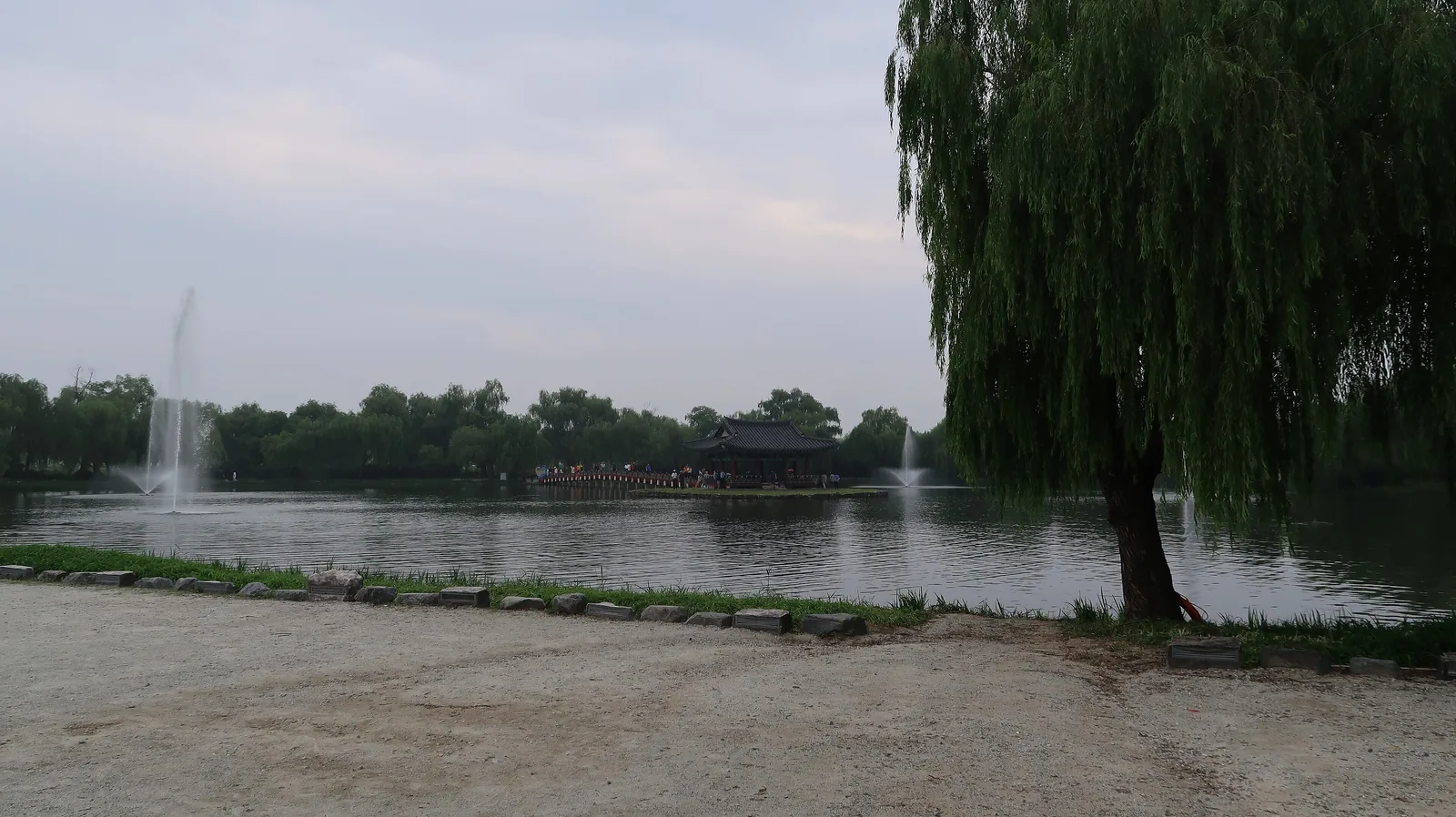
Gungnamji Pond, in Seodong Park, is the town's garden. VisitKorea calls it the oldest man-made garden in Korea. Its January 2025 article describes water lilies in June, white and red lotus in July, and lit bridges and Poryongjeong Pavilion at night.
Buyeo National Museum has a long history: VisitKorea says the Buyeo Preservation Society first set it up in 1929, and it moved to its present site on 6 August 1993, with four halls, an outdoor exhibition and about 1,000 relics. Its star is the gilt-bronze incense burner, a National Treasure. It is open 09:00–18:00, last entry 17:30, and closed on Mondays (the next working day when Monday is a holiday), New Year's Day, Seollal and Chuseok.
The Neungsan-ri Ancient Tombs are, in VisitKorea's words, the royal tombs of the Baekje dynasty from 538 to 660, with a miniature tomb museum at the entrance showing cross-sections. They are open all year, 09:00–18:00 from March to October and 09:00–17:00 from November to February. VisitKorea's 2025 article notes the Neungsa royal temple site and the Naseong city wall in the same area, and murals in Tomb No. 1.
Baekje Cultural Land, at 455 Baekjemun-ro, is what VisitKorea calls the largest history-themed park in Korea: a reconstructed Sabigung Palace, a full-size Neungsa Temple based on the Neungsan-ri excavations, with a 38 m wooden pagoda, Wiryeseong Fortress from the Hanseong period, Jehyangnu Pavilion and the Baekje History and Culture Museum. It is open 09:00–18:00 from March to October and 09:00–17:00 from November to February, with night opening to 22:00 on set dates, and closed on Mondays (the next working day when Monday is a holiday). VisitKorea's 2024 article describes an amphibious city tour bus with tickets at its car park 1, running Tuesday to Sunday: it enters the river at the Baengmagang leisure park and passes Nakhwaam and Goransa in about 40 minutes.
Busosanseong, Nakhwaam and the river
Busosanseong Fortress, which VisitKorea says served as a defensive wall for wartime preparedness, is a World Heritage component together with the Gwanbuk-ri site. VisitKorea's sources disagree on hours: its English page gives 09:00–18:00 all year, while its Korean article from 2024 gives 09:00–17:00 from November to February and closure on 1 January, Seollal and Chuseok. Start in the morning either way.
The short course runs from Nakhwaam to Goransa, about 1 hour 30 minutes by VisitKorea's 2025 figure, and most of its paths take wheelchairs and pushchairs. Nakhwaam is a cliff on the north side of Busosan facing the Baengmagang; VisitKorea retells the Samguk Yusa account of court women throwing themselves from it when Baekje fell, and the rock carries an inscription of its name by Song Si-yeol. Goransa, below it on the riverside cliff, is known for the Goran spring water behind the temple.
Then take to the water. VisitKorea describes boats on the Baengmagang north of Nakhwaam, with a landing at Goransa below the rock, and a hwangpo sailboat that leaves from Gudeurae pier and sails the 3.5 km stretch between Goransa and Subukjeong and back. Gudeurae pier is about 20 minutes on foot from the fortress's main gate, so the fortress, the river and the town make one loop.
Seasons and festivals
Summer belongs to Gungnamji. Water lilies open in June and white and red lotus in July, and the Seodong Lotus Festival is held at the pond each July; VisitKorea's 2025 listing gave that year's festival as 4 to 6 July. VisitKorea's 2024 guide to Chungcheongnam-do's markets also describes Buyeo Market and its summer night market, the Baengmagang Moonlight Night Market, with cultural performances.
Autumn brings the Baekje Cultural Festival, first held in 1955 and free to attend, VisitKorea says. In 2026 the 72nd festival ran from 3 to 11 October in Buyeo and Gongju on the same dates. Chungcheongnam-do's 2026 programme for Buyeo spread it across the town, with the main stage at the Jeongnimsa Temple Site, a theme hall at the Gwanbuk-ri site, a historical procession on 9 October, a night parade on 10 October and free shuttles from 09:00 to 23:00.
Winter shortens the days: the Jeongnimsa Temple Site closes at 21:00 rather than 22:00 from November to February, and the Neungsan-ri tombs, the Jeongnimsaji Museum and Baekje Cultural Land close at 17:00.
- June: water lilies at Gungnamji.
- July: lotus at Gungnamji and the Seodong Lotus Festival; in 2025 it ran from 4 to 6 July.
- Summer: the Baengmagang Moonlight Night Market (VisitKorea, 2024).
- Autumn: the Baekje Cultural Festival; in 2026 it ran from 3 to 11 October, with the main stage at the Jeongnimsa Temple Site.
- November to February: shorter hours at the temple site, the tombs, the Jeongnimsaji Museum and Baekje Cultural Land.
Onward to Gongju
Gongju, the earlier Ungjin capital from 475 to 538, holds two more Baekje Historic Areas components, Gongsanseong Fortress and the royal tombs at Songsan-ri, along with Gongju National Museum. The wide-area tourism bus leaves Buyeo Intercity Bus Terminal for Gongju Bus Terminal at 05:10, 11:10, 13:00 and 19:00 by Gongju City's timetable, and the southbound ride takes about 50 minutes, so the hop is short. See our Gongju guide for where to stay there.
Every Buyeo area guide
- Buyeo-eupBaekje's last capital: Busosanseong, the Jeongnimsa pagoda and Gungnamji's lotus pond.
Questions visitors ask
Where should I stay in Buyeo?
In Buyeo-eup, the town, close to the bus terminal and the Jeongnimsa Temple Site. VisitKorea puts Gungnamji about 12 minutes on foot from the terminal and the temple site a little over 10 minutes from the pond, and gives Buyeo-eup addresses for Busosanseong, the Neungsan-ri tombs and Buyeo National Museum.
How do I get to Buyeo from Seoul?
By bus from Dong Seoul Terminal: 2 hours 25 minutes to 2 hours 50 minutes, with four or five buses a day by VisitKorea's January 2025 figures. Or take the express bus to Gongju, about 1 hour 30 minutes from Seoul's Central terminal, and the wide-area bus on to Buyeo, about 50 minutes by Gongju City's timetable.
What in Buyeo is a UNESCO World Heritage site?
Four components of the Baekje Historic Areas, inscribed in 2015: the Archaeological Site in Gwanbuk-ri and Busosanseong Fortress, the Jeongnimsa Temple Site, the royal tombs in Neungsan-ri and the Naseong city wall, all tied by UNESCO to the Sabi capital.
Can I take a boat on the river in Buyeo?
Yes. VisitKorea describes boats on the Baengmagang north of Nakhwaam with a landing at Goransa, and a hwangpo sailboat from Gudeurae pier that sails the 3.5 km stretch between Goransa and Subukjeong and back. VisitKorea's 2024 article also describes an amphibious tour bus from Baekje Cultural Land, Tuesday to Sunday.
When is the Seodong Lotus Festival?
Each July at Gungnamji, VisitKorea says; in 2025 it ran from 4 to 6 July. Lotus flowers bloom at the pond in July and water lilies in June. Stay near the bus terminal, about 12 minutes on foot from the pond by VisitKorea's 2025 figure, for the lit bridges after dark.
Sources & review
Editorial review: · Korea Standard Time
- UNESCO World Heritage Centre — Baekje Historic Areas
- UNESCO World Heritage Centre — Decision 39 COM 8B.16
- VISITKOREA — Neungsan-ri Ancient Tombs
- VISITKOREA — Jeongnimsa Temple Site
- VISITKOREA — Jeongnimsaji Museum
- VISITKOREA (Korean) — Buyeo travel article: Gungnamji and Jeongnimsaji (2025)
- VISITKOREA (Korean) — Buyeo travel article: Busosanseong and the museum (2025)
- VISITKOREA (Korean) — Buyeo travel article (2024)
- VISITKOREA — Busosanseong Fortress
- VISITKOREA (Korean) — Nakhwaam Rock
- VISITKOREA (Korean) — Baengmagang river boats
- VISITKOREA (Korean) — Gudeurae hwangpo sailboat
- VISITKOREA — Buyeo travel course
- VISITKOREA — Top Summer Flower Spots for Stunning Photos (2025, lotus section)
- VISITKOREA — Buyeo National Museum
- VISITKOREA — Baekje Cultural Land
- VISITKOREA — Chungcheongnam-do traditional markets (2024)
- VISITKOREA — Baekje Cultural Festival
- Chungcheongnam-do — Baekje Cultural Festival programme in Buyeo (2026)
- Gongju City (Korean) — Wide-area tourism bus timetable
- Gongju City — Directions
- VISITKOREA — Getting from Incheon Airport (2026)
- VISITKOREA — Gongsanseong Fortress