
Daejeon · Where to stay
Where to stay in Daejeon
대전 숙소 지역
Daejeon is about an hour from Seoul by KTX, by Daejeon City's 2022 figure, and it offers two very different stays. Daejeon Station puts you in the old downtown of Jungang Market, Soje-dong and Euneungjeongi Culture Street; Yuseong puts you by hot springs known since the 7th century and Expo Science Park. Sejong makes a day out. Here is the quick answer for each trip, then everything behind it.
Quick pick
| Your trip | Stay in | Why |
|---|---|---|
| First visit | Daejeon Station & the Old Downtown | Jungang Market, Soje-dong and Euneungjeongi Culture Street, with the KTX at the door. |
| A short trip by KTX | Daejeon Station & the Old Downtown | About an hour from Seoul and Yongsan by KTX (Daejeon City, 2022), with the metro station in front. |
| Markets and food streets | Daejeon Station & the Old Downtown | Jungang Market, which VisitKorea calls the largest traditional market in the central region, runs from the station to the Daejeoncheon Stream. |
| Modern history | Daejeon Station & the Old Downtown | Soje-dong's century-old railway village and the 1932 provincial office, now the Modern History Exhibition Hall. |
| Hot springs | Yuseong Hot Springs | Springs known since the 7th century, and a free street foot spa 200 m from exit 7 of Yuseong Spa Station. |
| Science museums | Yuseong Hot Springs | The Yuseong Special Tourist Zone covers Expo Science Park; Hanbit Tower and the National Science Museum stand on Daedeok-daero. |
| An easy valley walk | Yuseong Hot Springs | Sutonggol Valley's gentle, flat trail is in Yuseong-gu, the same district as the hot springs. |
Why stay the night in Daejeon
Daejeon is close. Daejeon City's English directions page, dated 2022, puts Daejeon Station about an hour from Seoul and Yongsan by KTX, and VisitKorea calls it the central station of the city and one of the major train stations in Korea. That makes Daejeon easy to reach, and a night here turns a quick stop into a proper stay: an evening in the old downtown, a morning with the science museums, a soak at the end of the day.
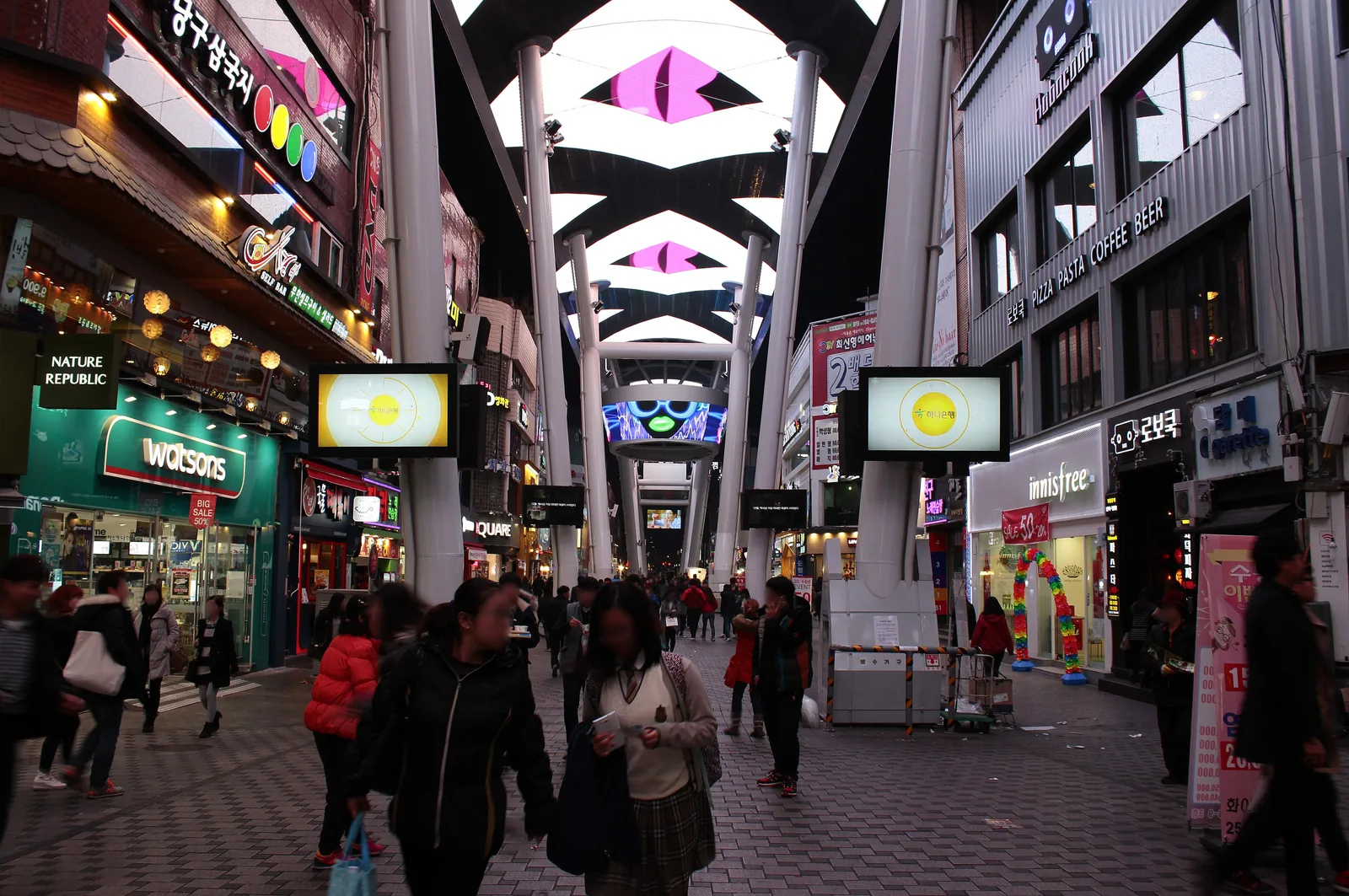
The first reason to stay is the old downtown around the station. Daejeon Station opened on 1 January 1905, when the railway between Seoul and Busan opened. Jungang Market stretches from the station to the Daejeoncheon Stream, and VisitKorea calls it the largest traditional market in the central region. Soje-dong, the railway workers' village beside the station, is now a café street, and Euneungjeongi Culture Street in Eunhaeng-dong sits in what VisitKorea calls Daejeon's original city centre.
The second is hot-spring water. VisitKorea describes Yuseongoncheon as a venerable hot spring area known since the 7th century, with water at 27–56 °C rising from 200 m underground, and its Korean-language guide says that of Korea's 116 hot-spring districts, Yuseong has the oldest history and the largest reserves and use in the country. The street foot spa, free in VisitKorea's words, is 200 m from a metro exit.
The third is science. Expo Science Park was established after the 1993 Daejeon Expo, Hanbit Tower gives a bird's-eye view from 93 m, and the National Science Museum has a dome observatory with a planetarium. VisitKorea's 2024 guide notes that Daedeok new town is planned around research institutes and universities. And VisitKorea's own guide covers Daejeon and Sejong together, which is how we treat them: Daejeon for the nights, Sejong for a day.
The two bases compared
Our rule: stay by Daejeon Station for a first visit, a short trip or a stop on the KTX, and in Yuseong for the hot springs and the science sights.
Daejeon Station and the old downtown is the all-round base. The KTX arrives at the door, the metro station is in front of the main station, and the old town is on foot: Jungang Market runs from the station to the Daejeoncheon Stream, and Soje-dong is five minutes from the east exit by VisitKorea's 2019 directions. Euneungjeongi Culture Street, a car-free street with cultural events, and the Daejeon Modern History Exhibition Hall, in the former Chungnam Provincial Office of 1932, complete the old centre. VisitKorea's walking course from the station runs about 4.3 km, from the Daejeon Travel Lounge through Jungang Market to Daedong Sky Park. The trade-off: no hot-spring water on your doorstep.
Yuseong is the stay for a slower trip. The foot spa is 200 m from exit 7 of Yuseong Spa Station, and VisitKorea says the Yuseong Special Tourist Zone takes in the hot springs, the Daedeok Science Complex, Kumdori Land and Expo Science Park. Hanbit Tower and the National Science Museum stand on Daedeok-daero; plan them for Tuesday to Sunday. The trade-off: the KTX is a metro ride away, at Daejeon Station on Line 1.
Two nights is a good shape for most trips: one by the station for the old downtown, one in Yuseong for the springs and the science sights. With one night, choose by your arrival: by the station for a late train in or an early one out, in Yuseong for a hot-spring evening.
- Daejeon Station & the Old Downtown: the KTX, Jungang Market, Soje-dong, Euneungjeongi Culture Street and the Modern History Exhibition Hall.
- Yuseong Hot Springs: the free foot spa by Yuseong Spa Station, hot springs known since the 7th century, and Expo Science Park, Hanbit Tower and the National Science Museum.
Getting to Daejeon
From Seoul, take the KTX from Seoul Station or Yongsan Station to Daejeon Station. Daejeon City's 2022 directions page gives about an hour by KTX, 1 hour 40 minutes by Saemaeul and 2 hours by Mugunghwa. The same page lists Daejeon Station on the Gyeongbu Line, and VisitKorea's train guide describes the Gyeongbu Line as the 447.1 km route between Seoul and Busan. By road, VisitKorea's bus guide lists Daejeon among the destinations from Seoul Express Bus Terminal, Dong Seoul Terminal and the Central City terminal.
Daejeon has a second station, Seodaejeon, on a different line: Daejeon City lists it on the Honam Line. The KTX from Seoul and Yongsan runs to Daejeon Station, the one by the old downtown. If your train runs to Seodaejeon, Daejeon City lists bus 618 from there to City Hall, and Seodaejeon Station has its own tourist information centre.
From Busan, Daejeon City's 2022 page gives 1 hour 50 minutes by KTX to Daejeon Station. VisitKorea's station page lists trains from Daejeon Station to Dongdaegu, Busan and Ulsan.
From Incheon Airport, go by rail. Daejeon City's 2022 directions give AREX to Seoul Station, about 1 hour 10 minutes, then the train to Daejeon Station, about an hour. VisitKorea's airport guide puts the AREX express at 43–51 minutes to Seoul Station and the all-stop train at 59–66 minutes.
- Seoul or Yongsan to Daejeon Station: about 1 hour by KTX; 1 hour 40 minutes by Saemaeul; 2 hours by Mugunghwa (Daejeon City, 2022).
- Busan to Daejeon Station: 1 hour 50 minutes by KTX (Daejeon City, 2022).
- Daejeon Station to Dongdaegu, Busan and Ulsan: trains on VisitKorea's station page (2021).
- Incheon Airport: AREX to Seoul Station, about 1 hour 10 minutes, then the train, about 1 hour (Daejeon City, 2022).
- Seoul by bus: Daejeon is a destination from Seoul Express Bus Terminal, Dong Seoul Terminal and the Central City terminal (VisitKorea).
Getting around: Line 1 and the city buses
Daejeon Metro Line 1 links both bases. VisitKorea's 2019 metro guide describes Line 1 running 20.5 km from Panam to Banseok through 22 stations across the city centre, every 5 to 10 minutes from 05:30 to 23:39, taking about 40 minutes end to end. The metro station at Daejeon Station is in front of the main station, VisitKorea says, and Daejeon City's 2022 page gives its first train at 05:36 and its last at 23:45. Ride it to Yuseong Spa Station for the hot springs.
For City Hall, Daejeon City lists buses 705 and 514 from Daejeon Station and bus 618 from Seodaejeon Station. For Sutonggol Valley, VisitKorea's 2024 guide gives under 30 minutes by taxi from Daejeon Station.
Daejeon City lists four tourist information points: the Daejeon Tourist Information Center, the Daejeon Travel Lounge, the Seodaejeon Station centre and the Daejeon Terminal Complex centre. The Travel Lounge, the first stop on VisitKorea's walk from Daejeon Station, also offers costume rentals and foreign-language services.
- Line 1: Panam to Banseok, 22 stations, every 5–10 minutes, 05:30–23:39 (VisitKorea, 2019).
- From Daejeon Station: first train 05:36, last 23:45 (Daejeon City, 2022).
- Yuseong Spa Station, exit 7: the foot spa is 200 m away (VisitKorea, 2019).
- Buses 705 and 514: Daejeon Station to City Hall; bus 618: Seodaejeon Station to City Hall (Daejeon City, 2022).
The old downtown: Jungang Market, Soje-dong and Eunhaeng-dong
VisitKorea's course "Walk into the Local Neighborhood from Daejeon Station" takes you to the local spots around the station on foot, about 4.3 km in all. It begins at the Daejeon Travel Lounge, passes through Jungang Market and ends at Daedong Sky Park, which VisitKorea calls a great spot for a panoramic view of downtown Daejeon, and its tip is Soje-dong's café street.
Jungang Market is the heart of it. VisitKorea's 2025 guide gives it over 100 years of history, and its stalls run from the station to the Daejeoncheon Stream: dried seafood, hardware, fish, herbal medicine, hanbok and food streets, at 783 Daejeon-ro, Dong-gu. Each shop keeps its own hours, so go in the daytime. The same 2025 guide lists the Sky Road, a media street whose large LED screens show videos after 6 p.m.
Soje-dong is the railway's village. VisitKorea calls it a century-old railway staff dormitory village turned café street, and its 2025 guide describes brick houses and narrow alleys once home to railway workers, including many Japanese railway technicians. Its 2019 directions put it five minutes on foot from Daejeon Station's east exit.
Eunhaeng-dong is the original city centre. Euneungjeongi Culture Street, at 164 Jungang-ro, is car-free, with cultural events, and VisitKorea's 2024 guide notes well-known restaurants and cute little shops clustered around it. The former Chungnam Provincial Office, built in 1932, has housed the Daejeon Modern History Exhibition Hall since 1 October 2013, telling the history and development of Daejeon over the past 100 years, at 85 Jungang-ro, Jung-gu. It closes on Mondays, 1 January, Seollal and Chuseok. In Dong-gu, Uam Historical Park is dedicated to the philosophy of Song Si-yeol, a Confucian scholar of the late Joseon period.
Yuseong and the science sights
Yuseong's hot springs run along Oncheon-ro. VisitKorea gives the water as 27–56 °C, flowing from 200 m underground, with a pH of 7.5–8.5. The foot spa, in Yuseong Hot Spring Park, is a free outdoor hot spring with natural thermal water in VisitKorea's words. Take exit 7 of Yuseong Spa Station, walk towards Chungnam National University and turn right at the Yuseong Oncheon crossroads: it is 200 m on, by VisitKorea's 2019 directions.
The science sights are on Daedeok-daero. Expo Science Park, at number 480, was established after the Daejeon Expo closed in 1993, with Hanbit Tower and a water plaza with a musical fountain. Hanbit Tower, 93 m high, gives a bird's-eye view of the park and major areas of Daejeon, open 09:30–17:40. The National Science Museum, at number 481, has about 4,200 exhibits from 322 subjects in four fields, a dome observatory with a planetarium and outdoor aircraft models, open 09:30–17:50. All three close on Mondays, 1 January, Seollal and Chuseok; when Monday is a holiday, the museum closes the next day.
Around them, Daejeon EXPO Plaza, at 169 Dunsan-daero in Seo-gu, is open 24 hours, with an outdoor performance hall, Hanbat Arboretum, bike paths and a fountain, and the Expo Bridge lights up at sunset. VisitKorea's Korean-language guide calls the Daejeon Expo Aquarium, at 1 Expo-ro, Korea's first exhibition space to combine living creatures with digital media, and dates the Daejeon Citizen Observatory to 3 May 2001, when it opened as the first astronomy science centre run by a local government. Daejeon City lists the Daejeon Prehistory Museum, at 126 Noeundong-ro, Yuseong-gu, with a restored excavation site.
For a walk, Sutonggol Valley is in Yuseong-gu: VisitKorea's 2024 guide calls the trail gentle and flat, with Course 1 about 3.2 km and about 2 hours 30 minutes.
A day in Sejong
VisitKorea calls Sejong the main administrative city of Korea and the first Hangul City. It makes a day out with a difference: lakes, gardens and government buildings rather than markets and springs. VisitKorea's Sejong course links four stops in about 6.34 km: Sejong Lake Park, the National Sejong Arboretum, the BOK Art Center and the Geumgang Pedestrian Bridge.
Sejong Lake Park is a large man-made park and one of the major tourism destinations in Sejong, says VisitKorea; its 2024 guide calls it the largest of its kind in Korea, with cultural events on its Floating Stage, and its 2025 Korean-language guide describes five themed islands. It is open 05:00–23:00, all year, at 216 Dasom-ro, and busiest at weekends, with performances, festivals and events. Sejong City calls it the central park for people in Sejong City, and puts the Milmaru Observatory, with a 360-degree view of the city, 1.92 km from the lake park.
The National Sejong Arboretum, at 136 Sumogwon-ro, was designed as the first urban arboretum in Korea; VisitKorea's 2024 guide calls it the third national arboretum, on 65 ha, with themed gardens including a Traditional Korean Garden and a Bonsai Garden, and its 2025 Korean-language guide adds a four-season greenhouse with Mediterranean, tropical and special exhibition houses. The arboretum's own site gives March to October, 09:00–18:00 (last entry 17:00), and November to February, 09:00–17:00 (last entry 16:00), closed on Mondays (the next day when Monday is a holiday), 1 January, Seollal and Chuseok, and during maintenance periods. Tickets are sold at the visitor centre and kiosks, or online as a mobile ticket.
The Geumgang Pedestrian Bridge opened in March 2022 and is, says VisitKorea, the first two-storey bridge in Korea: the upper deck for resting and events, the lower deck for bicycles only. Its 2024 guide calls it the circular Ieung Bridge, 1,446 m round. It is open 06:00–23:00, all year. The BOK Art Center, on the same course, is a complex cultural space with a concert hall, a gallery and a bookstore.
The Government Complex Sejong rooftop garden is the one to plan ahead. VisitKorea's 2024 guide calls it the largest rooftop garden in the world, with a 3.6 km trail; Sejong City gives it as 3.5 km long, with 60,445 m² of green and 1.3 million trees, open to the public since the second half of 2014; and a 2019 korea.kr article dates its Guinness listing to 25 May 2016, across 15 connected buildings. It is at 94 Dasom 2-ro. The Ministry of the Interior and Safety's February 2025 post gives the rules: visits are free, you book through Naver's online reservation or register on site, you bring your ID, and the garden closes for winter in January and February, reopening in March.
From Seoul, VisitKorea's 2025 Korean-language guide gives about 1 hour 40 minutes by express bus from Seoul Express Bus Terminal to Sejong City Hall, 13 a day from 06:06 to 22:21.
Sejong's Hangeul Festival uses the lake park. In 2026 it was held on 11 October, at Sejong Lake Park and Sejong Central Park; the next dates had not been published at the end of October 2026.
- Morning: the Government Complex rooftop garden, booked through Naver or on site; bring ID; closed January and February.
- Late morning: Sejong Lake Park, open 05:00–23:00, all year.
- Afternoon: the National Sejong Arboretum, closed on Mondays; last entry an hour before closing.
- Evening: the BOK Art Center, then the Geumgang Pedestrian Bridge, open until 23:00.
Festivals in 2026
Daejeon held two spring festivals in 2026. The Daejeon Science Festival ran from 17 to 19 April at DCC Exhibition Hall 2, 87 Expo-ro, and the Yuseong Hot Springs Culture Festival from 8 to 10 May at Yurim Park in Bongmyeong-dong. In Sejong, the Hangeul Festival was held on 11 October 2026 at Sejong Lake Park and Sejong Central Park. Dates for 2027 had not been published at the end of October 2026.
- 17–19 April 2026: the Daejeon Science Festival, DCC Exhibition Hall 2.
- 8–10 May 2026: the Yuseong Hot Springs Culture Festival, Yurim Park.
- 11 October 2026: the Sejong Hangeul Festival, Sejong Lake Park and Sejong Central Park.
Every Daejeon area guide
- Daejeon Station & the Old DowntownDaejeon's old heart at the KTX: Jungang Market, Soje-dong's railway alleys, Eunhaeng-dong.
- Yuseong Hot SpringsDaejeon's hot-spring quarter, known since the 7th century, with a free street foot spa.
Questions visitors ask
Where should I stay in Daejeon for a first visit?
By Daejeon Station, in the old downtown. The KTX from Seoul and Yongsan takes about an hour, by Daejeon City's 2022 figure, Jungang Market stretches from the station to the Daejeoncheon Stream, and Soje-dong is five minutes from the east exit. Euneungjeongi Culture Street and the Modern History Exhibition Hall complete the old centre, and Line 1 of the metro takes you to Yuseong's hot springs.
Daejeon Station or Seodaejeon: which station do I want?
Daejeon Station, for most trips from Seoul. Daejeon City lists it on the Gyeongbu Line, with the KTX from Seoul and Yongsan in about an hour, and it is the station for the old downtown and the metro. Seodaejeon is a different station, on the Honam Line, with bus 618 to City Hall.
How do I get from Seoul to Daejeon?
By KTX from Seoul Station or Yongsan Station to Daejeon Station: about an hour, by Daejeon City's 2022 directions page, or 1 hour 40 minutes by Saemaeul and 2 hours by Mugunghwa. Buses also run: VisitKorea lists Daejeon among the destinations from Seoul Express Bus Terminal, Dong Seoul Terminal and the Central City terminal.
Where should I stay in Daejeon for the hot springs?
In Yuseong, near Yuseong Spa Station on Line 1. VisitKorea puts the free street foot spa 200 m from exit 7, and says the Yuseong hot springs have been known since the 7th century, with water at 27–56 °C. Expo Science Park, Hanbit Tower and the National Science Museum on Daedeok-daero fill the day, except on Mondays.
Can I visit the rooftop garden of the Government Complex Sejong?
Yes, by booking. The Ministry of the Interior and Safety's February 2025 post says visits are free, that you book through Naver's online reservation or register on site, and that you bring your ID. The garden closes for winter in January and February and reopens in March. VisitKorea's 2024 guide calls it the largest rooftop garden in the world.
When is the Sejong Hangeul Festival?
In 2026 it was held on 11 October, at Sejong Lake Park and Sejong Central Park. The dates of the next festival had not been published at the end of October 2026. Sejong Lake Park is open 05:00–23:00, all year, and VisitKorea calls it the largest of its kind in Korea.
Sources & review
Editorial review: · Korea Standard Time
- Daejeon City — Directions (2022)
- Daejeon City — Tourist information centres
- Daejeon City — Museums
- VISITKOREA — Train
- VISITKOREA — Daejeon Station
- VISITKOREA — Express & Intercity Bus
- VISITKOREA — Airport
- VISITKOREA (Korean) — Daejeon subway trip (2019)
- VISITKOREA — Walk into the Local Neighborhood from Daejeon Station
- VISITKOREA — Must-have items in Daejeon and Sejong (2024)
- VISITKOREA — Euneungjeongi Culture Street
- VISITKOREA — Daejeon Jungang Market
- VISITKOREA — Hallyu: Daejeon (2025)
- VISITKOREA — Hallyu: Soje-dong and Expo Science Park (2025)
- VISITKOREA — Daejeon Modern History Exhibition Hall
- VISITKOREA (Korean) — 2026 travel month: Daejeon
- VISITKOREA — Yuseongoncheon Hot Springs
- VISITKOREA (Korean) — Yuseong Hot Springs
- VISITKOREA — Yuseong Special Tourist Zone
- VISITKOREA — Yuseong Foot Spa
- VISITKOREA — Daejeon travel course: Yuseong
- VISITKOREA (Korean) — Yuseong Hot Spring Park foot spa (2026)
- VISITKOREA — Daejeon Expo Park
- VISITKOREA — Hanbit Tower
- VISITKOREA — National Science Museum
- VISITKOREA — Daejeon EXPO Plaza
- VISITKOREA (Korean) — Yuseong Hot Springs Culture Festival 2026
- VISITKOREA (Korean) — Daejeon Science Festival 2026
- VISITKOREA — How to travel around Sejong, Korea's Multifunctional Administrative City
- VISITKOREA — Sejong Lake Park
- VISITKOREA (Korean) — National Sejong Arboretum trip (2025)
- Sejong City — Urban trip course
- VISITKOREA — National Sejong Arboretum
- National Sejong Arboretum — Visitor guide
- VISITKOREA — Geumgang Pedestrian Bridge
- Sejong City — Government Complex Sejong rooftop garden
- Korea.kr — Government Complex Sejong rooftop garden (2019)
- Ministry of the Interior and Safety — Rooftop garden viewing resumes (February 2025)
- VISITKOREA — Sejong Hangeul Festival