
Geoje · Where to stay
Where to stay in Geoje
거제 숙소 지역
Geoje is Korea's second-largest island, according to VisitKorea, and too big to see from one base. You have three: Gohyeon, the bus terminal town; Jangseungpo and the east-coast ports, with four of the seven Oedo boat docks and the Jisimdo ferry; and Hakdong and the south coast, for Windy Hill, Sinseondae and Haegeumgang. Here is the quick answer for each trip, then everything behind it.
Quick pick
| Your trip | Stay in | Why |
|---|---|---|
| First visit | Jangseungpo & the East Coast Ports | Four of the seven Oedo docks, the Jisimdo ferry and shallow beaches, with an intercity bus terminal at Jangseungpo. |
| Oedo Botania | Jangseungpo & the East Coast Ports | Jangseungpo, Jisepo, Wahyeon and Gujora all have boats to Oedo. |
| Camellias in late winter | Jangseungpo & the East Coast Ports | Jisimdo, the camellia island, is about 15 minutes by ferry from Jangseungpo Port. |
| Families and gentle beaches | Jangseungpo & the East Coast Ports | Gujora and Wahyeon have wide, shallow beaches; Hakdong's water is deep, with rough waves. |
| Sunsets and sea views | Hakdong & the South Coast | Sinseondae is a sunset lookout, and Haegeumgang's rocks are VisitKorea's pick for sunrise and sunset. |
| Windy Hill and Haegeumgang | Hakdong & the South Coast | Windy Hill stands at the end of Dojangpo village, at the entrance to the Haegeumgang islets. |
| Spring canola | Hakdong & the South Coast | Sinseondae's bright-yellow canola flowers are out in April and May. |
| Arriving and leaving by bus | Gohyeon | Buses from Seoul Nambu, Dong Seoul, Daejeon, Dongdaegu and Busan arrive at Gohyeon Bus Terminal. |
| Korean War history | Gohyeon | The Geoje POW Camp Historic Park is in Gohyeon-dong. |
Why stay the night on Geoje
Geoje is an island to sleep on, not to drive through. Oedo Botania, the garden island VisitKorea names among Geoje's main sights, is reached only by boat from one of seven docks, and VisitKorea gives visitors two hours on the island. Sinseondae is a sunset lookout, VisitKorea names Ilwolbong and Sajabawi on Haegeumgang for sunrise and sunset, and Jisimdo's camellias are a ferry ride from Jangseungpo. Fit all that into a day from Busan and you spend much of it on buses.
Distances on the island are real. VisitKorea's Korean site puts Hakdong about 1 hour 5 minutes and Dojangpo about 1 hour 23 minutes from Gohyeon Bus Terminal by city bus, and VisitKorea's own Tongyeong–Geoje itinerary recommends a rental car or taxi because public transport is limited. A night on the coast saves you those rides.
VisitKorea names the Haegeumgang islets, Oedo Botania, Maemiseong Fortress and the Geoje POW Camp Historic Park as the island's main sights, alongside the pebble beaches of Hakdong, Yeocha, Mangchi and Nongso. Each base on this page is built around one part of that list.
The three bases compared
Our rule: stay on the east coast for Oedo, Jisimdo and gentle beaches; on the south coast for Windy Hill, Sinseondae and sunsets; and in Gohyeon for a night between buses or a base with a car.
Gohyeon is the bus terminal town. Gohyeon Bus Terminal takes the intercity buses from Seoul Nambu, Dong Seoul, Daejeon, Dongdaegu and Busan in VisitKorea's listings, and it is where VisitKorea's city-bus directions to the coast begin. The Geoje POW Camp Historic Park, on the site of what VisitKorea calls South Korea's largest prisoner-of-war camp, is in Gohyeon-dong, and Gohyeon Market has a live-fish market and a five-day market. None of the seven Oedo docks is here, and the south coast is over an hour away by city bus.
Jangseungpo and the east-coast ports are the stay for boats and beaches. Four of VisitKorea's seven Oedo docks are on this coast: Jangseungpo, Jisepo, Wahyeon and Gujora. Jangseungpo Port also runs cruises to Haegeumgang and the ferry to Jisimdo, about 15 minutes, and has its own intercity bus terminal, with direct buses from Seoul Nambu and Gimhae Airport in VisitKorea's 2019 listings. Gujora's beach is shallow and warm, Wahyeon's wide and shallow, and Gongot-i's daffodil terraces are in Wahyeon-ri. Okpo, nearby, adds the park for Admiral Yi's first victory.
Hakdong and the south coast are the stay for scenery. Hakdong's beach is 1.2 km of black pebbles; Windy Hill and its windmill stand at the end of Dojangpo fishing village, Sinseondae's lookout sits between Dojangpo and Haegeumgang, and the Haegeumgang islets lie in front of Windy Hill. Dojangpo and Haegeumgang are two of the seven Oedo docks. The trade-off is the bus ride from Gohyeon: about 1 hour 5 minutes to Hakdong.
Two nights is the sweet spot: one on the east coast for Jisimdo and Oedo, one on the south coast for Windy Hill and Sinseondae's sunset.
- Gohyeon: the bus terminal, the POW Camp Historic Park and Gohyeon Market; over an hour by city bus to the south coast.
- Jangseungpo & the East Coast Ports: four Oedo docks, the Jisimdo ferry, shallow beaches at Gujora and Wahyeon, and Okpo nearby.
- Hakdong & the South Coast: the black-pebble beach, Windy Hill, Sinseondae and Haegeumgang, with Oedo boats from Dojangpo and Haegeumgang.
Getting to Geoje
Since 14 December 2010, the Geoga Bridge, also called the Busan–Geoje Fixed Link, has carried traffic from Gadeokdo in Busan to Jangmok-myeon on Geoje: 8.2 km of four-lane road, beginning with a 3.7 km immersed tunnel under the sea and continuing through a land tunnel and over cable-stayed bridges. Announcing the opening, Busan City said it cut the Busan–Geoje journey from 2 hours 10 minutes to 50 minutes, and the distance from 140 km to 60 km.
From Busan, buses leave Busan Seobu Intercity Bus Terminal for Gohyeon. VisitKorea's Korean site, in figures updated in 2019, gives about 1 hour 20 minutes, with departures about every 20 minutes from 06:00 to 22:00. By car, its 2021 figure from the Busan and Masan direction is 1 hour 13 minutes, 72.7 km.
From Seoul, buses leave Seoul Nambu Terminal and Dong Seoul Terminal. VisitKorea's 2019 figures give about 4 hours 20 minutes from Nambu to Gohyeon Bus Terminal, about 4 hours 45 minutes from Dong Seoul, and about 5 hours 30 minutes from Nambu to Jangseungpo. Driving from Seoul, its 2021 figure is 4 hours 40 minutes, 398.6 km. The same 2021 listing gives 2 hours 40 minutes by bus from Daejeon and 2 hours 10 minutes from Dongdaegu.
At Gimhae International Airport, VisitKorea's 2026 guide says you can buy tickets for intercity buses to Geoje. Its Korean site's 2019 figure for the airport bus to Jangseungpo is about 1 hour 10 minutes. Busan Seobu Intercity Bus Terminal, with buses to Gohyeon, is about 15 minutes from the airport by subway or taxi.
Geoje has no railway yet. The Southern Inland Railway, 174.6 km from Gimcheon to Geoje, broke ground near Gyeonnaeryang on 6 February 2026. The government expects Seoul to Geoje to take around 2 hours 50 minutes once it opens, against 4 hours 30 minutes to 5 hours by bus or car today, and gives no opening year.
- Busan Seobu to Gohyeon: about 1 hour 20 minutes (VisitKorea, 2019).
- Seoul Nambu to Gohyeon: about 4 hours 20 minutes; Dong Seoul to Gohyeon: about 4 hours 45 minutes (VisitKorea, 2019).
- Seoul Nambu to Jangseungpo: about 5 hours 30 minutes (VisitKorea, 2019).
- Gimhae Airport to Jangseungpo: about 1 hour 10 minutes (VisitKorea, 2019); tickets to Geoje on sale at the airport (VisitKorea, 2026).
- Train: none yet; the Southern Inland Railway broke ground on 6 February 2026.
Getting around: car or bus
Drive if you can. VisitKorea's own Tongyeong–Geoje itinerary, written in 2018, says public transport on both is limited and recommends a rental car or a taxi. Without a car, Geoje works, but slowly, and the right base matters more.
By bus, Gohyeon Bus Terminal is the starting point for VisitKorea's city-bus directions. Its Korean site gives about 1 hour 5 minutes to Hakdong, about 1 hour 23 minutes to Dojangpo for Windy Hill and Sinseondae, and about 56 minutes to Wahyeon. Along the coast the hops are shorter: Hakdong to Dojangpo about 23 minutes, and Gujora to Wahyeon about 16 minutes. If you are travelling by bus, sleep on the coast you came for rather than riding out from Gohyeon every day.
Geoje City's own one-day course runs from the Geoje Bridge to the POW Camp Historic Park, Hakdong, Windy Hill and Sinseondae, Haegeumgang and Oedo, the Shipbuilding and Marine Culture Center, the Maengjongjuk bamboo park and out over the Geoga Bridge. That loop, in from Tongyeong and out to Busan, is a good shape for a road trip.
Oedo and the boats
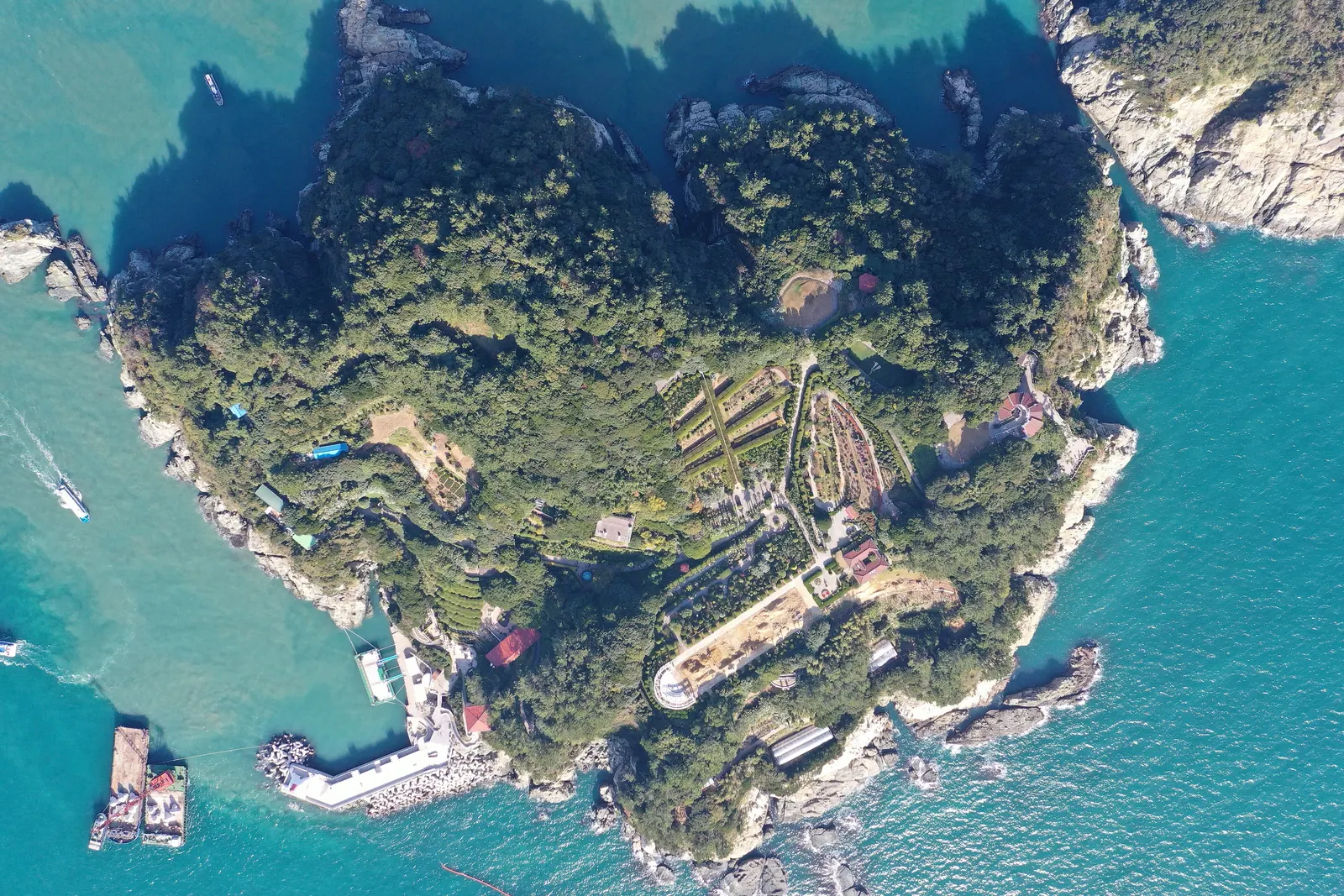
Oedo Botania is a garden island in Hallyeohaesang National Park, 148,760 square metres divided into Seodo and Dongdo, with Dongdo kept in its natural state. Its name joins botany and utopia, VisitKorea's Korean site explains; the garden takes the rear garden of Buckingham Palace as its motif, the Venus Garden has 12 Venus statues, and the last episode of Winter Sonata was filmed here. VisitKorea's English guide counts over 3,000 kinds of flowers and trees.
You reach it only by boat, and VisitKorea gives visitors two hours on the island. Oedo Botania has no lift and no accessible toilets, a step at the main entrance and no wheelchair or pushchair hire, according to VisitKorea's Korean site.
Some boats take in the coast on the way. From Dojangpo village or Gujora, VisitKorea's Korean site says, cruise boats pass Haegeumgang before landing on Oedo, and they enter Sipja Cave only when the sea is calm. The Haegeumgang cruise from a quay in Galgot-ri, near Haegeumgang Village, sails past Sipjadonggul Cave, Sajabawi and Chotdaebawi; a valid ID is required to board, and sailings depend on the weather.
Jisimdo is the other boat trip: about 15 minutes by ferry from Jangseungpo Port, and about two hours to walk the whole island. VisitKorea says it has more old camellia trees than any other island in the southern sea, its Korean site puts camellias at 60–70% of the forest, and Japanese colonial-era fortifications, from gun emplacements to a runway, still stand.
VisitKorea lists seven docks with boats to Oedo:
- Jangseungpo: also cruises to Haegeumgang and the ferry to Jisimdo.
- Jisepo: the passenger terminal for Haegeumgang and Oedo cruises.
- Wahyeon: on the east coast, with a wide, shallow beach.
- Gujora: cruises to Haegeumgang, Naedo and Oedo.
- Dojangpo: VisitKorea's pick for a Windy Hill day.
- Haegeumgang: on the south coast.
- Dadae: the seventh dock on VisitKorea's list.
Seasons on Geoje
Late winter belongs to the camellias. On Jisimdo they start to bloom in early December and have mostly dropped by late April, and VisitKorea's Korean site, in 2019, named late February to mid-March as the best time to go. Gongot-i, the terraced garden in Wahyeon-ri, has a camellia tunnel of 333 steps.
Spring is daffodils and canola. Gongot-i's daffodils bloom in March and April on a hillside farm built up by a local couple, about 20 minutes' walk from the end of Yegu village. At Sinseondae, April and May bring bright-yellow canola flowers to the lookout.
Summer is beach season. Gujora's beach is about 1.1 km long, shallow and warm; Wahyeon's is wide, shallow and backed by pines, and busy in summer. Hakdong's black pebbles are for walking barefoot and listening to: its water is deep, with rough waves.
Winter ends with fireworks: Jangseungpo Port holds a year-end fireworks festival every year, and its lit Songgu-yeongsin Somang-gil is made for walks after dark.
Korea's second-largest island
Geoje is the second-largest island in South Korea, after Jeju, according to VisitKorea, and its Korean site adds that it is the largest of the south coast's islands. VisitKorea describes its coastline as complex and extensive. Hallyeohaesang National Park runs from Jisimdo in Geoje to Odongdo in Yeosu, takes in the Haegeumgang islets, and has its Geoje District office in Dongbu-myeon.
History runs deep here. The Geoje POW Camp Historic Park stands on the site of a camp that held up to 173,000 North Korean and Chinese prisoners during the Korean War. Okpo Great Victory Commemorative Park, built in 1996, marks Admiral Yi Sun-sin's first victory, at the Battle of Okpo in the Imjin War. Chilcheollyang Battle Park, in Hacheong-myeon, remembers the Joseon navy's heavy defeat there in the Jeongyu War. Gohyeonseong was a walled county seat from 1453 to 1663, and Maemiseong Fortress, in Jangmok-myeon, is a wall one man, Baek Soon-sam, built alone after Typhoon Maemi in 2003.
For food, VisitKorea points to sea pineapple bibimbap and sea urchin and seaweed soup, and Gohyeon Market has a live-fish market.
Tongyeong next door
Geoje's other bridge leads west to Tongyeong. The first Geoje Bridge, 740 m long, was completed in 1971 and joined the island to the mainland through Tongyeong; a new Geoje Bridge, 940 m long, opened on 22 April 1999. VisitKorea's 2018 itinerary gives about 30 minutes by bus from Tongyeong Bus Terminal to Gohyeon Bus Terminal, so Tongyeong's harbour, Jungang Market and cable car are an easy day out, and the city has been a UNESCO Creative City of Music since 2015.
The government pairs the two as well. In September 2026 it named a Gimhae Airport tourism zone linking Busan, Gyeongju, Ulsan, Geoje and Tongyeong, with Geoje and Tongyeong supplying its south-coast tourism.
Every Geoje area guide
- GohyeonGeoje's bus terminal town, with the POW Camp park and Gohyeon Market close at hand.
- Jangseungpo & the East Coast PortsFour of Geoje's seven Oedo docks, the camellia island of Jisimdo and shallow beaches.
- Hakdong & the South CoastBlack-pebble beach, Windy Hill, Sinseondae's sunsets and the rock islets of Haegeumgang.
Questions visitors ask
Where should I stay in Geoje for Oedo?
On the east coast, at Jangseungpo, Jisepo, Wahyeon or Gujora: four of the seven docks VisitKorea lists for Oedo boats are there. If Windy Hill and Haegeumgang are also on your list, the south coast works too, with Oedo boats from Dojangpo and Haegeumgang. Either way, book near the dock you will sail from, and expect two hours on the island.
Where should I stay in Geoje without a car?
On the coast you came for, or in Gohyeon if you are only passing through. Long-distance buses arrive at Gohyeon Bus Terminal, but VisitKorea's Korean site puts Hakdong about 1 hour 5 minutes and Dojangpo about 1 hour 23 minutes away by city bus. Jangseungpo has its own intercity bus terminal, with buses from Seoul Nambu and Gimhae Airport in VisitKorea's 2019 listings, and boats from its own port.
How do I get from Busan to Geoje?
By bus from Busan Seobu Intercity Bus Terminal to Gohyeon, about 1 hour 20 minutes with departures about every 20 minutes from 06:00 to 22:00, according to VisitKorea's Korean site in figures updated in 2019. By car, the Geoga Bridge has linked Busan and Geoje since 14 December 2010, and VisitKorea's 2021 figure for the drive is 1 hour 13 minutes.
Is there a train to Geoje?
No. Geoje has no railway yet. The Southern Inland Railway from Gimcheon to Geoje, 174.6 km, broke ground on 6 February 2026, and the government's announcement gives no opening year. Until then, take the bus: VisitKorea's 2019 figures give about 4 hours 20 minutes from Seoul Nambu Terminal to Gohyeon.
When do the camellias bloom on Jisimdo?
They start in early December and have mostly dropped by late April, and VisitKorea's Korean site named late February to mid-March as the best time in 2019. Jisimdo is about 15 minutes by ferry from Jangseungpo Port, so stay on the east coast and take an early boat.
Sources & review
Editorial review: · Korea Standard Time
- VISITKOREA — Geojedo Island
- VISITKOREA — Geoje's island and coast course (2024)
- VISITKOREA (Korean) — Geojedo
- Busan Metropolitan City — Busan Sibo: Geoga Bridge opens to traffic
- Busan Metropolitan City — Busan Sibo: Geoga Bridge structure
- VISITKOREA (Korean) — Geoga Bridge
- VISITKOREA (Korean) — Geoje Bridge
- Korea.kr — Southern Inland Railway groundbreaking
- Korea.kr — Regional airport tourism zones
- VISITKOREA (Korean) — Geoje POW Camp and getting to Geoje (2019)
- VISITKOREA (Korean) — Geoje travel course and transport (2021)
- VISITKOREA (Korean) — Geoje course and buses from Seoul (2019)
- VISITKOREA (Korean) — Jisimdo and Jangseungpo (2019)
- VISITKOREA — [Korea Beyond Seoul] Fly to Gimhae International Airport
- VISITKOREA — Tongyeong and Geoje itinerary
- VISITKOREA (Korean) — Geoje essential sights and city buses
- Geoje City — Recommended tour courses
- VISITKOREA — Oedo Botania
- VISITKOREA (Korean) — Oedo Botania
- VISITKOREA (Korean) — Oedo boats and Windy Hill (2025)
- VISITKOREA (Korean) — Haegeumgang and Oedo by boat (2021)
- VISITKOREA — Haegeumgang Cruise
- VISITKOREA (Korean) — Jangseungpo Port
- VISITKOREA (Korean) — Jisepo Port
- VISITKOREA — Jisimdo Island
- VISITKOREA (Korean) — Jisimdo
- VISITKOREA (Korean) — Gongot-i
- VISITKOREA (Korean) — Gongot-i in spring (2021)
- VISITKOREA — Sinseondae Observatory
- VISITKOREA — Gujora Beach
- VISITKOREA (Korean) — Wahyeon, Gujora and Okpo walks (2021)
- VISITKOREA — Hakdong Mongdol Beach
- VISITKOREA — Windy Hill
- VISITKOREA — Haegeumgang
- VISITKOREA — Hallyeohaesang National Park (Geoje District)
- VISITKOREA — Geoje POW Camp Historic Park
- VISITKOREA — Okpo Great Victory Commemorative Park
- VISITKOREA — Maemiseong Fortress
- VISITKOREA (Korean) — Gohyeonseong Fortress
- VISITKOREA (Korean) — Gohyeon Market
- UNESCO — Tongyeong, Creative City of Music