
Tongyeong · Where to stay
Where to stay in Tongyeong
통영 숙소 지역
Tongyeong deserves more than a day trip from Busan. You have two bases: Gangguan, the old harbour with Jungang Market, Dongpirang's murals and the harbour at night; and Mireukdo, the island joined to the city by bridges and an undersea tunnel, with the cable car, the luge and the concert hall. Here is the quick answer for each trip, then everything behind it.
Quick pick
| Your trip | Stay in | Why |
|---|---|---|
| First visit | Gangguan & Jungang Market | VisitKorea calls Gangguan the perfect starting point for a trip to Tongyeong, with the market, the murals and the harbour together. |
| Food and markets | Gangguan & Jungang Market | Jungang Market, with nearly 400 years of history and a kkulppang street, faces a harbour lined with Chungmu gimbap restaurants. |
| Night views | Gangguan & Jungang Market | VisitKorea's Korean site picks Gangguan as Tongyeong's signature night view, and DPIRANG opens 19:00 to midnight, except on Mondays, east of the harbour. |
| Island day trips | Gangguan & Jungang Market | Tongyeong Ferry Terminal in Seoho-dong stands on the same waterfront road as Gangguan. |
| Admiral Yi and naval history | Gangguan & Jungang Market | Tongjeyeong and Sebyeonggwan are about ten minutes' walk from Dongpirang. |
| Cable car and luge | Mireukdo | The Tongyeong Cable Car and Skyline Luge stand opposite each other on Balgae-ro. |
| Family days out | Mireukdo | The cable car, the luge's four tracks and Dara Park are all on the island. |
| Concerts | Mireukdo | Tongyeong Concert Hall, 1,309 seats right above the sea, is in Donam-dong on Mireukdo. |
| Resort stay and sunsets | Mireukdo | The Donam Tourist Complex has accommodation, yachts and water sports, and Dara Park is the island's sunset spot. |
Why stay the night in Tongyeong
Tongyeong comes alive after dark, and a day trip misses it. VisitKorea's Korean site picks Gangguan's harbour as the city's signature night view, seen from the benches on the Gangguan bridge, and Seopirang's lanes are lit after sunset. DPIRANG, the night-time digital theme park in Nammangsan Sculpture Park, opens only from 19:00 to midnight and closes on Mondays; its 1.3 km trail runs through 15 themes. None of that fits between a morning bus in and an afternoon bus out.
It is also a long way to come for a few hours. Tongyeong has no railway, the bus terminal is out of town in Jukrim, and the city's sights sit on both sides of the water: the harbour, the market and the mural village in town, and the cable car, the luge and the sunset park on Mireukdo. A night, better two, lets you do both and add an island by ferry.
Tongyeong City calls itself the city of cultural arts and the beautiful Hallyeosudo Waterway, and VisitKorea's own nickname for it is the Naples of Korea. Both are earned. This was the home of the Joseon navy's Tongjeyeong headquarters, the birthplace of the composer Isang Yun and the novelist Pak Kyongni, and, since 2015, a UNESCO Creative City of Music.
The two bases compared
Tongyeong's two stay areas sit on either side of the water, and each gives you a different half of the city on your doorstep. Our rule: for a first visit, stay at Gangguan. Stay on Mireukdo if the cable car, the luge and a resort-style stay are the point, or split two nights between them.
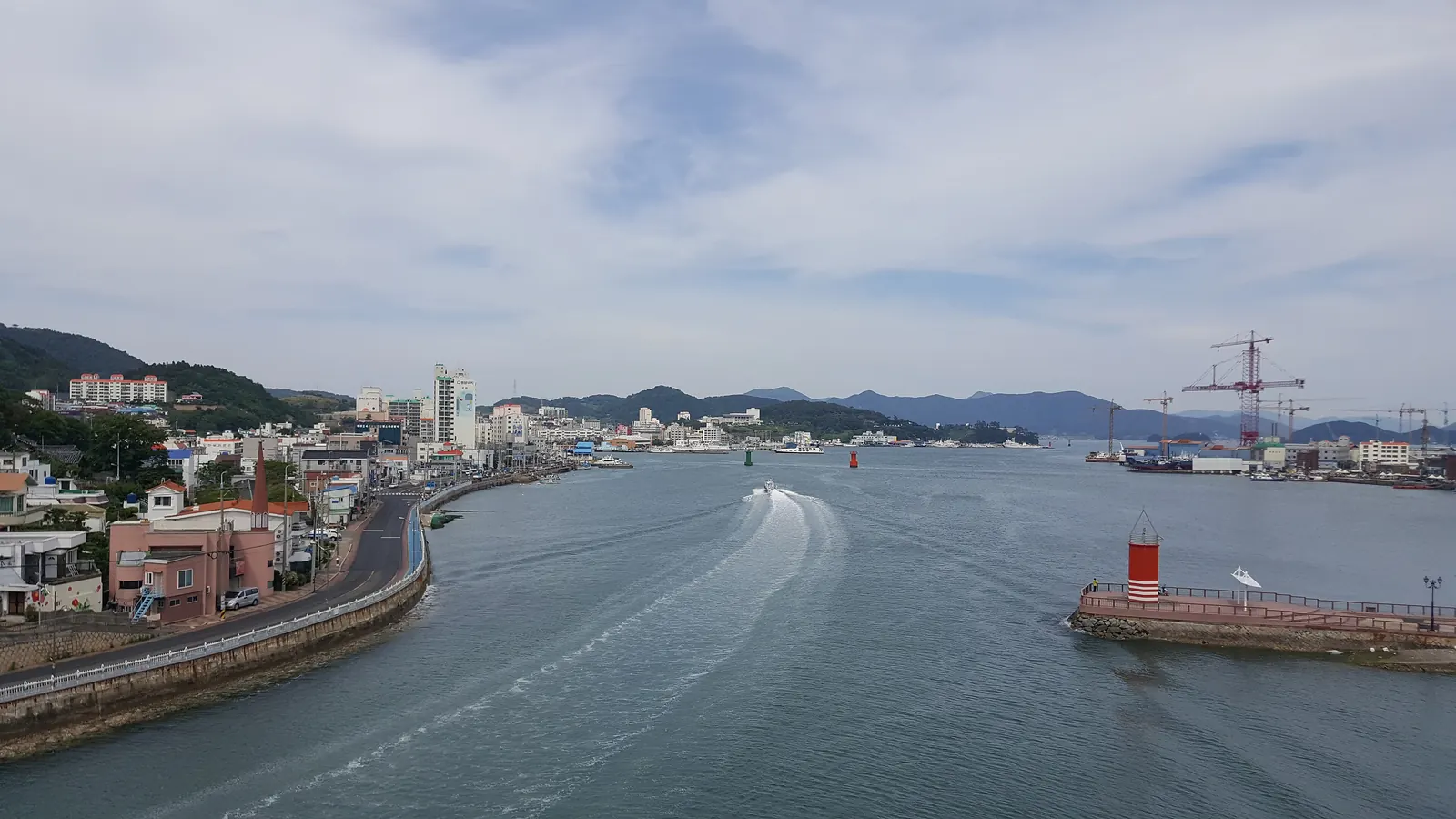
Gangguan and Jungang Market are the stay for food, history and evenings. VisitKorea calls Gangguan the perfect starting point for a trip to Tongyeong. Fishing boats moor in the inner harbour, rows of restaurants serve Chungmu gimbap, and Jungang Market, nearly 400 years old, faces the water with Dongpirang's mural village next door. Tongjeyeong and Sebyeonggwan (established 1605), are about ten minutes' walk from Dongpirang, and so is Seopirang, the site of Pak Kyongni's birthplace. The island ferries leave from Tongyeong Ferry Terminal in Seoho-dong, on the same waterfront road. The trade-off is the bus terminal, about 5.9 km away by taxi.
Mireukdo is the stay for the outdoors and for music. VisitKorea lists the island as a Special Tourist Zone inside Hallyeohaesang National Park, and its Donam Tourist Complex has accommodation, restaurants, yacht services and water sports. The Tongyeong Cable Car, 1,975 m long and opened in 2008, climbs Mireuksan to just below its 461-metre summit, and Skyline Luge's four tracks stand opposite the lower station. Tongyeong Concert Hall sits right above the sea in Donam-dong, and Dara Park is the sunset spot in the south. City bus 141 runs from the bus terminal to the cable car. The trade-off: the market, the harbour evenings and the ferries are trips back into town.
Neither base is at the bus terminal. It stands at 24 Jukrim 4-ro in Gwangdo-myeon, with its own tourist information centre, and a room beside it only makes sense for a very late arrival or a very early bus. Everyone else should ride on to Gangguan or Mireukdo on the first night.
- Gangguan & Jungang Market: the market, Dongpirang, Tongjeyeong and harbour nights; island ferries from Seoho-dong; about 5.9 km by taxi from the bus terminal.
- Mireukdo: the cable car, Skyline Luge, the Concert Hall and Dara Park; resort and marina stays; city bus 141 from the bus terminal.
Getting to Tongyeong
There is no railway to Tongyeong. You arrive by bus, at Tongyeong Bus Terminal in Jukrim, Gwangdo-myeon, or by car, leaving the expressway at Buk-Tongyeong IC or Tongyeong IC. A line is on its way: the Southern Inland Railway, 174.6 km from Gimcheon to Geoje, broke ground on 6 February 2026, and the government's announcement gives no opening year. For now, plan on the bus.
From Seoul, Tongyeong City's 2016 timetable lists the nonstop bus from Seoul Nambu Terminal at 4 hours 10 minutes, and its timetable also shows an express service on the Seoul Gyeongbu line. VisitKorea's Korean site, updated in 2025, gives about four hours by express bus from Seoul.
From Busan, intercity buses leave Busan Seobu Intercity Bus Terminal for Tongyeong Bus Terminal. The two official figures differ: VisitKorea's 2026 Gimhae Airport guide puts the ride at about 80 minutes, while Tongyeong City's English site, which dates from 2016, lists 2 hours 10 minutes for the nonstop.
From Gimhae International Airport, VisitKorea's advice is to head to Busan Seobu Intercity Bus Terminal, about 15 minutes from the airport by subway or taxi, and take the Tongyeong bus from there. The airport's ticket counters sell intercity tickets to Ulsan, Changwon and Geoje, VisitKorea notes; for Tongyeong, change at Seobu.
Tongyeong City's 2016 English timetable page also lists nonstop buses from Daegu (2 hours 40 minutes), Daejeon (2 hours 40 minutes), Gwangju (2 hours 30 minutes), Jinju (1 hour 20 minutes) and Changwon's Masan Nambu terminal (1 hour 10 minutes).
- Seoul Nambu: nonstop bus, 4 hours 10 minutes (Tongyeong City).
- Seoul: about four hours by express bus (VisitKorea, 2025).
- Busan Seobu: about 80 minutes (VisitKorea, 2026); 2 hours 10 minutes (Tongyeong City, 2016).
- Gimhae Airport: about 15 minutes by subway or taxi to Busan Seobu, then the Tongyeong bus.
- Train: none yet; the Southern Inland Railway broke ground on 6 February 2026.
Getting around and the island ferries
Plan each move from the bus terminal. Gangguan is about 5.9 km away by taxi. The cable car's operator and Skyline Luge's site give city bus 141 from the terminal to the stop in front of the cable car, about 20 minutes in smooth traffic, and the cable car's operator gives the same 20 minutes by taxi. VisitKorea's Korean site lists further routes from the terminal: 521, 613 and 420 to the Nammangsan Park entrance for DPIRANG, then about six minutes on foot; 101, 121 and 128 to Donam-dong for the Concert Hall, then about 590 m; and 101, 141 and 200 to the Manbok Apartment stop for the Isang Yun Memorial Park, then about 210 m.
The island ferries do not leave from Gangguan. They sail from Tongyeong Ferry Terminal, 234 Tongyeonghaean-ro in Seoho-dong, which has its own tourist information centre; Gangguan's Munhwa Madang is at 328 on the same waterfront road.
Hansando is where Admiral Yi Sun-sin commanded his fleets for most of the Imjin War, and Jeseungdang stands there. Bijindo has a 550 m beach that appears to join two islands, sandy on the west side and pebbly on the east, with both sunrise and sunset in view. At Somaemuldo you can walk from one island to the other at low tide, and the lighthouse island is reached only when the sea path opens, so plan the day around the tide table. For hikers, VisitKorea describes Saryangdo as Jirisan Mountain on the Sea, a demanding route of iron stairs and suspension bridges.
VisitKorea's Korean site gives these crossings from Tongyeong Ferry Terminal:
- Hansando: about 30 minutes, hourly from 07:00 to 18:00 with extra sailings in peak season (2018 figures).
- Bijindo: about 40 minutes (2021). The terminal sells same-day tickets only, so book online.
- Somaemuldo: about 1 hour 30 minutes (2021).
A UNESCO Creative City of Music
In 2015 UNESCO named Tongyeong a Creative City of Music, one of 47 cities that joined the Creative Cities Network that December. UNESCO's own page puts it simply: music is the city's lifeblood, and Isang Yun is its best-known musical figure.
Isang Yun was born in Tongyeong on 17 September 1917 and died in Berlin on 3 November 1995. After the premiere of his work at Donaueschingen in 1966 he became, in Tongyeong City's words, a world-celebrated composer, and he taught at the Berlin Art University from 1977 to 1987. The Isang Yun Memorial Park in Docheon-dong, where he was born, has an exhibition hall and a memorial hall.
The Tongyeong International Music Festival, founded in 2002 and dedicated to Isang Yun, is held each spring; in 2026 it ran 27 March – 5 April, under the theme Face the Depth. Tongyeong Concert Hall, on Mireukdo, has 1,309 seats and sits right above the sea; it opened in 2014. TIMF lists the final round of the ISANGYUN Competition 2026 on 7 November 2026 at 15:00.
Music is not Tongyeong's only art. Pak Kyongni (1926–2008), author of the 16-volume historical novel Toji (1969–1994), was born here; the site of her birthplace is at Seopirang, five minutes on foot from the Munhwa Madang bus stop at Gangguan, and her memorial hall and grave are in Sanyang-eup. The painter Jeon Hyuck-lim's museum stands in his former home on the way to Yonghwasa Temple on Mireuksan.
Admiral Yi Sun-sin and the Hansan Battle Festival
Tongyeong is Admiral Yi Sun-sin's city. The Battle of Hansan was, in VisitKorea's words, a 1592 naval battle fought off Hansando Island during the Joseon dynasty, and Hansando is where he commanded the fleets for most of the Imjin War (1592–1598). Jeseungdang, on Hansando, was built in 1593, the year after the great victory, and served as the headquarters of the Three-Province Navy until it was lost in 1597.
The navy's legacy runs through the city. Samdo Sugun Tongjeyeong, the historic naval headquarters, is about ten minutes' walk from Dongpirang, and beside its remains stands Sebyeonggwan, established in 1605 and one of the widest buildings of the Joseon period. Chungnyeolsa Shrine is dedicated to the admiral and is open all year, 09:00–18:00 from March to October and 09:00–17:00 from November to February. Yi Sun-sin Park, at the foot of Mangilbong Peak, has his statue, an observation deck and walking paths, and is open 24 hours.
The Hansan Battle Festival commemorates the victory around the city; Tongyeong City lists it for 12 to 16 August every year. In 2026 it ran 12–16 August, with a battle re-enactment, fireworks at night and street parades. For festival week, book early.
What to eat in Tongyeong
Chungmu gimbap is the dish to start with. It began in Chungmu City, today's Tongyeong, as food for sailors on long voyages: the rice and the laver come separately, with radish kimchi and spicy cuttlefish or mussel on the side. Tongyeong-eup became Chungmu City in 1955, and Chungmu City and Tongyeong-gun merged into Tongyeong City on 1 January 1995, but the name stayed on the food. Gangguan has rows of restaurants serving it.
Kkulppang, honey bread, is the other local staple: round dough filled with sweet red beans, coated in grain syrup and topped with sesame seeds, with some versions adding peanuts, almonds or pumpkin seeds. Jungang Market has a kkulppang street, and kkwabaegi, twisted doughnuts, are sold next to the market too.
VisitKorea's Korean site adds milmyeon, sirakguk and ujjamyeon to Gangguan's list, along with dachi-jip seafood taverns that serve more than 20 seasonal dishes. Oysters are Tongyeong's speciality, and Tongyeong City's English FAQ, written in 2007, said more than 70% of Korea's oysters were harvested here. The city's own food list also names sashimi and pepper-pot soup, eel dishes and seafood soups.
Geoje next door
Geoje, Korea's second-largest island by VisitKorea's account, borders Tongyeong to the east across the Geoje Bridge. The first bridge was completed in 1971; a new Geoje Bridge, 940 m long, opened on 22 April 1999. VisitKorea's 2018 Tongyeong–Geoje itinerary gives about 30 minutes by bus from Tongyeong Bus Terminal to Gohyeon Bus Terminal, which puts Oedo, Windy Hill and the Haegeumgang islets within day-trip reach.
The government pairs the two cities as well. In September 2026 the government named a Gimhae Airport tourism zone linking Busan, Gyeongju, Ulsan, Geoje and Tongyeong, with Geoje and Tongyeong supplying its south-coast tourism.
Every Tongyeong area guide
- Gangguan & Jungang MarketThe old harbour, Jungang Market and Dongpirang's murals: Tongyeong's food and nights.
- MireukdoTongyeong's resort island: the cable car, the luge, the concert hall and Dara Park.
Questions visitors ask
Where should I stay in Tongyeong for one night?
Gangguan. VisitKorea calls it the perfect starting point for a trip to Tongyeong, and a room there puts Jungang Market, Dongpirang's murals, the harbour night view and DPIRANG close at hand. Tongjeyeong and Sebyeonggwan are about ten minutes' walk from Dongpirang, and the island ferries leave from Seoho-dong on the same waterfront road.
Is there a train to Tongyeong?
No. Tongyeong has no railway, so you arrive by bus, at Tongyeong Bus Terminal in Jukrim, or by car. Tongyeong City lists the nonstop bus from Seoul Nambu at 4 hours 10 minutes. The Southern Inland Railway from Gimcheon to Geoje broke ground on 6 February 2026, and the government's announcement gives no opening year.
How do I get from Busan or Gimhae Airport to Tongyeong?
By intercity bus from Busan Seobu Intercity Bus Terminal. VisitKorea's 2026 guide gives about 80 minutes; Tongyeong City's 2016 English site lists 2 hours 10 minutes for the nonstop. From Gimhae Airport, VisitKorea's advice is to go to Busan Seobu first, about 15 minutes by subway or taxi, and take the Tongyeong bus from there.
Where do the island ferries leave from?
From Tongyeong Ferry Terminal, 234 Tongyeonghaean-ro in Seoho-dong, not from Gangguan, which is at 328 on the same road. VisitKorea's Korean site gives about 30 minutes to Hansando (2018), and 40 minutes to Bijindo and 1 hour 30 minutes to Somaemuldo (2021). The terminal sells Bijindo tickets for the same day only, so book that crossing online.
When is the Tongyeong International Music Festival?
It is held each spring; in 2026 it ran 27 March – 5 April. The festival was founded in 2002 and is dedicated to the composer Isang Yun, born in Tongyeong in 1917, and the city has been a UNESCO Creative City of Music since 2015. For concerts at Tongyeong Concert Hall, stay on Mireukdo.
Can I visit Geoje from Tongyeong?
Yes. Geoje lies across the Geoje Bridge to the east, and VisitKorea's 2018 itinerary gives about 30 minutes by bus from Tongyeong Bus Terminal to Gohyeon Bus Terminal. For Oedo, Windy Hill and the Haegeumgang islets, a night on Geoje itself saves the long city-bus rides from Gohyeon to the coast.
Sources & review
Editorial review: · Korea Standard Time
- Tongyeong City — English home page
- Tongyeong City — History
- Tongyeong City — FAQ: the easiest way to Tongyeong
- Tongyeong City — Express and intercity buses
- Tongyeong City — Tourist information centres
- Tongyeong City — Yun Isang
- Tongyeong City — Pak Kyongni
- Tongyeong City — Hansan Daecheop Festival
- Tongyeong City — Chungmu gimbap
- Korea.kr — Southern Inland Railway groundbreaking
- Korea.kr — Regional airport tourism zones
- VISITKOREA — [Korea Beyond Seoul] Fly to Gimhae International Airport
- VISITKOREA — Smart Tourism: Tongyeong Gangguan
- VISITKOREA — Gangguan Port
- VISITKOREA — Jungang Traditional Market
- VISITKOREA (Korean) — Tongyeong Jungang Market
- VISITKOREA (Korean) — Tongyeong night views
- VISITKOREA (Korean) — Dongpirang and Seopirang at night
- VISITKOREA (Korean) — DPIRANG
- VISITKOREA (Korean) — Tongyeong travel list 2026
- VISITKOREA (Korean) — Gangguan food and getting there
- VISITKOREA (Korean) — Gangguan, Seopirang and Mireuksan course
- VISITKOREA — Sebyeonggwan Hall
- VISITKOREA — Chungnyeolsa Shrine
- VISITKOREA — Yi Sun-sin Park
- VISITKOREA — Isang Yun Memorial Park
- VISITKOREA — Mireukdo Island Special Tourist Zone
- VISITKOREA — Tongyeong Cable Car
- VISITKOREA (Korean) — Mireukdo
- VISITKOREA — Tongyeong with your pet: Napoli of the East
- VISITKOREA — Skyline Luge Tongyeong
- VISITKOREA — Dara Park
- VISITKOREA (Korean) — Tongyeong Concert Hall and Isang Yun Memorial Park
- VISITKOREA — Pak Kyongni Memorial Hall
- VISITKOREA — Jeon Hyuck Lim Museum of Art
- Tongyeong Tourism Development Corporation — Directions
- Tongyeong Tourism Development Corporation — Cable car opening (2008)
- Skyline Luge Tongyeong — Getting here
- VISITKOREA (Korean) — Tongyeong islands and the ferry terminal
- VISITKOREA (Korean) — Hansando and Jeseungdang
- VISITKOREA — Hansando Island
- VISITKOREA — Bijindo Island
- VISITKOREA — Somaemuldo Island
- UNESCO — Tongyeong, Creative City of Music
- UNESCO — 47 cities join the UNESCO Creative Cities Network
- TIMF — About the Tongyeong International Music Foundation
- TIMF — Tongyeong International Music Festival
- TIMF — 2026 Tongyeong International Music Festival notice
- TIMF — Home: upcoming concerts
- TIMF — Tongyeong Concert Hall
- VISITKOREA — 2026 summer festivals
- VISITKOREA — Tongyeong honey bread
- VISITKOREA — Geojedo Island
- VISITKOREA (Korean) — Geoje Bridge
- VISITKOREA — Tongyeong and Geoje itinerary