
Namhae · Where to stay
Where to stay in Namhae
남해 숙소 지역
Namhae rewards a slow trip and an early alarm. It is one of Korea's largest islands, joined to the mainland by bridges, with three bases worth a night: Namhae-eup, the county town where every intercity bus ends; German Village in Mulgeon, where miners and nurses home from Germany settled; and Sangju, under Geumsan and the Boriam sunrise. Here is the quick answer, then the detail.
Quick pick
| Your trip | Stay in | Why |
|---|---|---|
| Travelling by bus | Namhae-eup | Every intercity route, from Seoul Nambu, Busan Seobu, Jinju and Suncheon, runs to Namhae Public Bus Terminal here. |
| Market days | Namhae-eup | The five-day market fills Namhae Traditional Market on every date ending in 2 or 7. |
| Garlic and Hanwoo Festival | Namhae-eup | Held around the Museum of Exile Literature in town; 11–14 June in 2026. |
| A night with a story | Mulgeon & German Village | Villagers who settled here after working in Germany run their houses as guesthouses. |
| The coast without a car | Mulgeon & German Village | The Namhae–Mijo rural bus reaches the Mulgeon Village stop in about an hour by VisitKorea's 2021 guide, 250 m from the village. |
| Oktoberfest | Mulgeon & German Village | Namhae County's festival in the village, held every October since 2010; 9–11 October in 2026. |
| Sunrise at Boriam | Sangju & Geumsan | Boriam opens at 03:30 on Geumsan, in the same township as the beach. |
| Beach holiday | Sangju & Geumsan | About 2 km of white sand and shallow water, popular with families. |
| Driving the south coast | Sangju & Geumsan | Mijo Port, the Seolli Skywalk and Daraengi Village are all a drive from Sangju. |
Why stay the night in Namhae
Namhae is an island to slow down on, and its signature moment comes before breakfast. Boriam, a hermitage on Geumsan, opens daily at 03:30, and VisitKorea's advice is plain: stay a night and watch the sunrise from the mountain. VisitKorea and the Ministry of Oceans and Fisheries count Boriam among Korea's three great prayer sites, alongside Bomunsa on Ganghwado and Hongnyeonam at Naksansa, and the rock arch of Ssanghongmun, which VisitKorea ranks first among Geumsan's 38 scenic sights, is on the same mountain.
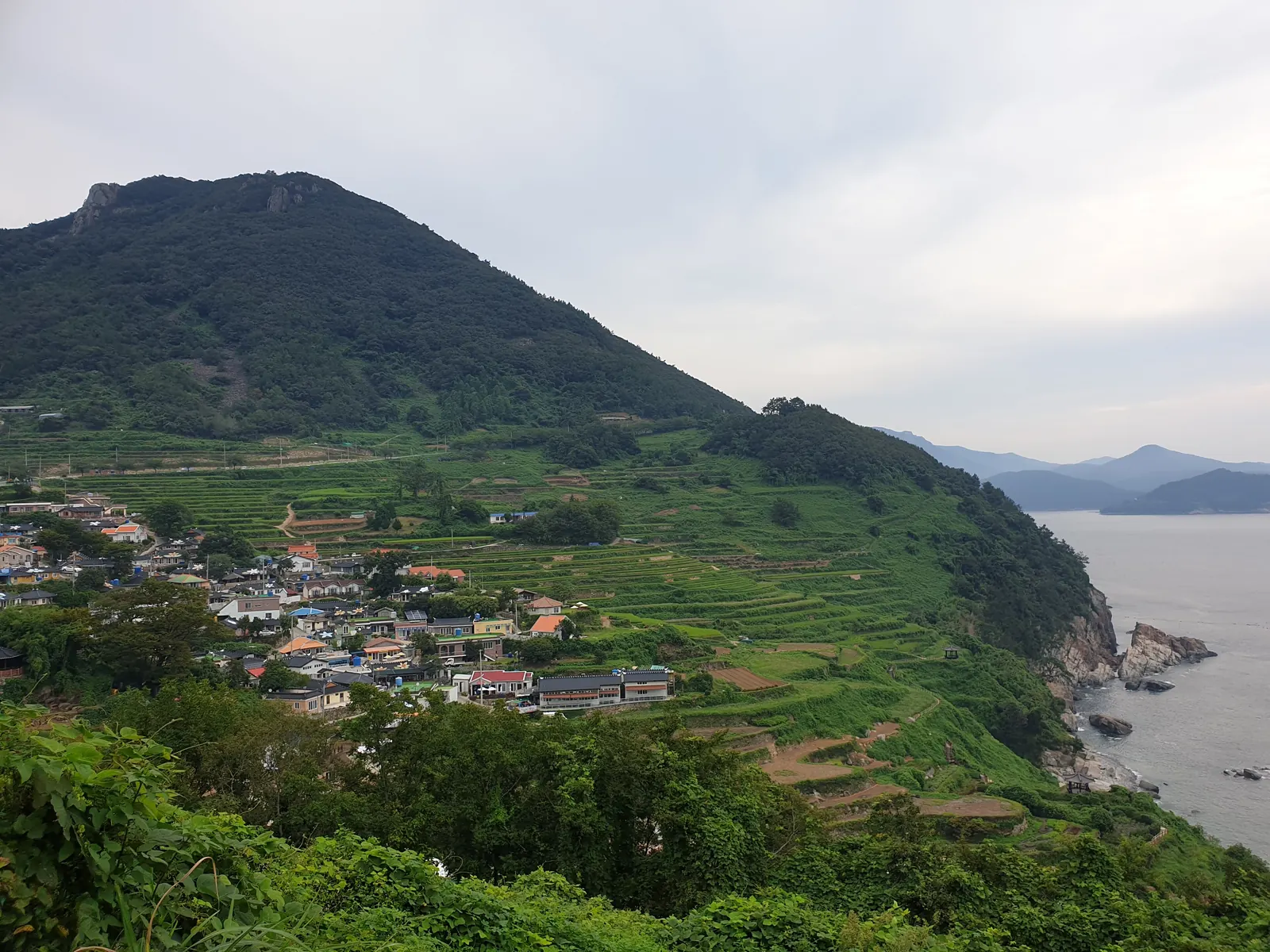
The island sets the pace. Namhae is one of Korea's largest islands, made up of two main islands, Namhaedo and Changseondo, and Korea.net notes that its sea is often called the Mediterranean of Korea. Much of its farmland is terraced; at Daraengi Village in Nam-myeon, more than 100 curved paddies climb a steep hillside above the sea. The sights are spread round the coast, and a night or two lets you see them at an island's pace rather than a day-tripper's.
Then there is German Village in Mulgeon-ri, built for the Korean miners and nurses who worked in West Germany and came home to retire. Some villagers run their houses as guesthouses, so you can spend the night inside that history, with German restaurants and cafés in the village and the Namhae German Exhibition Hall telling the story.
The three bases compared
Namhae's bases are far apart, and the right one depends on how you travel. Our rule: without a car, stay in Namhae-eup, or in German Village if you are happy with a rural bus. With a car, stay in Sangju for the sunrise and the south coast. For two nights, take German Village and Sangju.
Namhae-eup is the county town and the transport base. Every intercity route, from Seoul Nambu, Busan Seobu, Jinju, Suncheon, Masan and Changwon, runs to Namhae Public Bus Terminal, and the Namhae–Mijo rural bus to German Village starts there. Namhae Traditional Market, trading for more than 120 years, holds its five-day market on dates ending in 2 and 7, and the Museum of Exile Literature, which VisitKorea calls Korea's first and largest museum of exile and its literature, stands in town. The trade-off: the beaches, Boriam and German Village are all outside town.
Mulgeon and German Village are the stay for character. Villagers who travel often to Germany run their empty houses as guesthouses, and the village presents itself as one hotel spread across its pensions, restaurants and shops, with German-style breakfast. The Namhae German Exhibition Hall, the roughly 300-year-old Mulgeon-ri windbreak forest, Treasure Island Observatory on the Mulmi coast road and the Wonye Art Village are among its nearby sights. The rural bus from Namhae-eup takes about an hour by VisitKorea's 2021 guide, and the village is 250 m from the stop.
Sangju and Geumsan are the stay for sea and sunrise. Sangju Silver Sand Beach has about 2 km of white sand and shallow water backed by pines about a century old, and Namhae County calls it the most beautiful getaway on the south coast. Boriam is on Geumsan behind it, in the same township, Sangju-myeon. Mijo Port, the Seolli Skywalk, Songjeong Solbaram Beach and Daraengi Village are all a drive away. Sangju lies about 22 km south of Namhae-eup, and it is a base for drivers.
Two nights is the sweet spot. Arrive in Namhae-eup by bus and pick up a hire car there, spend the first night in German Village, then drive on for a night in Sangju and the Boriam sunrise. VisitKorea's south-coast course links Boriam, Sangju Beach, Treasure Island Observatory and German Village in about 33 km.
- Namhae-eup: every intercity bus, the five-day market and the Museum of Exile Literature; the base without a car.
- Mulgeon and German Village: guesthouses run by villagers, the Exhibition Hall and Oktoberfest; about an hour by rural bus from Namhae-eup.
- Sangju and Geumsan: 2 km of silver sand and the Boriam sunrise; about 22 km south of Namhae-eup, a base for drivers.
Getting to Namhae
There is no railway to Namhae; the way in is by road, over the bridges. Intercity buses run to Namhae Public Bus Terminal in Namhae-eup, and Namhae County's transport data lists timetables between the terminal and Busan, Jinju, Suncheon, Seoul Nambu, Masan and Changwon.
From Busan, intercity buses leave Busan Seobu Intercity Bus Terminal, at Sasang Station on Busan Metro Line 2. VisitKorea's June 2019 timetable listed 14 buses a day between 06:20 and 19:20 and gives the journey as about two and a half hours. Drivers head west along the Namhae Highway.
From Seoul, buses leave Seoul Nambu Terminal several times a day. VisitKorea's 2019 and 2021 guides and Korea.net's 2015 guide all give about four and a half hours. They are intercity buses, not express buses, so book them on T-money Bus (txbus.t-money.co.kr) or Bustago (bustago.or.kr), the sites VisitKorea lists for intercity tickets. Nambu Terminal's intercity routes cover Gyeongsangnam-do among other regions.
By rail, take the KTX to Jinju or Suncheon and continue by bus. From Jinju, go to the Gaeyang stop and take the bus to Namhae Public Bus Terminal. From Suncheon, take the bus from Suncheon bus terminal via Jingyo terminal to Namhae. Those are the two routes German Village's own site gives train travellers.
- Busan Seobu (Sasang): about two and a half hours, by VisitKorea's 2019 timetable.
- Seoul Nambu: about four and a half hours, by VisitKorea's 2019 and 2021 guides.
- KTX to Jinju: bus from the Gaeyang stop to Namhae Public Bus Terminal.
- KTX to Suncheon: bus from Suncheon bus terminal via Jingyo.
Getting around the island
Plainly: hire a car if you can. Korea.net calls Namhae hardly a well-organised tourist spot because of its inconvenient traffic, and its sights are spread round the coast. Korea.net's guide points to hire-car outlets near the bus terminal in Namhae-eup, with online booking too, and suggests starting from the east at the terminal and working west. Taxi tours of the island also run.
Without a car, the rural bus that matters is the Namhae–Mijo line. VisitKorea's 2021 guide has it running from the terminal in Namhae-eup to the Mulgeon Village stop in about an hour, with German Village 250 m on foot from there. German Village's own site names the Eunjeom–Mijo rural line and gives the bus company, Namheung Yeogaek, on 055-863-3507 for times. That makes German Village the coastal base you can reach without driving.
For Boriam, Sangju and Daraengi, drive. The road to Boriam climbs past Aenggang Pass and Bokgok Reservoir to the Bokgok car parks, with a shuttle between car parks 1 and 2 for anyone who finds the walk hard; from the ticket office it is about 15 minutes on foot to the hermitage. At Daraengi, park at the car park and walk into the village.
Bridges, and a tunnel to come
Namhae was joined to the mainland in 1973, when the Namhae Bridge was completed to Geumnam-myeon in Hadong. VisitKorea describes it as an imposing suspension bridge, 660 m long and 52 m high, and picks the view from in front of Chungnyeolsa, across the Noryang Strait.
The Changseon Bridge followed in 1980, linking Namhaedo with Changseondo, and in 2003 the Changseon–Samcheonpo Bridge, 3.4 km long, joined Changseondo to Sacheon. From the Changseon Bridge you look down on the jukbangnyeom of the Jijok Strait, bamboo weirs that have caught anchovies for more than 500 years.
The main road on to the island from Hadong now crosses the Noryang Bridge. It opened at 18:00 on 13 September 2018 on a 13.8 km section of Route 19 between Gohyeon-myeon in Namhae and Geumnam-myeon in Hadong, built to replace the ageing two-lane Namhae Bridge. The Ministry of Land, Infrastructure and Transport put the saving on that section at 10 minutes, from 28 to 18.
Another link is on the way. In May 2023 the ministry announced that the Namhae–Yeosu undersea tunnel project was under way, with a detailed-design contractor chosen and the aim of starting construction that year. The tunnel is not open yet, so treat Namhae and Yeosu as separate stops for now.
The story of German Village
German Village begins with a departure. In December 1963, 247 Korean miners boarded a plane for West Germany, and from 1966 young nurses followed. VisitKorea notes that the workers earned foreign currency during Korea's modernisation. Decades later, many of the miners and nurses who had gone in the 1960s and 1970s came home to retire, and German Village in Mulgeon-ri is where they settled.
The village's own history tells how it came about. Namhae County twinned with Nordfriesland in 1997 and began the project in 1999. It prepared the plots and sold them to Koreans from Germany, who had to have lived there for 20 years or more, and the site works were finished in September 2003. The houses were built in German style with materials imported from Germany, and the village now has about 40 of them.
The Namhae German Exhibition Hall opened in the village in 2014 to tell this story. It is open 09:00–18:00, with last entry 30 minutes before closing, and closed on Mondays (Tuesday when Monday is a public holiday), 1 January, Seollal and Chuseok. Every October the village celebrates the workers with its Oktoberfest, held since 2010; in 2026 it ran from 9 to 11 October.
People still live here, and VisitKorea asks visitors to be considerate. The village is free to enter and open all year, with German restaurants and cafés, and a night in one of its guesthouses gives you its evening and its early morning.
Walking the Namhae Barae-gil
Barae is the local Namhae word for catching and gathering sea lettuce, work done at low tide, mainly by the island's mothers, and the Namhae Barae-gil walking network takes its name from it.
Namhae County puts the network at 240 km in all: 16 main courses, 4 branch courses and 1 tourist-theme branch, with many main courses doubling as courses 36 to 46 of the Namhaearang-gil. The four branches are the Eupnae (town), Noryang, Geumsan and Dacho routes, so Namhae-eup and Geumsan each have a branch of their own. The Barae-gil is now run by the Namhae Tourism and Culture Foundation.
Course 11, the Daraengi Jiget-gil, is the one to pick for a day. VisitKorea gives it as 16 km and about five hours, from Pyeongsanhang Port past Sachon Beach to Daraengi Village, where trails run between the terraced paddies.
Festivals and seasons
Garlic is Namhae's signature crop, and the Namhae Garlic and Hanwoo Festival celebrates it together with premium Korean beef. It is held around the Museum of Exile Literature in Namhae-eup, with a shuttle bus from the car park; in 2026 it ran from 11 to 14 June. Namhae garlic is on sale at any Nonghyup or market on the island, and Namhae also grows yuzu, used in drinks and teas.
In mid-May, the Treasure Island Anchovy Festival is held around Mijo Port, a national fishing port since 1971 that lands anchovy, Spanish mackerel and hairtail. In October, German Village holds its Oktoberfest.
Spring is the season VisitKorea singles out: Namhae, it says, is even more beautiful in spring. Cherry trees line the road beyond the Namhae Bridge, rapeseed and lavender bloom at Daraengi, and garlic grows tall in the terraced paddies. Summer belongs to Sangju Silver Sand Beach, and in winter professional athletes come to Sangju to train.
- Mid-May: Treasure Island Anchovy Festival, Mijo Port.
- 11–14 June 2026: Garlic and Hanwoo Festival, Namhae-eup.
- 9–11 October 2026: Oktoberfest, German Village.
Every Namhae area guide
- Namhae-eupNamhae's county town: every intercity bus ends here, and the five-day market is in town.
- Mulgeon & German VillageSleep in the village where Korea's miners and nurses settled after Germany.
- Sangju & GeumsanSilver sand under Geumsan, and the drive up to Boriam for sunrise.
Questions visitors ask
Where should I stay in Namhae without a car?
Namhae-eup or German Village. Every intercity route runs to Namhae Public Bus Terminal in Namhae-eup, so the town is the straightforward base for arriving and leaving. For a night on the coast, take the Namhae–Mijo rural bus from the terminal to the Mulgeon Village stop, about an hour by VisitKorea's 2021 guide, and walk 250 m to German Village, where villagers run guesthouses.
Is there a train to Namhae?
No. There is no railway to Namhae. Take the KTX to Jinju and the bus from the Gaeyang stop to Namhae Public Bus Terminal, or the KTX to Suncheon and the bus from Suncheon bus terminal via Jingyo. Both routes end in Namhae-eup, where the rural bus to German Village and the hire cars are.
How long is the bus to Namhae from Busan or Seoul?
From Busan Seobu Intercity Bus Terminal at Sasang, VisitKorea's 2019 timetable gives about two and a half hours. From Seoul Nambu Terminal, VisitKorea's 2019 and 2021 guides give about four and a half hours, with buses several times a day. Both arrive at Namhae Public Bus Terminal in Namhae-eup.
Where should I stay for the Boriam sunrise?
Sangju. Boriam and Sangju Silver Sand Beach are both in Sangju-myeon, and VisitKorea's advice is to stay a night and see the sunrise from Geumsan. Boriam opens daily at 03:30. Drive to the Bokgok car parks; from the ticket office the hermitage is about 15 minutes on foot.
Can you drive from Namhae to Yeosu through the undersea tunnel?
Not yet. In May 2023 the Ministry of Land, Infrastructure and Transport announced that the Namhae–Yeosu undersea tunnel project was under way, with the aim of starting construction that year. Until it opens, Namhae's road links are its bridges: the Noryang Bridge from Hadong, opened in 2018, and the Changseon–Samcheonpo Bridge to Sacheon, opened in 2003.
Sources & review
Editorial review: · Korea Standard Time
- VISITKOREA (Korean) — Geumsan Boriam
- VISITKOREA (Korean) — Namhae travel course (2025)
- VISITKOREA — Geumsan Boriam Hermitage
- Ministry of Oceans and Fisheries (Badaon) — Boriam
- VISITKOREA — Sangju Silver Sand Beach
- Korea.net — Namhae island feature (2015)
- Korea.net — Namhae island feature (2022)
- VISITKOREA (Korean) — Namhae island travel article (2019)
- VISITKOREA — Gacheon Daraengi Village
- VISITKOREA — Namhae German Village
- VISITKOREA (Korean) — Namhae German Village and Wonye Art Village (2021)
- Namhae German Village — German Village Hotel
- VISITKOREA — Namhae German Exhibition Hall
- Public Data Portal — Namhae County transport information
- VISITKOREA Accessible Travel — Namhae Traditional Market
- VISITKOREA (Korean) — Namhae Traditional Market
- VISITKOREA — Namhae Garlic and Korean Beef Festival
- Namhae German Village — Mulgeon windbreak forest
- VISITKOREA — Namhae Treasure Island Observatory
- Namhae German Village — Nearby sights
- Namhae County — Beaches
- VISITKOREA — Namhae course: miners and nurses who went to Germany
- Busan Metropolitan City — Public transportation
- VISITKOREA — Intercity buses
- Namhae German Village — Directions
- Korea.net — Getting around Namhae (2022)
- VISITKOREA (Korean) — Namhae spring course (2020)
- Ministry of Land, Infrastructure and Transport — Noryang Bridge opening (2018)
- Ministry of Land, Infrastructure and Transport — Namhae–Yeosu undersea tunnel project under way (2023)
- Namhae German Village — History
- VISITKOREA — Namhae German Village Oktoberfest
- Namhae County — Namhae Barae-gil
- Namhae County (Korean) — Namhae Barae-gil courses
- Namhae Tourism and Culture Foundation — Home
- VISITKOREA — Daraengi Jiget-gil
- Ministry of Oceans and Fisheries (Badaon) — Mijo Port
- Namhae County — Special products
- Korea.net — Namhae coast and islets (2022)
- Namhae German Village — Wonye Art Village